
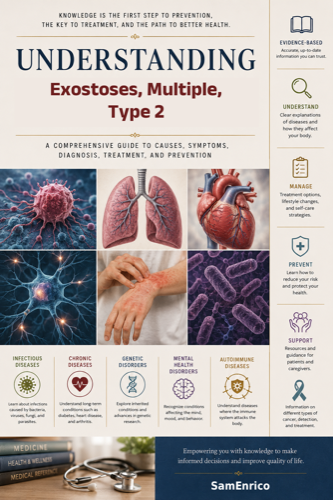
Understanding Exostoses, Multiple, Type 2 Audiobook
This disease publication, published by SamEnrico,
by Key Tanisha
This disease publication, published by SamEnrico, covers Understanding Exostoses, Multiple, Type 2
Formats
Free sample
Chapter 1: The Knobby Knee...--–- The mother’s hand trembled as she guided her three-year-old son’s fingers over the hard, painless bumps on his knees. “He’s too young for arthritis,” she whispered to the pediatrician. “But these lumps… they weren’t there six months ago.” The boy, Liam, sat quietly on the examination table, more curious than concerned. His knees looked knobby, almost like two stones hidden beneath the skin. The pediatrician palpated the lesions—firm, immobile, and bony-hard—and then, almost as an afterthought, glanced at the father’s wrists.
There they were: identical bumps on the father’s distal ulnae, silent companions for thirty years. The father had never mentioned them. “I thought everyone had those,” he said with a shrug. That moment—the recognition of a familial pattern—transformed Liam from a boy with “funny knees” to a patient with a diagnosis: Multiple Hereditary Exostoses (MHE), later confirmed as Type 2 due to an EXT2 mutation. This chapter begins where that examination ended.
We will define what MHE is, distinguish Type 2 from its genetic cousin Type 1, trace the natural history from birth through adulthood, and establish the foundational knowledge every patient, family, and clinician needs to navigate this condition.What’s in a Name? The Lexicon of Extra Bone The first obstacle to understanding this disease is its bewildering terminology. Over two centuries, physicians have described the same phenomenon using at least four distinct names, each emphasizing a different feature. Exostosis (plural: exostoses) is the oldest term, derived from Greek *ex-* (out) and osteon (bone), literally meaning “bone outgrowth.” It is a descriptive, almost primitive term that captures the visible lump but says nothing about its structure or origin. Osteochondroma is the precise pathological term.
It specifies that the lesion consists of two components: a bony stalk or base (osteo-) that is continuous with the underlying cortex and medullary canal, capped by a layer of hyaline cartilage (-chondroma). This cartilage cap is the living, growing part of the lesion; the bone beneath is a trailing remnant. The distinction matters because the cartilage cap is the site of both growth and, rarely, malignant transformation. Diaphyseal aclasis is an older British term that fell out of favor in the 1980s. “Aclasis” means failure of separation—a reference to the theory that exostoses form because cartilage cells fail to detach properly from the growth plate.
While the mechanism is now known to be more complex, the term persists in some European textbooks. Finally, Multiple Hereditary…
This is the end of the free sample. Get the Audiobook to keep going. Buy now
About this book
Details
- Author
- Key Tanisha
- Publisher
- SamEnrico
- Language
- English
- Genre
- Non-Fiction, Informative, Educational
- Released
- 2026-05-09
- Pages (approx.)
- 150
- Available as
- eBook, Audiobook

Listen in the VoxFlicks app
Audiobooks and audio dramas wherever you go. Sign in with your SamEnrico account and press play.
More by Key Tanisha
 Emotional Eating WorkbookKey Tanisha$11.99
 Self Hypnosis Strength TrainingKey Tanisha$11.99
 Shift Work Cognitive PerformanceKey Tanisha$11.99
 The Trade Show CollectorKey Tanisha$11.99
 Self Esteem and Silent TreatmentKey Tanisha$11.99
 The Last Broadcast: The 1996 TWA Flight 800 Conspiracy FilesKey Tanisha$11.99
 Excalibur’s Lost Daughter: The Forgotten Heir of AvalonKey Tanisha$11.99
 P Card Program GuideKey Tanisha$12.99
 Executive Summary Quick Reference for Daily UseKey Tanisha$12.99
 Oil EngineeringKey Tanisha$11.99
 How to Become a Mold StamperKey Tanisha$11.99