
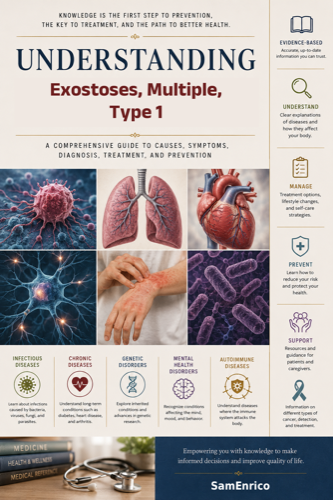
Non-FictionInformativeEducational
Understanding Exostoses, Multiple, Type 1 Audiobook
This disease publication, published by SamEnrico,
This disease publication, published by SamEnrico, covers Understanding Exostoses, Multiple, Type 1
Formats
Free sample
Chapter 1: The Bone Garden--The first time four-year-old Liam’s mother felt the hard ridge beneath his kneecap, she assumed it was a bug bite. It was summer in Atlanta, and the playground at Piedmont Park was notorious for fire ants. But the bump didn’t itch. It didn’t redden. And when she pressed her finger against it, Liam didn’t flinch.
He just kept stacking wooden blocks on the living room floor, his tongue protruding slightly in concentration.“Feel this,” she said to her husband that evening, guiding his hand to the same spot. “Right here. On the inside of his knee.”Her husband ran his thumb over the protrusion. It was immovable. Bone-hard.
And completely painless.“Probably just a normal part of his anatomy,” he said. “Kids have weird lumps and bumps.”They were right about one thing: children do have strange lumps. But this one was not normal. This was the first exostosis—the first seed planted in what would become, over the next two decades, a bone garden.The Architecture of Childhood To understand what grew on Liam’s knee, you must first understand how a child’s skeleton builds itself. Unlike adults, children are not simply smaller versions of grown-ups.
Their bones are under active construction—a dynamic, demolition-and-rebuild project that begins in the womb and does not finish until the mid-twenties.The architects of this process are the growth plates, or physes. These are layers of cartilage located near the ends of long bones—the femur, the tibia, the humerus, the radius, the ulna. A growth plate is essentially a factory with a single purpose: to make bone longer. On one side of the factory, new cartilage cells called chondrocytes are constantly being produced. On the other side, those cartilage cells are systematically replaced by hard, mineralized bone.
The result is that the bone gets longer, the child gets taller, and the growth plate itself remains at the same relative position, churning out new tissue like a conveyor belt that never runs out of raw material.This process is called endochondral ossification, and it is one of the most precisely regulated biological systems in the human body. The timing matters. The location matters. The signals that tell a chondrocyte when to grow, when to stop growing, and when to die—those matter most of all.In a healthy child, that signaling system works like a well-rehearsed orchestra.…
This is the end of the free sample. Get the Audiobook to keep going. Buy now
About this book
Details
- Author
- Rosado Millie
- Publisher
- SamEnrico
- Language
- English
- Genre
- Non-Fiction, Informative, Educational
- Released
- 2026-06-02
- Pages (approx.)
- 146
- Available as
- eBook, Audiobook

Listen in the VoxFlicks app
Audiobooks and audio dramas wherever you go. Sign in with your SamEnrico account and press play.
More by Rosado Millie
 Shift Work Sleep Debt RepaymentRosado Millie$11.99
 Body Image for Port Wine Stain GuideRosado Millie$11.99
 The Creative NetworkerRosado Millie$11.99
 55 Plus Community AnalysisRosado Millie$11.99
 Method of Loci for Law EnforcementRosado Millie$11.99
 The Moon Chasers: Medieval Dreams of the Lunar FrontierRosado Millie$11.99
 The Drowned Choir of St. BrigidRosado Millie$11.99
 Office WorkerRosado Millie$11.99
 Procurement KPI DashboardRosado Millie$12.99
 Executive Summary Workbook with Real ExamplesRosado Millie$12.99
 How to Become a Mold Stamper And RepairerRosado Millie$11.99
You may also like
 Hong Kong Handover 1997Dunn Johnnie$11.99
 Zumba For Postnatal Recovery CourseNeal Christian$11.99
 Zumba for BeginnersLadner Nikia$11.99
 YouTube Comment Mining GuideHumes Pandora$12.99
 Worry Box MeditationCarlin Rudy$11.99
 Workplace Stress MeditationNguyen Lynn$11.99
 Workplace Stress and Sleep RepairHawley Ivory$11.99
 Workplace Perfectionism CureDelaney Jeffry$11.99
 Workplace Injustice Anger GuideWallen Isabelle$11.99
 Work Addiction and Burnout LinkGreenwood Ester$11.99
 Women in Yoga and WellnessBeattie Galina$11.99
 Women in Stand Up ComedyChun Evangeline$11.99