
Non-FictionInformativeEducational
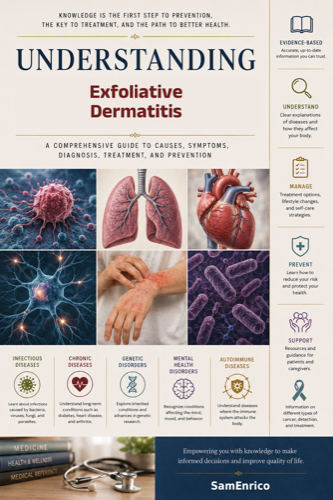
Understanding Exfoliative Dermatitis eBook
This disease publication, published by SamEnrico,
This disease publication, published by SamEnrico, covers Understanding Exfoliative Dermatitis
Formats
Free sample
Chapter 1: The 90% Rule--–- The first time Sarah noticed her skin felt different, she was standing in front of her bathroom mirror, applying moisturizer to what she thought was a stubborn patch of eczema on her thighs. Three weeks later, she would be lying in a burn unit, her entire body the color of a ripe tomato, sheets of skin peeling off with every movement, a cardiologist explaining that her heart was failing because her skin had stopped working. Between those two moments—the mirror and the ICU—Sarah lost something more than her health. She lost time. She lost the chance to intervene before her body spiraled into a crisis that would take four months to climb out of.
The difference between Sarah and another patient we'll meet later in this chapter is not the severity of their disease. It is the moment they understood what was actually happening to them.This chapter exists to ensure you never lose that time.Before we talk about treatment, before we discuss medications, hospital stays, or long-term recovery, we must first answer a single question with absolute clarity: What exactly is exfoliative dermatitis, and how do you know if you have it? The answer is simpler than you might think, but it requires unlearning nearly everything popular culture and even some doctors have taught you about skin disease.The Name Problem: Why Words Matter Exfoliative dermatitis. Erythroderma. Hebradisease.
Wilson-Brocq syndrome. Red man syndrome. The peeling disease. Throughout medical history, this condition has accumulated names like barnacles on a ship’s hull, each one capturing a different angle of the same terrifying reality.Let me be clear about what we will call this condition throughout this book. Exfoliative dermatitis (ED) and erythroderma are used interchangeably in medical literature, though some purists distinguish between them.
Erythroderma describes the redness (erythro = red, derma = skin). Exfoliative dermatitis describes the peeling (exfoliative = scaling off). Since patients with this condition almost always have both redness and scaling, we will treat the terms as synonyms. The historical eponyms—Hebra’s disease, Wilson-Brocq disease—are medical relics, named after 19th-century dermatologists who described the condition before we understood its causes. We honor their observations but leave their names behind because naming a disease after a person teaches you nothing about what is happening inside your body.What you need to know is this: Exfoliative dermatitis is not a specific disease.
It is a final common pathway. Think of it like a fire alarm. A fire alarm can be triggered by many different things—a kitchen fire, faulty wiring, burnt toast, steam from a shower, someone pulling the handle as a prank. The alarm sounds the same regardless of the cause. Your job, and your doctors’ job, is not just to shut off the alarm.
It is to find out what is burning.ED is your body’s alarm that something has gone fundamentally wrong with your immune system’s relationship with your skin. That something could be a medication you started three weeks ago. It could be a lifelong battle with psoriasis that suddenly exploded. It could be an undiagnosed lymphoma. It could be something no one ever identifies.
But the alarm itself—the redness, the scaling, the systemic chaos—is recognizable regardless of the underlying trigger.The 90% Rule: Your First Diagnostic Tool Here is the single most important clinical fact in this entire book. Every dermatologist learns it in training. Every emergency physician should know it. And you, as a patient or caregiver, must memorize it.Exfoliative dermatitis is defined as redness and scaling involving at least 90% of the body’s skin surface.Ninety percent. Not 50%.
Not 70%. Not “a really bad rash on your arms and chest.” Ninety percent of the skin on your entire body—face, scalp, trunk, arms, hands, legs, feet, back, buttocks, genitals—must be red and scaling to meet the formal definition of ED.Why 90%? Because at that threshold, the remaining healthy skin—less than 10% of your body’s surface—can no longer compensate for the functions the diseased skin has lost. Your skin is not just a wrapper. It is a breathing, regulating, protecting organ.
When 90% of it goes into inflammatory overdrive, your entire body follows.Let me give you a visual. Stand in front of a full-length mirror. Look at your palms. Look at the soles of your feet. Look at your lips.
Look at your eyelids. Now imagine every other inch of skin—every square centimeter—is bright red, warm to the touch, and shedding visible flakes. That is ED.The 90% rule is your first shield against medical gaslighting. If a doctor tells you, “It’s just a bad rash, try this cream,” and you know—you know—that 90% of your body is red and peeling, you have permission to push back. You can say, “This meets the definition of exfoliative dermatitis, which is a medical emergency.
I need a dermatology consult today.”Sarah did not know the 90% rule. She trusted her primary care doctor who said it was “just widespread eczema” and prescribed a stronger steroid cream. By the time she reached the burn unit, 98% of her body was involved. She had lost 12 pounds of muscle in three weeks. Her heart was racing at 130 beats per minute while she lay completely still.
The 90% rule, if she had known it, could have saved her those three weeks of deterioration.The Misdiagnosis Trap: Why ED Is So Often Missed Exfoliative dermatitis is rare. Depending on which study you read, it affects between 1 in 50,000 and 1 in 100,000 people per year. For comparison, eczema affects 1 in 5 children. Psoriasis affects 1 in 50 adults. When a doctor hears hoofbeats, they think horses, not zebras.
ED is a zebra.But there is a deeper problem. In its early stages, ED looks exactly like a bad flare of whatever skin condition you already have. If you have psoriasis, an ED flare looks like psoriasis—just more of it. If you have eczema, an ED flare looks like eczema—just angrier. The transition from “bad flare of my usual condition” to “exfoliative dermatitis” is a gradual creep, not a dramatic event.
Most patients cross the 90% threshold without realizing it because they have been watching their skin worsen for weeks or months.This is why the 90% rule is so powerful. It gives you an objective measure. Do not rely on your doctor’s visual impression alone. Ask them to estimate the percentage of body surface area involved. If they hesitate or guess, ask them to use the rule of palms—the patient’s own palm represents approximately 1% of body surface area.
If your skin looks like 90 palms’ worth of redness and scaling, you have ED.The second reason ED is misdiagnosed is that the scaling and peeling often lag behind the redness. You can be red—intensely, diffusely red—for days or even weeks before the skin begins to shed in visible sheets. This is particularly true in drug-induced ED, where the inflammatory response is driven by immune cells attacking the skin rather than by the accelerated cell turnover seen in psoriasis. A patient can present to the emergency room looking like a boiled lobster with no visible peeling, be sent home with antihistamines, and…
This is the end of the free sample. Get the eBook to keep going. Buy now
About this book
Details
- Author
- Duff Cathrine
- Publisher
- SamEnrico
- Language
- English
- Genre
- Non-Fiction, Informative, Educational
- Released
- 2026-06-02
- Pages (approx.)
- 145
- Available as
- eBook, Audiobook

Read better in the ZLOADR app
Your eBooks on your phone or tablet. Sign in with your SamEnrico account and start reading.
More by Duff Cathrine
 Shift Work Shift Trading GuideDuff Cathrine$11.99
 The Flaky Contact HandlerDuff Cathrine$11.99
 Self Esteem After Prison HandbookDuff Cathrine$11.99
 Cesium In Alternative Cancer CareDuff Cathrine$11.99
 Self Esteem Interracial RelationshipDuff Cathrine$11.99
 Silk & Shadows: The Secret Life of a Victorian CouturierDuff Cathrine$11.99
 The Last Message of the Karluk: A Ghost Ship’s Final BroadcastDuff Cathrine$11.99
 NIST Framework SpecialistDuff Cathrine$11.99
 ToS for Blockchain AppsDuff Cathrine$12.99
 Executive Summary Formula That WorksDuff Cathrine$12.99
 How to Become a Molder-machine TenderDuff Cathrine$11.99
You may also like
 Hong Kong Handover 1997Dunn Johnnie$11.99
 Zumba For Postnatal Recovery CourseNeal Christian$11.99
 Zumba for BeginnersLadner Nikia$11.99
 YouTube Comment Mining GuideHumes Pandora$12.99
 Worry Box MeditationCarlin Rudy$11.99
 Workplace Stress MeditationNguyen Lynn$11.99
 Workplace Stress and Sleep RepairHawley Ivory$11.99
 Workplace Perfectionism CureDelaney Jeffry$11.99
 Workplace Injustice Anger GuideWallen Isabelle$11.99
 Work Addiction and Burnout LinkGreenwood Ester$11.99
 Women in Yoga and WellnessBeattie Galina$11.99
 Women in Stand Up ComedyChun Evangeline$11.99