
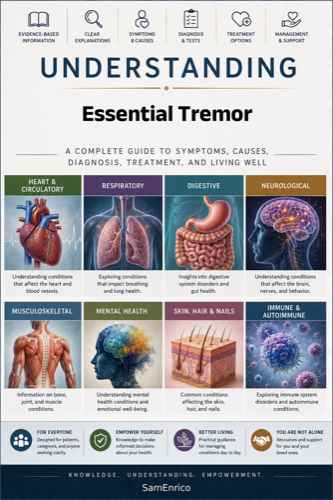
Non-FictionInformativeEducational
Understanding Essential Tremor eBook
This condition publication, published by SamEnrico
by Nowak Rupert
This condition publication, published by SamEnrico, covers Understanding Essential Tremor
Formats
Free sample
Chapter 1: The Soda Can Moment--– I remember exactly where I was when I realized something was wrong. Not the kind of wrong you can ignore or explain away. The kind that makes your stomach drop.It was a Tuesday. A completely unremarkable Tuesday in November, the kind of Tuesday you forget five minutes after it ends. I was at a work dinner with fourteen colleagues and two visiting executives from the London office.
The restaurant was one of those places with white tablecloths and servers who refold your napkin when you use the bathroom. I was already nervous because I had been asked to give a short toast at the end of the meal. Public speaking never came naturally to me, but I had prepared. I had rehearsed. I had my three sentences memorized.Then the server brought the drinks.I had ordered a sparkling water.
Seltzer. Nothing fancy. The glass was tall and thin and sweating. I reached for it with my right hand, the way I had done ten thousand times before in my life. And that is when it happened.My hand would not stop moving.It was not a shiver.
It was not the jitteriness of too much coffee. It was a rhythmic, back-and-forth tremor that turned the surface of that sparkling water into something resembling a shaken snow globe. I watched, almost in slow motion, as a wave sloshed over the rim and cascaded down the side of the glass. Then another wave. Then a third.
By the time I managed to set the glass back down—using both hands like a child learning to drink—there was a pool of water spreading across the white tablecloth. A small lake. An embarrassment lake.The man next to me glanced over. “Nervous about the toast?” he asked, smiling kindly.I smiled back. “Yeah.
Must be.”But I knew it was not just nerves. Something in me knew.The Million-Dollar Misdiagnosis That was my soda can moment. Everyone with essential tremor has one. Maybe yours was different. Maybe it was trying to sign your name at the bank and watching the pen trace a line that looked like an EKG reading.
Maybe it was the time you tried to apply mascara and ended up looking like a raccoon that had been in a fight. Maybe it was the first time you poured coffee for a guest and realized you could not stop until the cup overflowed onto the saucer.These moments are tiny. They are also enormous. They are the first crack in the dam of normalcy.For years after my soda can moment, I collected misdiagnoses the way some people collect stamps. My primary care doctor told me it was “essential tremor” in a dismissive tone that clearly meant “nothing to worry about, now please leave my office.” A neurologist who specialized in something else entirely watched me hold out my hands for eight seconds and said, “Probably just enhanced physiologic tremor.
Cut back on caffeine.”I cut back on caffeine. The tremor got worse.Another doctor suggested I see a psychiatrist. I did. The psychiatrist, to his credit, was excellent. He listened carefully, watched my hands shake while I filled out his intake forms, and then said something that changed everything: “I don’t think this is in your head.
I think you need a movement disorder specialist.”A movement disorder specialist. I did not even know those three words could be arranged in that order.What Essential Tremor Actually Is (And What It Is Not)Here is what I wish someone had told me on that Tuesday in November: essential tremor is not Parkinson’s disease. I cannot tell you how many times I have heard someone say, “Oh, my grandmother had the shakes. Parkinson’s, right?” Wrong. Wrong in a way that matters enormously.Parkinson’s disease is a resting tremor.
That means the shaking happens when your hands are doing nothing at all—sitting in your lap, hanging at your sides. The classic Parkinson’s tremor is often described as “pill-rolling” because it looks like you are rolling a marble between your thumb and index finger. It is slow, coarse, and asymmetrical.Essential tremor is the opposite. It is an action tremor. It happens when you are trying to do something.
Pouring. Writing. Eating. Pointing. Holding a phone to your ear.
The tremor is faster, usually 4 to 12 cycles per second. And unlike Parkinson’s, essential tremor often improves temporarily after a small amount of alcohol—which is a diagnostic clue, not a treatment recommendation, as we will discuss later in this book.Essential tremor is also not “just aging.” I cannot count how many people have told me, “Well, I’m getting older. What do I expect?” Here is what you should expect: if you are over sixty-five, your risk of essential tremor is about 5 percent. That is higher than the general population, yes. But it means that 95 percent of people your age do not have it.
It is not an inevitable consequence of getting older any more than asthma or diabetes is. It is a specific neurological condition with its own biology, its own genetics, and its own treatments.Essential tremor is also not a psychological problem. I want to say that again, louder, for the people in the back: essential tremor is not caused by anxiety, repressed emotions, childhood trauma, or a weak character. You did not give yourself this tremor by worrying too much or being too sensitive. Yes, anxiety makes tremor worse.
Yes, stress amplifies every shake. But the underlying problem is in your brain—specifically in a region called the cerebellum, which is responsible for coordinating movement. You have a hardware issue, not a software issue. The fact that some doctors still imply otherwise is a failure of medical education, not a failure of your personality.The Spectrum: Classic ET and ET-Plus One of the most important things I learned on my journey is that essential tremor is not one thing. It is a spectrum.
At one end sits what doctors call “classic ET.” That means you have an action tremor—probably in your hands, possibly also in your head or voice—and nothing else. Your balance is fine. Your walking is fine. Your thinking is clear. You just shake.But about 30 to 50 percent of people with essential tremor develop what is now called “ET-plus.” This is a newer category, added to medical guidelines in 2018, and it matters because it changes how you think about your future.
ET-plus means you have the tremor plus something else. That something else can be mild gait problems (you walk a little differently, maybe a bit wider or slower), mild cognitive changes (your memory is not what it used to be, or you struggle with word-finding), or sensory symptoms like loss of smell.Let me be very clear about what ET-plus is not. It is not Parkinson’s. It is not dementia. Most people with ET-plus live full, independent lives for decades.
But it is a recognition that essential tremor is not always “just a tremor.” It is a neurological condition that can have subtle effects beyond the shaking.I have a…
This is the end of the free sample. Get the eBook to keep going. Buy now
About this book
Details
- Author
- Nowak Rupert
- Publisher
- SamEnrico
- Language
- English
- Genre
- Non-Fiction, Informative, Educational
- Released
- 2026-05-06
- Pages (approx.)
- 143
- Available as
- eBook, Audiobook

Read better in the ZLOADR app
Your eBooks on your phone or tablet. Sign in with your SamEnrico account and start reading.
More by Nowak Rupert
 Self Doubt In New Roles GuideNowak Rupert$11.99
 Second Generation Art ExpressionNowak Rupert$11.99
 Baby Boomer Subscription AdoptionNowak Rupert$11.99
 Smoking Cessation for Social WorkersNowak Rupert$11.99
 Keto Fasting Combination GuideNowak Rupert$11.99
 Exercise Sleep Memory ConnectionNowak Rupert$11.99
 Ella Fitzgerald ScatNowak Rupert$11.99
 Distraction Proof Focus Training CourseNowak Rupert$11.99
 The Tsars and the Celtic Twilight: Russia’s Forgotten Gaelic LegacyNowak Rupert$11.99
 How to Produce Sink Mats and GridsNowak Rupert$11.99
 ARIPO Renewal RequirementsNowak Rupert$12.99
 Middle East Sales Tech Stack BlueprintNowak Rupert$12.99
You may also like
 Hong Kong Handover 1997Dunn Johnnie$11.99
 Zumba For Postnatal Recovery CourseNeal Christian$11.99
 Zumba for BeginnersLadner Nikia$11.99
 YouTube Comment Mining GuideHumes Pandora$12.99
 Worry Box MeditationCarlin Rudy$11.99
 Workplace Stress MeditationNguyen Lynn$11.99
 Workplace Stress and Sleep RepairHawley Ivory$11.99
 Workplace Perfectionism CureDelaney Jeffry$11.99
 Workplace Injustice Anger GuideWallen Isabelle$11.99
 Work Addiction and Burnout LinkGreenwood Ester$11.99
 Women in Yoga and WellnessBeattie Galina$11.99
 Women in Stand Up ComedyChun Evangeline$11.99