
Non-FictionInformativeEducational
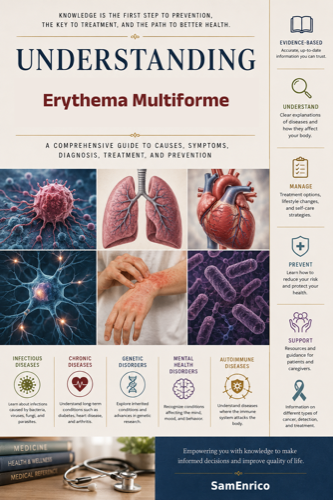
Understanding Erythema Multiforme eBook
This disease publication, published by SamEnrico,
This disease publication, published by SamEnrico, covers Understanding Erythema Multiforme
Formats
Free sample
Chapter 1: The Rash That Hides--It begins, almost always, as nothing at all. A slight redness on the back of a hand. A warm patch on the forearm that could be a bug bite. A pink spot on the palm that you might dismiss as an allergic reaction to a new soap. This is how Erythema Multiforme announces itself—not with a bang, but with a whisper.
And that whisper is why so many patients spend weeks, months, or even years bouncing between doctors, searching for a name for what is happening to their skin.For Sarah, a 28-year-old elementary school teacher from Ohio, the first spot appeared on a Tuesday in March. She noticed it while grading papers—a small, round, red patch on the back of her left hand, about the size of a pencil eraser. It didn't itch much. It wasn't painful. She thought nothing of it.
By Thursday, there were four more spots on her right hand. By Saturday, her palms were covered. By Monday, she could not hold a pen.Sarah's story is not unique. In fact, it is almost universal among people with Erythema Multiforme. The journey from first spot to correct diagnosis is often a frustrating odyssey through urgent care clinics, emergency rooms, and dermatology offices, filled with misdiagnoses of ringworm, hives, eczema, and even poison ivy.
This book exists to end that journey. This chapter exists to give you, the reader, something that Sarah did not have: a clear, complete, and compassionate understanding of what Erythema Multiforme truly is, what it is not, and how to recognize it from the very first spot.The Name Itself: Breaking Down the Mystery The name "Erythema Multiforme" sounds intimidating, as medical names often do. But like most medical terms, it is simply descriptive Latin and Greek stitched together. Let us take it apart piece by piece.Erythema comes from the Greek word erythros, meaning red. In medical terminology, erythema refers to redness of the skin caused by increased blood flow to superficial capillaries.
It is the same word used to describe the redness of a sunburn, the flush of embarrassment, or the inflammation around a healing wound. In EM, this redness is not random—it is the visible signature of an immune reaction happening beneath the surface.Multiforme comes from Latin: multi- meaning many, and formae meaning shapes or forms. This is the most important part of the name. It tells you that this condition does not look the same in every person, or even in the same person over time. The rash of EM is, quite literally, many-formed.
It can appear as flat spots, raised bumps, blisters, or the famous target lesions that look like tiny bullseyes. It can be red, purple, or brownish. It can itch, burn, or feel like nothing at all.So the full name, "Erythema Multiforme," translates to "redness of many forms." This is not just etymology—it is a clinical warning. If you are looking for one textbook appearance, you will miss the diagnosis entirely. EM is a shapeshifter, and recognizing its many faces is the first step to understanding it.What Erythema Multiforme Actually Is At its core, Erythema Multiforme is an immune-mediated skin condition.
That phrase—"immune-mediated"—deserves unpacking because it is the key to everything else in this book.Your immune system exists to protect you. It is a complex network of cells, proteins, and chemical signals designed to identify and destroy threats: bacteria, viruses, fungi, and even your own cells if they become cancerous. Normally, this system works beautifully. It recognizes what belongs in your body and what does not, attacking only the invaders.In EM, something goes wrong with this recognition system. The immune system becomes confused.
It mistakes something harmless—or something that is no longer a threat—for a danger that requires an all-out attack. Specifically, certain immune cells called T-lymphocytes become activated and migrate to the skin. Once there, they release chemical signals that trigger inflammation and cause the death of keratinocytes, the cells that make up the outer layer of your skin.This is not an infection. You cannot catch EM from another person. It is not contagious.
It is not a sign that your immune system is weak or failing. Rather, it is a sign that your immune system is overreacting—like a fire alarm that goes off not because there is a fire, but because someone burned toast. The response is real, the damage is real, but the trigger is far less dangerous than the reaction suggests.The Three Faces of EM: Acute, Recurrent, and Persistent One of the most common sources of confusion in older medical texts—and even in some current online resources—is the idea that EM comes in only two forms: mild or severe. This binary framework misses a crucial dimension: the pattern of the disease over time.After reviewing thousands of patient cases and the leading dermatology references, this book presents a tripartite classification that better reflects what patients actually experience. Understanding which category you or your loved one falls into is essential for choosing the right treatment and setting realistic expectations.Acute Self-Limited EMThis is the first category.
Acute self-limited EM occurs when a person has a single episode of the rash that resolves on its own within a matter of weeks, typically two to six weeks. The triggers may include an infection, a medication, or sometimes no identifiable trigger at all. After the rash clears, it never returns. For these patients, EM is a one-time event—memorable and often frightening, but ultimately a closed chapter in their medical history.Acute self-limited EM is more common in children than in adults, and it is often triggered by Mycoplasma pneumoniae or a viral upper respiratory infection. These patients do not need long-term suppressive therapy.
They need accurate diagnosis, symptomatic treatment during the flare, and reassurance that the condition is unlikely to recur.Recurrent Episodic EMThis is the second category, and it is the one most commonly associated with Herpes Simplex Virus (HSV). Patients with recurrent episodic EM experience repeated flare-ups separated by symptom-free intervals. The intervals may last weeks, months, or even years. Between flares, the skin is completely clear. When a flare occurs, it typically follows a trigger—most often an HSV reactivation, which may be symptomatic (a cold sore) or completely subclinical (no visible blister at all).The recurrent episodic pattern is the most frustrating for many patients because it creates a sense of unpredictability.
You never know when the next flare will come. You never know how bad it will be. This uncertainty can be psychologically draining, which is why Chapter 7 is devoted entirely to managing HSV-associated EM and Chapter 11 provides practical strategies for living with recurrence.Persistent Chronic EMThe third category is the least common but the most challenging. Persistent chronic EM is defined by lesions that last for more than one month without a complete break. Unlike recurrent EM, where the skin clears entirely between episodes, persistent EM leaves the patient in a state of continuous disease.
New lesions may appear as old ones fade, but there is never a time when the skin is fully clear.This pattern is…
This is the end of the free sample. Get the eBook to keep going. Buy now
About this book
Details
- Author
- Lynch Natasha
- Publisher
- SamEnrico
- Language
- English
- Genre
- Non-Fiction, Informative, Educational
- Released
- 2026-06-02
- Pages (approx.)
- 159
- Available as
- eBook, Audiobook

Read better in the ZLOADR app
Your eBooks on your phone or tablet. Sign in with your SamEnrico account and start reading.
More by Lynch Natasha
 Dark Room Sleep TechniqueLynch Natasha$11.99
 Micronutrients For AthletesLynch Natasha$11.99
 Self Esteem for Perfectionists HandbookLynch Natasha$11.99
 Remote Expense Policy GuideLynch Natasha$11.99
 Method of Loci for Names FacesLynch Natasha$11.99
 The Silent Codebreakers: Women Who Cracked the Nazi EnigmaLynch Natasha$11.99
 The Billion-Dollar Bet: How a Rogue Trader Almost Broke a BankLynch Natasha$11.99
 Ultimate Handbook Guide to Saratov : (Russia) Travel GuideLynch Natasha$11.99
 Lighting ArtistLynch Natasha$11.99
 Freelance CV Writer PricingLynch Natasha$12.99
 Mentoring Reverse Culture ShockLynch Natasha$12.99
You may also like
 Hong Kong Handover 1997Dunn Johnnie$11.99
 Zumba For Postnatal Recovery CourseNeal Christian$11.99
 Zumba for BeginnersLadner Nikia$11.99
 YouTube Comment Mining GuideHumes Pandora$12.99
 Worry Box MeditationCarlin Rudy$11.99
 Workplace Stress MeditationNguyen Lynn$11.99
 Workplace Stress and Sleep RepairHawley Ivory$11.99
 Workplace Perfectionism CureDelaney Jeffry$11.99
 Workplace Injustice Anger GuideWallen Isabelle$11.99
 Work Addiction and Burnout LinkGreenwood Ester$11.99
 Women in Yoga and WellnessBeattie Galina$11.99
 Women in Stand Up ComedyChun Evangeline$11.99