
Non-FictionInformativeEducational
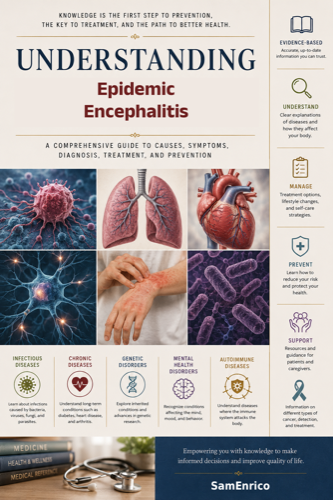
Understanding Epidemic Encephalitis eBook
This disease publication, published by SamEnrico,
This disease publication, published by SamEnrico, covers Understanding Epidemic Encephalitis
Formats
Free sample
Chapter 1: The Invisible Storm...--The human brain is the most complex structure in the known universe. Encased within a bony vault, bathed in sterile cerebrospinal fluid, and shielded by a fortress of cells called the blood-brain barrier, it operates in silent isolation from the rest of the body’s daily battles. When a virus breaches this sanctuary, the result is not merely an infection—it is a biological catastrophe. This is epidemic encephalitis: the invisible storm that turns the organ of thought, memory, and identity into a battlefield.For most people, the word “encephalitis” conjures vague images of meningitis or perhaps a tropical disease seen only on medical dramas. The reality is far more intimate and terrifying.
Encephalitis means inflammation of the brain parenchyma—the very tissue that makes us who we are. Unlike meningitis, which inflames the protective layers around the brain and often presents with the classic triad of fever, headache, and neck stiffness, encephalitis attacks the substance of thought itself. Patients do not simply feel ill; they become someone else. They forget their children’s names. They speak in word salads.
They see faces that are not there. They may seize, collapse into comas, or emerge weeks later with a permanently altered personality.This chapter lays the foundation for everything that follows. It defines epidemic encephalitis with precision, distinguishes it from its clinical mimics, traces the historical outbreaks that shaped our understanding, and introduces the critical classification systems that clinicians and public health officials use to make sense of this devastating condition. By the end of this chapter, the reader will understand not only what epidemic encephalitis is, but why it has been called one of the most underrecognized public health emergencies of the twenty-first century.Defining the Beast: Encephalitis vs. Meningitis vs.
Meningoencephalitis The first step in understanding epidemic encephalitis is to place it within the family of central nervous system (CNS) infections. Too often, patients and even some clinicians use the terms “meningitis” and “encephalitis” interchangeably. This is a dangerous conflation because the two conditions have different causes, different treatments, different outcomes, and—crucially—different implications for epidemic control.Meningitis is inflammation of the meninges, the three layers of tissue (dura mater, arachnoid mater, and pia mater) that envelop the brain and spinal cord. Bacterial meningitis, caused by organisms such as Neisseria meningitidis or Streptococcus pneumoniae, is a medical emergency characterized by fever, headache, photophobia, and nuchal rigidity (neck stiffness so severe that the patient cannot touch their chin to their chest). Viral meningitis, while unpleasant, is typically self-limiting and far less deadly.
The key point is that meningitis spares the brain parenchyma. Patients with uncomplicated meningitis remain neurologically intact—they are confused by the pain and fever, but they know who they are and where they are.Encephalitis is a different order of threat. The term derives from the Greek enkephalos (brain) and the suffix -itis (inflammation). It refers to inflammation of the brain tissue itself. Neurons swell and die.
Glial cells activate in a destructive frenzy. The blood-brain barrier, normally a selective filter, becomes a sieve, allowing immune cells to pour into regions where they cause collateral damage. The clinical hallmarks of encephalitis are not headache and neck stiffness (though these may be present) but rather altered mental status, focal neurologic deficits, seizures, and behavioral changes. A patient with encephalitis may stare vacantly at a wall for hours, then suddenly begin speaking in a language no one understands. They may develop hemiparesis (weakness on one side of the body) as if they have had a stroke, or they may experience olfactory hallucinations—the infamous “burning rubber” or “rotten eggs” smell that, as we will see in later chapters, is almost pathognomonic for herpes simplex virus encephalitis.Between these two poles lies meningoencephalitis, a hybrid condition in which both the meninges and the brain parenchyma are inflamed.
Many viral infections of the CNS present as meningoencephalitis rather than pure encephalitis or pure meningitis. For example, West Nile virus, one of the major epidemic arboviruses covered in this book, can cause a spectrum ranging from uncomplicated febrile illness to severe meningoencephalitis with flaccid paralysis. The distinction matters clinically because the presence of encephalitis—brain tissue involvement—is a powerful predictor of poor outcome. Patients with pure viral meningitis rarely die or suffer permanent neurologic damage. Patients with viral encephalitis have mortality rates ranging from 5% for some arboviruses to over 40% for Nipah virus and up to 70% for untreated herpes simplex encephalitis.
Among survivors, a staggering proportion are left with permanent cognitive, behavioral, or physical disabilities.Epidemic vs. Sporadic: Why the Distinction Saves Lives The word “epidemic” in this book’s title is not decorative. It signals a specific public health reality: some causes of encephalitis occur in outbreaks that affect many people in a defined geographic area or time period. Understanding the difference between epidemic and sporadic encephalitis is essential for clinicians on the ground, for public health officials allocating resources, and for the general public trying to make sense of alarming news headlines.Sporadic encephalitis occurs as isolated cases, usually with no direct link between patients. The most common cause of sporadic viral encephalitis worldwide is herpes simplex virus type 1 (HSV-1).
Each year, HSV-1 causes an estimated 2,000 to 4,000 cases of encephalitis in the United States alone, with a predilection for the temporal lobes and a devastating tendency to cause severe memory impairment. Other sporadic causes include varicella-zoster virus (the same virus that causes chickenpox and shingles), cytomegalovirus, and enteroviruses. Importantly, sporadic cases do not cluster in time or place. A case of HSV encephalitis in Boston in January is not connected to a case in Los Angeles in March. There is no common source of exposure, no shared vector, and no need for community-wide interventions beyond standard precautions.Epidemic encephalitis is an entirely different beast.
It occurs when a pathogen spreads through a population, producing a cluster of cases that exceed the expected baseline. The outbreaks may be seasonal, as with Japanese Encephalitis, which peaks during the monsoon months when mosquitoes breed in flooded rice paddies. They may be focal, as with Nipah virus, which repeatedly emerges in specific districts of Bangladesh and India where date palm sap is harvested. Or they may explode across continents, as West Nile virus did when it arrived in New York in 1999 and spread to all 48 contiguous United States within five years.The public health implications of epidemic encephalitis are profound. When a cluster of encephalitis cases appears—say, five children admitted to a single hospital in Kerala, India, over the course of a week with fever, altered mental status, and seizures—the response is not merely clinical but epidemiological.
Investigators must identify the common exposure. Is it mosquito-borne? If so, where are the breeding sites? Is it food-borne? If so, what did the patients eat?
Is it transmissible from human to human? If so, healthcare workers need airborne and contact precautions immediately. The difference between a contained outbreak and a regional catastrophe often comes down to hours of investigation and decisive action.A Critical Nuance: Why Sporadic Pathogens Appear in This Book Readers will notice that later chapters discuss HSV-1 and other sporadic causes of encephalitis in considerable detail.…
This is the end of the free sample. Get the eBook to keep going. Buy now
About this book
Details
- Author
- Sessions Amiee
- Publisher
- SamEnrico
- Language
- English
- Genre
- Non-Fiction, Informative, Educational
- Released
- 2026-06-02
- Pages (approx.)
- 151
- Available as
- eBook, Audiobook

Read better in the ZLOADR app
Your eBooks on your phone or tablet. Sign in with your SamEnrico account and start reading.
More by Sessions Amiee
 Retirement Savings Fear GuideSessions Amiee$11.99
 Insulin Resistance Stress GuideSessions Amiee$11.99
 Time Boundary Protection GuideSessions Amiee$11.99
 Teresian Dark Night of Sense GuideSessions Amiee$11.99
 Remote Decision Making FrameworkSessions Amiee$11.99
 Whispers of the Sky Serpent: The Lost Flight of the QuetzalcoatlusSessions Amiee$11.99
 Summits of Courage: The Pioneering Women of Middle Eastern MountaineeringSessions Amiee$11.99
 SAFe for Caterpillar StartupsSessions Amiee$12.99
 AI Art Prompt LibrarySessions Amiee$12.99
 High Reach OperatorSessions Amiee$11.99
 How to Start a Dairy Products (retail) Business (Beginners Guide)Sessions Amiee$11.99
You may also like
 Hong Kong Handover 1997Dunn Johnnie$11.99
 Zumba For Postnatal Recovery CourseNeal Christian$11.99
 Zumba for BeginnersLadner Nikia$11.99
 YouTube Comment Mining GuideHumes Pandora$12.99
 Worry Box MeditationCarlin Rudy$11.99
 Workplace Stress MeditationNguyen Lynn$11.99
 Workplace Stress and Sleep RepairHawley Ivory$11.99
 Workplace Perfectionism CureDelaney Jeffry$11.99
 Workplace Injustice Anger GuideWallen Isabelle$11.99
 Work Addiction and Burnout LinkGreenwood Ester$11.99
 Women in Yoga and WellnessBeattie Galina$11.99
 Women in Stand Up ComedyChun Evangeline$11.99