
Non-FictionInformativeEducational
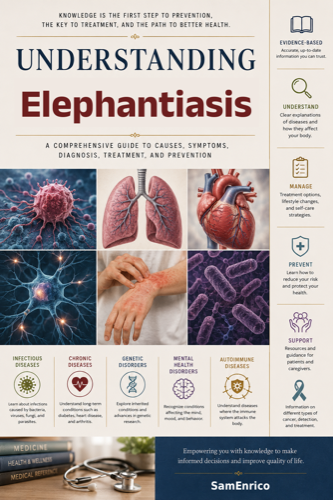
Understanding Elephantiasis eBook
This disease publication, published by SamEnrico,
by Dietz Marg
This disease publication, published by SamEnrico, covers Understanding Elephantiasis
Formats
Free sample
Chapter 1: The Swollen Curse...--–- Joseph Tetteh first noticed the itching in his left foot. He was forty-three years old, a fisherman from the Volta Region of Ghana, and he assumed he had picked up a mild fungal infection from standing hours each day in damp sandals. His wife suggested a traditional poultice. His eldest daughter, a nurse's aide in Accra, sent home a tube of antifungal cream. For six months, the itching came and went, nothing more than an annoyance.
Then came the fever. Not the familiar malarial kind that responds to a course of artemisinin, but something different. The fever struck suddenly at dusk, and with it came a burning pain that raced up the inside of his left leg like a match lighting a fuse. The skin turned red. The lymph nodes behind his knee swelled to the size of small eggs.
He could not walk. For three days, he lay on a bamboo mat while neighbors whispered. Some said he had been cursed by a rival fisherman who envied his catch. Others suspected a supernatural snake had coiled inside his flesh. His wife, practical and unsentimental, borrowed money for a motorbike taxi to the district clinic.
The clinical officer there wrote a single word in Joseph's health record: Lymphangitis. He prescribed oral antibiotics and paracetamol. Within a week, the fever broke, the redness faded, and Joseph returned to his canoe. He told himself the ordeal was over.It was, in fact, just beginning.The Unseen Invader Joseph Tetteh had no way of knowing that the real culprit was not a fungus, not a curse, not even the bacterial infection that the clinical officer had treated. The true invader was a translucent, thread-like worm called Wuchereria bancrofti, and it had taken up residence in his lymphatic system years earlier.
The itching, the fever, the burning lymphangitis—these were not separate illnesses. They were chapters of a single, unfolding story: the story of lymphatic filariasis, a disease that would eventually swell his leg to the size of a baobab trunk, deform his foot into a leathery, moss-covered mass, and drive him from his fishing community into a life of isolation. But Joseph was not unique. He was one of 880 million people living in 52 countries who remain at risk of the same fate. And his story, repeated in millions of variations across tropical and subtropical regions, is the story this chapter will unfold: the history, the misconceptions, the hidden burden, and the critical first steps toward understanding what elephantiasis truly is—and what it is not.The name "elephantiasis" comes from the Greek elephas, meaning elephant, and it was chosen by ancient physicians because the affected limb—swollen, thickened, gray and cracked—resembled the leg of an elephant.
But for most of human history, the name was the only accurate thing about the disease. The causes attributed to it ranged from the bizarre to the brutal. In medieval Europe, elephantiasis was often conflated with leprosy—a confusion that would persist for centuries and compound the stigma of both diseases. In India, the ancient Sushruta Samhita described a condition called shlipada ("foot with rough, uneven skin") and recommended bloodletting and purgatives. In the Caribbean, enslaved Africans who developed the massive swellings were sometimes accused of witchcraft or punished for malingering.
Even as late as the 19th century, respected physicians argued that elephantiasis was caused by "bad blood," "humid air," or moral degeneracy. The truth—that a mosquito-borne parasitic worm was responsible—would not be established until the 1860s, when the Brazilian physician Otto Wucherer and the British parasitologist Patrick Manson independently identified microfilariae in blood and lymphatic fluid. But the weight of centuries of misconception is not easily lifted. To this day, in endemic communities, patients are accused of having been cursed, of having committed incest, of having touched a dead body, or of being contagious. These beliefs are not harmless folklore.
They are the engine of social destruction, and they rest on a single, fundamental misunderstanding: that elephantiasis is a mysterious, untreatable affliction rather than a preventable, manageable parasitic infection.The goal of this chapter—and of this entire book—is to replace that misunderstanding with clarity. Elephantiasis is not a curse. It is not a form of leprosy. It is not contagious through touch, shared meals, or proximity. It is the late-stage manifestation of a neglected tropical disease (NTD) called lymphatic filariasis, caused by microscopic worms transmitted by mosquitoes, and it is entirely preventable.
By the end of this chapter, you will understand what elephantiasis is, where it occurs, who is at risk, and why the World Health Organization has committed to eliminating it as a public health problem by the year 2030. More importantly, you will understand why that goal is both achievable and urgent.What Elephantiasis Actually Is Let us begin with precision. The term "elephantiasis" is often used loosely to describe any severe swelling of a limb, but in medical nosology it refers specifically to the chronic, irreversible lymphedema caused by lymphatic filariasis (LF). There is also a non-infectious form called podoconiosis, caused by prolonged barefoot exposure to volcanic soil, but the two conditions are distinct in cause, treatment, and geographic distribution. This book focuses on infectious elephantiasis—the filarial form—because it is the one that affects hundreds of millions and is the target of a global elimination campaign.Lymphatic filariasis is caused by three species of nematode (roundworm): Wuchereria bancrofti, which causes more than 90% of cases; Brugia malayi; and Brugia timori.
These worms are tiny at first—microscopic larvae injected by a biting mosquito—but over 6 to 12 months, they mature into adult worms that can live for five to seven years inside the human lymphatic system. Adult female worms are 80 to 100 millimeters long (about the length of a human fingernail) but as thin as a strand of sewing thread. They coil inside lymphatic vessels, sometimes dozens of them in a single node, and each female produces millions of offspring called microfilariae. These microfilariae circulate in the blood, waiting to be picked up by another mosquito, which will then pass the infection to another human. This is the life cycle: mosquito to human, human to mosquito, repeated across generations.
The adult worms do not multiply inside the human body. If you are infected, every adult worm you carry was deposited by a mosquito bite. You cannot generate new worms on your own. This is a crucial point for understanding both treatment and elimination strategies.The damage these worms cause is not primarily mechanical, though they do physically obstruct lymphatic flow. The real harm is inflammatory.
The human immune system recognizes the worms as foreign and attacks them—but the worms are masters of evasion. They secrete proteins that modulate the immune response, preventing their own destruction while provoking a low-grade, chronic inflammation that gradually destroys the delicate endothelial lining of the lymphatic vessels. Over years, this leads to lymphangiectasia (abnormal dilation), leakage of protein-rich fluid into surrounding tissues, and eventually fibrosis (hardening and scarring). The protein-rich fluid is a perfect culture medium for bacteria. Once a limb develops chronic lymphedema, it is only a matter of time before bacterial entry lesions—cracked heels, fungal intertrigo between…
This is the end of the free sample. Get the eBook to keep going. Buy now
About this book
Details
- Author
- Dietz Marg
- Publisher
- SamEnrico
- Language
- English
- Genre
- Non-Fiction, Informative, Educational
- Released
- 2026-06-02
- Pages (approx.)
- 143
- Available as
- eBook, Audiobook

Read better in the ZLOADR app
Your eBooks on your phone or tablet. Sign in with your SamEnrico account and start reading.
More by Dietz Marg
 Chunking for Exam SuccessDietz Marg$11.99
 Cortisol and Immune SuppressionDietz Marg$11.99
 Food Addiction Recovery Journal CourseDietz Marg$11.99
 Study Group Stress ManagementDietz Marg$11.99
 Bones and Badges: The Hound of TroyDietz Marg$11.99
 The Celestial Cartographers: Ancient Babylon and the Birth of AstronomyDietz Marg$11.99
 How to Become a Radiation-protection EngineerDietz Marg$11.99
 Russian Logistics DirectoryDietz Marg$12.99
 Bookkeeping Tax DeductionsDietz Marg$12.99
 Facilities Management TechnicianDietz Marg$11.99
You may also like
 Hong Kong Handover 1997Dunn Johnnie$11.99
 Zumba For Postnatal Recovery CourseNeal Christian$11.99
 Zumba for BeginnersLadner Nikia$11.99
 YouTube Comment Mining GuideHumes Pandora$12.99
 Worry Box MeditationCarlin Rudy$11.99
 Workplace Stress MeditationNguyen Lynn$11.99
 Workplace Stress and Sleep RepairHawley Ivory$11.99
 Workplace Perfectionism CureDelaney Jeffry$11.99
 Workplace Injustice Anger GuideWallen Isabelle$11.99
 Work Addiction and Burnout LinkGreenwood Ester$11.99
 Women in Yoga and WellnessBeattie Galina$11.99
 Women in Stand Up ComedyChun Evangeline$11.99