

Non-FictionInformativeEducational
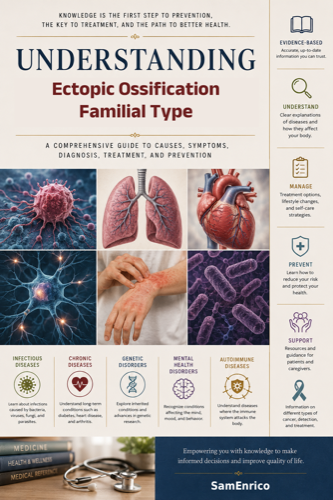
Understanding Ectopic Ossification Familial Type eBook
This disease publication, published by SamEnrico,
This disease publication, published by SamEnrico, covers Understanding Ectopic Ossification Familial Type
Formats
Free sample
Chapter 1: The Hidden Bone...--–- The human body is a masterpiece of biological engineering, capable of healing wounds, mending broken bones, and fighting off countless invaders. But sometimes, that brilliant engineering goes terribly wrong. Imagine your child falls off a tricycle—a minor bump, nothing more. A few weeks later, a small lump appears on their back. The doctor says it's just a bruise.
But the lump doesn't go away. It grows harder. Colder. Stranger. Then another lump appears on their neck.
Then another on their shoulder. And slowly, inexorably, your child begins to turn into a statue—not of stone, but of bone. This is not a horror movie. This is familial ectopic ossification, one of the most devastating and misunderstood genetic conditions in all of medicine.This chapter opens the door to a world that most physicians will never see and most families will never imagine. It is the story of what happens when the body's bone-building machinery runs amok, when a single misspelling in our genetic code turns our own repair systems against us, and when a disease so rare that it affects only a handful of people in a million becomes the central organizing reality of an entire family's existence.
By the time you finish these pages, you will understand not just the definition of familial ectopic ossification, but its texture, its terror, and most importantly, its hidden clues that can lead to early diagnosis and better outcomes.The Diagnosis Nobody Wants to Hear Familial ectopic ossification belongs to a shadowy category of diseases known as ultra-rare disorders. The most common form, Fibrodysplasia Ossificans Progressiva (FOP), affects approximately one person in every 1.5 to 2 million births worldwide. To grasp how few people that represents, consider this: in the entire United States, with a population of over 330 million people, only about 200 to 250 individuals live with FOP at any given time. You could fit every person with this disease in America into a single中型 theater. You could hold a global conference in a modest hotel ballroom.But rarity is not mercy.
For the roughly 4,000 people with FOP worldwide, and the even smaller numbers with related conditions like Progressive Osseous Heteroplasia (POH), the disease dominates every moment of every day. It determines how they move, what they eat, where they go to school, whether they can work, and ultimately, how long they live. The average lifespan for someone with severe FOP is approximately 40 to 50 years, with death typically resulting from restrictive lung disease as bone encases the rib cage, or from complications of immobility such as pneumonia or cardiac strain.The term "familial ectopic ossification" describes a group of disorders united by a single terrible feature: the formation of true, organized bone in soft tissues where bone has no business existing. The word "ectopic" comes from the Greek "ektopos," meaning "out of place." "Ossification" refers to bone formation. "Familial" indicates a genetic basis.
But here is where most people stumble. "Familial" does NOT mean that the disease must run in families. Approximately half of all FOP cases arise from spontaneous new mutations—flukes of nature that occur during the formation of a sperm or egg cell, with no prior family history. These individuals are the first in their bloodline to carry the mutation, but they have the exact same disease as those who inherited it, and they can pass it to their children.This misunderstanding has caused countless misdiagnoses. Parents are told, "It can't be genetic because no one else in your family has it." Doctors dismiss the possibility of an inherited disorder.
Years are lost. Harm is done. By the time the correct diagnosis is made, the patient has often lost mobility that could have been preserved with simple precautions.The Second Skeleton: What Actually Happens To understand familial ectopic ossification, you must first understand how normal bone forms. The human skeleton is not a static structure like the frame of a house. It is living tissue, constantly being broken down and rebuilt in a process called remodeling.
Specialized cells called osteoblasts build new bone. Other cells called osteoclasts chew up old bone. The two work in balance, maintaining strength while allowing repair.Bone formation follows two main pathways. The first, called intramembranous ossification, creates flat bones like those of the skull. Stem cells transform directly into bone-forming cells, laying down mineralized tissue without an intermediate cartilage stage.
The second pathway, called endochondral ossification, builds long bones like those of the arms and legs. Here, stem cells first form a cartilage model, which is gradually replaced by bone. Both pathways rely on a family of signaling molecules called Bone Morphogenetic Proteins (BMPs). These proteins act like generals commanding an army, telling stem cells when to become bone, when to stop, and where to build.In familial ectopic ossification, this command system breaks catastrophically. A mutation in the ACVR1 gene (also called ALK-2) alters the receptor that responds to BMP signals.
The receptor becomes stuck in the "on" position, like a smoke alarm that rings constantly regardless of whether there is smoke. Stem cells that would normally form muscle, fat, or connective tissue receive a continuous stream of "become bone" commands. They obediently transform into cartilage, then into bone, laying down a second skeleton that progressively immobilizes the patient.The process typically begins in a specific pattern. The first lesions often appear in the neck and upper back, then spread to the shoulders, then downward to the lower back and hips, then to the jaw, and finally to the chest wall and ribs. Each flare-up adds new bone, and once bone forms, it is permanent.
No medication, no surgery, no supplement can reverse established ectopic bone. The only strategy that works is prevention—avoiding the triggers that cause new lesions to form.The Trigger That Starts the Fire Here is what makes familial ectopic ossification so insidious: the triggers are everywhere. Unlike acquired heterotopic ossification, which follows major trauma like a car accident or hip replacement surgery, the familial form can be sparked by events so minor that most people wouldn't even notice them. A toddler bumps her head on a coffee table. A child receives a routine vaccination.
A teenager twists an ankle during gym class. A young adult gets the flu. Any inflammation, any injury, any immune activation can flip the switch and start the bone-building cascade.The mechanism is both simple and devastating. Inflammation recruits immune cells to the site of injury. These cells release growth factors and cytokines—chemical messengers that normally coordinate healing.
In a healthy person, these signals eventually subside, and healing completes. But in someone with the ACVR1 mutation, the BMP receptor cannot turn off. The signals that should fade instead persist, driving stem cells relentlessly down the bone formation pathway. A small bump becomes a small lump. That lump hardens into cartilage, then into bone.
And that bone never goes away.The most dangerous triggers are those that involve needles or surgery. An intramuscular (IM) injection—the standard way of giving vaccines, antibiotics, and many other medications—creates a pocket of trauma deep within the muscle. In a patient with familial ectopic ossification, that injection site frequently transforms into a large bone deposit. Patients…
This is the end of the free sample. Get the eBook to keep going. Buy now
About this book
Details
- Author
- Lin Henriette
- Publisher
- SamEnrico
- Language
- English
- Genre
- Non-Fiction, Informative, Educational
- Released
- 2026-05-11
- Pages (approx.)
- 156
- Available as
- eBook, Audiobook

Read better in the ZLOADR app
Your eBooks on your phone or tablet. Sign in with your SamEnrico account and start reading.
More by Lin Henriette
 Elevator Pitch Perfection GuideLin Henriette$11.99Elevator Pitch Perfection GuideLin Henriette$11.99
 Food Addiction and Trauma ManualLin Henriette$11.99
 Personal Ing For Success NonprofitLin Henriette$11.99
 Caffeine and Adrenal Fatigue GuideLin Henriette$11.99
 Weekend Distraction Reclaim GuideLin Henriette$11.99
 The Last Whistle: The Ghostly Echoes of the Centralia Mine FireLin Henriette$11.99
 The Last Queen of Sheba: A Love, a Kingdom, and a Vanishing EmpireLin Henriette$11.99
 Voiceover Portfolio GrowthLin Henriette$12.99
 Breach Notification Regulator MapLin Henriette$12.99
 How to Start a Parking Meter Coin Collection Service Business (Beginners Guide)Lin Henriette$11.99
 Diversity MarketingLin Henriette$11.99
You may also like
 Hong Kong Handover 1997Dunn Johnnie$11.99
 Zumba For Postnatal Recovery CourseNeal Christian$11.99
 Zumba for BeginnersLadner Nikia$11.99
 YouTube Comment Mining GuideHumes Pandora$12.99
 Worry Box MeditationCarlin Rudy$11.99
 Workplace Stress MeditationNguyen Lynn$11.99
 Workplace Stress and Sleep RepairHawley Ivory$11.99
 Workplace Perfectionism CureDelaney Jeffry$11.99
 Workplace Injustice Anger GuideWallen Isabelle$11.99
 Work Addiction and Burnout LinkGreenwood Ester$11.99
 Women in Yoga and WellnessBeattie Galina$11.99
 Women in Stand Up ComedyChun Evangeline$11.99