
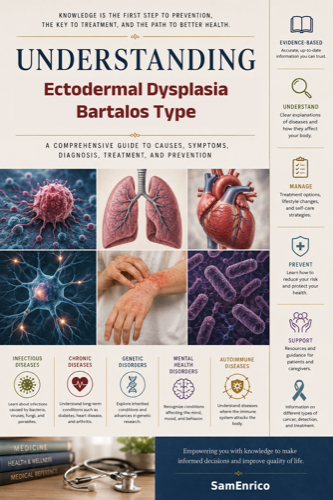
Non-FictionInformativeEducational
Understanding Ectodermal Dysplasia Bartalos Type eBook
This disease publication, published by SamEnrico,
This disease publication, published by SamEnrico, covers Understanding Ectodermal Dysplasia Bartalos Type
Formats
Free sample
Chapter 1: The Invisible Inheritance...–- The call came on a Tuesday afternoon in July. The air conditioning in Dr. Sarah Chen’s suburban Chicago office had been struggling all day, the aging unit groaning against a heat index of 104 degrees. She was reviewing lab results for a six-year-old boy named Marcus when her nurse poked her head in. "Mom is worried.
He’s flushed, lethargic, and his skin is hot to the touch. No fever."Sarah walked into the examination room to find Marcus slumped against his mother’s side, his straw-blonde hair sparse and wispy, his skin dry despite the oppressive humidity, his small mouth revealing several missing teeth where permanent incisors should have been. His mother, Denise, had brought him in because he seemed "off" after playing in the backyard sprinkler for twenty minutes. "He barely sweated," she said, her voice trembling. "I watched him.
Just a little on his forehead. Nothing like his brother."Sarah had seen this constellation of signs before, though only once in her fifteen-year career. The sparse hair. The missing teeth. The alarming inability to sweat.
And now, the heat-induced collapse. She ordered immediate cooling measures—ice packs to the neck and armpits, a cool bath, oral rehydration solution—and watched as Marcus slowly returned to baseline over the next hour. When he was stable, she sat down with Denise and used words that would change their lives: "I think Marcus may have a form of Ectodermal Dysplasia."Denise had never heard the term. She had never heard of any condition that caused a child to overheat dangerously during ordinary play. She had never heard of a world where missing teeth and thin hair were not cosmetic inconveniences but medical clues to a genetic blueprint written in a language she was only beginning to learn.This book is for Denise.
And for Marcus. And for the thousands of families around the world who have received a diagnosis of Ectodermal Dysplasia—specifically, the ultra-rare Bartalos Type—only to find that the information available is scattered across dense medical journals, contradictory websites, and fragmented support groups. This book exists to gather every thread of knowledge into one place: clinical, practical, emotional, and hopeful.What Is Hiding Beneath the Surface?Every human body begins as a single cell. Within weeks, that cell divides, differentiates, and organizes into three distinct layers: the endoderm (which becomes the gut and lungs), the mesoderm (which becomes muscles, bones, and blood), and the ectoderm. The ectoderm is the outermost layer, and from it springs an astonishing array of structures that we often take for granted—until something goes wrong.The ectoderm gives rise to the skin that wraps around our bodies, the hair that covers our scalps, the nails that protect our fingertips, the enamel of our teeth, and the sweat glands that cool us when temperatures rise.
It also contributes to parts of the eyes, ears, and nervous system. When a genetic mutation disrupts the development of the ectoderm, the result is a family of conditions known collectively as Ectodermal Dysplasias (EDs).But here is where most introductory resources stop. They explain the ectoderm, list the symptoms, and send patients on their way with a pamphlet and a phone number. This book will not do that. Because understanding Bartalos Type—an ultra-rare variant within the ED family—requires more than a high school biology review.
It requires a deep dive into genetics, a practical guide to every affected body system, a roadmap through the medical system, and honest conversations about school, work, relationships, and self-worth.The Family Tree of Ectodermal Dysplasias Imagine a vast library with over two hundred books, each one describing a different type of Ectodermal Dysplasia. Some of these books are thick and well-worn—these represent the more common types like X-linked hypohidrotic ED (affecting approximately 1 in 20,000 live births). Others are thin pamphlets with only a handful of documented cases. Bartalos Type sits in the latter category. It is so rare that many genetic databases have only a few dozen entries worldwide.What does "ultra-rare" actually mean?
The medical community generally defines a rare disease as one affecting fewer than 1 in 2,000 people in the United States (the threshold established by the Orphan Drug Act of 1983). But within the rare disease world, there is a further distinction. An ultra-rare disease affects fewer than 1 in 50,000 people, and in many cases, the number of documented individuals worldwide can be counted in the dozens or even the single digits. Bartalos Type falls into this ultra-rare category.To put this in perspective: if you filled an NFL stadium to capacity (approximately 70,000 people), you might expect to find roughly three or four individuals with the more common forms of ED. You might find zero individuals with Bartalos Type.
This rarity creates a unique set of challenges for patients and families. The average primary care physician may never encounter a single case in their entire career. Even specialists in dermatology or genetics may only see one or two cases. Information is scarce. Research funding is almost nonexistent compared to common diseases.
And families often feel profoundly alone.Yet—and this is a crucial point that will echo throughout this book—being rare does not mean being without resources. The broader ED research community has accumulated decades of clinical experience, and much of that knowledge applies directly to Bartalos Type. The management strategies for hypohidrosis (lack of sweating) are the same whether the underlying genetic cause is one mutation or another. The dental rehabilitation protocols for missing teeth have been refined across thousands of ED patients. And the support networks, while small, are fiercely dedicated.The Classic Triad: A Preview of What Follows Every experienced clinician who has worked with Ectodermal Dysplasia knows the "classic triad" of symptoms.
These three features appear together so consistently that their presence is often enough to raise suspicion of an ED diagnosis even before genetic confirmation. The triad consists of:Hypohidrosis: The reduced ability to sweat. This is not simply "not sweating much" during exercise. It is a profound physiological deficit that can lead to life-threatening hyperthermia in hot environments. Patients with hypohidrosis may have sweat glands that are entirely absent, severely reduced in number, or nonfunctional.
Their bodies cannot cool themselves through evaporation, making them vulnerable to heat exhaustion, heat stroke, and even death during heat waves, sports activities, or any situation where body temperature rises faster than it can dissipate.Hypodontia: The congenital absence of teeth. In Bartalos Type, this typically affects both primary (baby) and permanent teeth. The missing teeth are often the incisors and canines—the visible front teeth that shape a smile and help with biting. The teeth that do erupt may be conical (peg-shaped), widely spaced, or malformed. Beyond the cosmetic and psychological impact, hypodontia creates real functional problems: difficulty chewing, speech impediments (particularly with sibilant sounds), and jawbone atrophy over time because the bone that normally supports teeth is not stimulated.Hypotrichosis: Sparse, thin, slow-growing hair.
This affects the scalp, eyebrows, eyelashes, and body hair. Patients often describe hair that "never grows past a certain length" or hair that is so fine and fragile that it breaks easily. The hair may be…
This is the end of the free sample. Get the eBook to keep going. Buy now
About this book
Details
- Author
- Damron Shanda
- Publisher
- SamEnrico
- Language
- English
- Genre
- Non-Fiction, Informative, Educational
- Released
- 2026-05-18
- Pages (approx.)
- 157
- Available as
- eBook, Audiobook

Read better in the ZLOADR app
Your eBooks on your phone or tablet. Sign in with your SamEnrico account and start reading.
More by Damron Shanda
 Personal Ing For Success EntrepreneurshipDamron Shanda$11.99
 Mindfulness for Period PainDamron Shanda$11.99
 Peer Relationship Building GuideDamron Shanda$11.99
 Mindfulness for Student StressDamron Shanda$11.99
 Hypnotic Eye Closure MethodsDamron Shanda$11.99
 The Seismologist Who Felt the Earth Tremble: John Milne and the Birth of Modern Earthquake ScienceDamron Shanda$11.99
 Love and Lace: The Scandal That Crowned a QueenDamron Shanda$11.99
 Voiceover Buyout GuideDamron Shanda$12.99
 South African Data Breach GuideDamron Shanda$12.99
 How to Become a Cargo CheckerDamron Shanda$11.99
 Deep Belief Network OperatorDamron Shanda$11.99
You may also like
 Hong Kong Handover 1997Dunn Johnnie$11.99
 Zumba For Postnatal Recovery CourseNeal Christian$11.99
 Zumba for BeginnersLadner Nikia$11.99
 YouTube Comment Mining GuideHumes Pandora$12.99
 Worry Box MeditationCarlin Rudy$11.99
 Workplace Stress MeditationNguyen Lynn$11.99
 Workplace Stress and Sleep RepairHawley Ivory$11.99
 Workplace Perfectionism CureDelaney Jeffry$11.99
 Workplace Injustice Anger GuideWallen Isabelle$11.99
 Work Addiction and Burnout LinkGreenwood Ester$11.99
 Women in Yoga and WellnessBeattie Galina$11.99
 Women in Stand Up ComedyChun Evangeline$11.99