
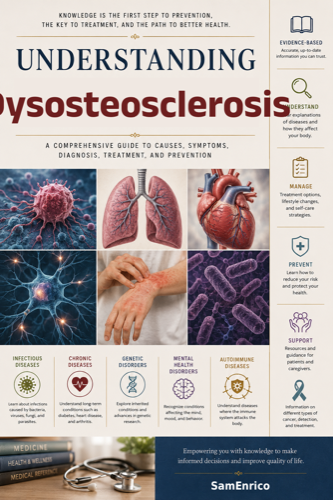
Non-FictionInformativeEducational
Understanding Dysosteosclerosis eBook
This disease publication, published by SamEnrico,
This disease publication, published by SamEnrico, covers Understanding Dysosteosclerosis
Formats
Free sample
Chapter 1: The Vanishing Diagnosis...–- The first mistake was calling it nothing at all.In the winter of 1968, a three-year-old girl named Margot was brought to the skeletal dysplasia clinic at the Hospital for Sick Children in London. She had stopped walking. Her head seemed too large for her body, her forehead bulged forward like a shelf, and when the ophthalmologist looked into her eyes, he saw optic nerves the color of pale ash—compressed, dying, starved of space. Her X-rays showed bones so dense they appeared painted white, yet paradoxically, her long bones had fractured twice that year from no known fall. The attending radiologist pulled the films from the view box, held them up to the window light, and said something that would echo through medical literature for decades: "I've seen osteopetrosis.
This isn't it."And so began the long, confused, and often contradictory history of dysosteosclerosis—a disease so rare that for nearly thirty years, it was diagnosed fewer times than most people have celebrated birthdays. A disease that, even today, has no dedicated Wikipedia page, no pharmaceutical company pipeline, no celebrity spokesperson, and no awareness ribbon. A disease that hides in plain sight, masquerading as other conditions, slipping through diagnostic cracks, and leaving families to navigate a medical system that often responds with a shrug and the words, "We just don't know."This book is written for those families. It is also written for the clinicians who will one day sit across from a child like Margot, holding X-rays that don't quite match the textbooks, and who will need more than a shrug. This chapter lays the foundation: what dysosteosclerosis is, how it came to be named (and renamed, and misnamed), who it affects, and why—despite its rarity—getting the diagnosis right matters more than almost anything else.What's in a Name?
The Problem of Classification Dysosteosclerosis is a mouthful. Break it down: dys (abnormal), osteo (bone), sclerosis (hardening). Literally, "abnormal bone hardening." But that literal translation is both accurate and dangerously incomplete, because not all bone hardening is the same, and not all abnormal bone is hard in the way you might think.The condition belongs to a family of disorders called sclerosing bone dysplasias—a group of more than fifty rare genetic diseases characterized by increased bone density. Within that family, dysosteosclerosis occupies a confusing middle ground. It shares features with osteopetrosis ("marble bone disease"), the most famous of the sclerosing dysplasias, but it differs in crucial ways.
It shares features with pyknodysostosis (the condition some historians retroactively diagnose in the artist Henri de Toulouse-Lautrec), but it diverges in others. And it shares features with Pyle disease, craniometaphyseal dysplasia, and dozens of other conditions whose names sound like ancient Greek curses.Why does this matter? Because a patient who is diagnosed with osteopetrosis may receive a bone marrow transplant—a high-risk procedure that has saved lives in that condition. The same patient, if they actually have dysosteosclerosis, might derive no benefit from that transplant while suffering all of its complications. A patient diagnosed with pyknodysostosis may be told that fractures heal normally; a patient with dysosteosclerosis faces brittle bone that heals poorly and may require完全不同 surgical approaches.
Classification is not academic pedantry. Classification determines whether a child receives a life-saving treatment or a life-threatening one.A Brief History of Confusion: How Dysosteosclerosis Got Its Name The first description of what we now call dysosteosclerosis appeared in the German medical literature in 1956, when a radiologist named H. Spranger (no relation to the later famous dysmorphologist) reported a child with "unusual osteosclerosis of the skull base and vertebrae." But the condition did not receive its formal name until 1968, the same year Margot was seen in London.That year, a team led by Dr. Juergen Spranger (yes, the famous dysmorphologist) published a paper titled "Dysosteosclerosis: A New Form of Sclerosing Bone Dysplasia." The paper described two unrelated children—a boy and a girl—with a striking combination of features: dense skull base, relatively normal skull cap, thickened long bones with a "bone-within-a-bone" appearance on X-ray, and progressive neurological deterioration from cranial nerve compression. Spranger proposed the name "dysosteosclerosis" to distinguish the condition from osteopetrosis (where the entire skeleton is uniformly dense) and from pyknodysostosis (where the skull sutures remain open and the jaw is underdeveloped).For the next two decades, the name stuck.
But so did the confusion. Throughout the 1970s and 1980s, case reports appeared under multiple names: "osteosclerosis with cranial nerve palsies," "sclerosteosis-like syndrome," "atypical osteopetrosis." Some clinicians argued that dysosteosclerosis was simply a mild variant of osteopetrosis. Others argued it was a distinct entity. Still others suggested it might be two or three different diseases lumped together by superficial X-ray similarities.The genetic revolution of the 1990s and 2000s was supposed to settle the debate. Instead, it complicated it further.
Researchers identified mutations in the TCIRG1 gene—one of the genes responsible for osteopetrosis—in some patients diagnosed with dysosteosclerosis. This seemed to support the "mild variant" theory. But then other patients with identical X-ray findings had mutations in SLC29A3, a gene never implicated in osteopetrosis. And still other patients had mutations in CSF1R, a gene involved in microglial function in the brain. Patients who looked the same on X-rays had different genes.
Patients with different X-rays sometimes shared the same gene.This brings us to the current understanding—one that this book will use throughout: Dysosteosclerosis is currently defined as a clinical-radiographic syndrome, not a single gene disorder. That is, the diagnosis is made based on a specific pattern of symptoms and imaging findings, not on a genetic test result. Multiple genes can produce that pattern, and some cases remain genetically unexplained. This is not a failure of science; it is a reflection of the complexity of bone biology. What looks like one disease to the radiologist may be several different molecular diseases that converge on a common appearance.The Numbers: How Rare Is Rare?If you search medical literature for "dysosteosclerosis," you will find approximately 45 to 50 reported cases.
That is not 45 to 50 per year, or per decade. That is 45 to 50 in the entire history of modern medicine, spanning nearly seventy years.To put that in perspective: a disease is considered "rare" in the United States if it affects fewer than 200,000 people. Dysosteosclerosis affects fewer than 200. A disease is considered "ultra-rare" if it affects fewer than 1,000 people worldwide. Dysosteosclerosis affects fewer than 100.
By any measure, this is among the rarest of the rare.But those numbers come with important caveats. First, the 45 to 50 figure represents only published cases—patients whose doctors recognized something unusual, wrote it up, and got the paper accepted. There may be additional unpublished cases, patients diagnosed in countries with limited research infrastructure, or patients who died before a diagnosis was ever made. Second, of those 45 to 50 reported cases, only about 18 have undergone modern genetic testing. The remainder were diagnosed by radiographic criteria alone—which means some of those historical cases might actually be other conditions if re-evaluated today.
Third, the advent of next-generation sequencing is revealing that some patients previously labeled as "atypical osteopetrosis" or "unspecified sclerosing dysplasia" actually have dysosteosclerosis-causing mutations. The true prevalence may…
This is the end of the free sample. Get the eBook to keep going. Buy now
About this book
Details
- Author
- Lyman Estrella
- Publisher
- SamEnrico
- Language
- English
- Genre
- Non-Fiction, Informative, Educational
- Released
- 2026-06-02
- Pages (approx.)
- 159
- Available as
- eBook, Audiobook

Read better in the ZLOADR app
Your eBooks on your phone or tablet. Sign in with your SamEnrico account and start reading.
More by Lyman Estrella
 The Breath as MetronomeLyman Estrella$11.99
 Hypnotic Amnesia Induction CourseLyman Estrella$11.99
 Talking to Doctors GuideLyman Estrella$11.99
 Perimenopause Menstrual ChangesLyman Estrella$11.99
 Instagram Pet Aesthetic AccountsLyman Estrella$11.99
 The Crown Unraveled: When Queen Elizabeth II’s Sister Almost Toppled the MonarchyLyman Estrella$11.99
 Iron Tracks to Victory: The Railroad That Won the WarLyman Estrella$11.99
 CopLyman Estrella$11.99
 Stock Photo Passive IncomeLyman Estrella$12.99
 Accelerator Co Founder RulesLyman Estrella$12.99
 How to Start a Parking Lot Operation Business (Beginners Guide)Lyman Estrella$11.99
You may also like
 Hong Kong Handover 1997Dunn Johnnie$11.99
 Zumba For Postnatal Recovery CourseNeal Christian$11.99
 Zumba for BeginnersLadner Nikia$11.99
 YouTube Comment Mining GuideHumes Pandora$12.99
 Worry Box MeditationCarlin Rudy$11.99
 Workplace Stress MeditationNguyen Lynn$11.99
 Workplace Stress and Sleep RepairHawley Ivory$11.99
 Workplace Perfectionism CureDelaney Jeffry$11.99
 Workplace Injustice Anger GuideWallen Isabelle$11.99
 Work Addiction and Burnout LinkGreenwood Ester$11.99
 Women in Yoga and WellnessBeattie Galina$11.99
 Women in Stand Up ComedyChun Evangeline$11.99