
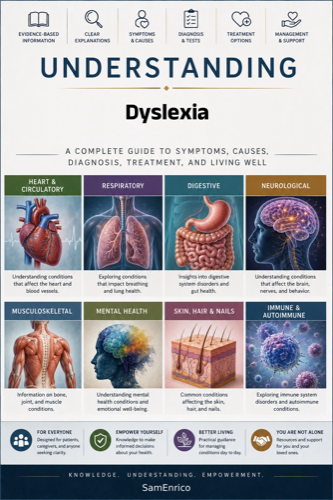
Understanding Dyslexia eBook
This condition publication, published by SamEnrico
by Thomas James
This condition publication, published by SamEnrico, covers Understanding Dyslexia
Formats
Free sample
Chapter 1: Beyond the Label...--–- It begins quietly. Not with a dramatic scene of a child throwing a book across the room, though that may come later. Not with a tearful parent-teacher conference, though that, too, is on the horizon. It begins with a subtle, almost invisible misalignment between effort and outcome. A child tries—genuinely tries—to sound out a word she saw just three sentences ago.
It was “the.” But here it is again, and she stares at it as if encountering an alien symbol. Her teacher sighs. Her parent wonders if she’s paying attention. And the child, who cannot name what is wrong, concludes the only explanation that makes sense: I must not be very smart.This book is written for that child, for the adults who love her, and for the teachers who want to reach her but lack the training to do so. Understanding Dyslexia is not a clinical textbook, though it will give you the science.
It is not a memoir, though it will share stories of struggle and triumph. It is a guide—practical, compassionate, and unflinching—for anyone who has ever watched a bright child struggle to read and wondered why the usual methods aren't working.Before we dive into the neuroscience of the dyslexic brain, before we map out interventions and accommodations and legal rights, we must first clear the ground. Dyslexia, as you will come to see, is one of the most researched, most misunderstood, and most manageable learning differences in existence. And yet, it remains shrouded in myths that harm children every single day.This chapter has a simple but urgent purpose: to redefine dyslexia beyond the common misconceptions and stereotypes. We will begin with a wake-up call about how schools are failing to identify these children.
We will explore the emotional reality of living with an unrecognized learning disability through profiles of successful individuals who struggled before the world knew what to call their difficulty. We will define dyslexia as a spectrum, showing how it looks different in a preschooler versus a teenager. And we will establish the prevalence of this condition—not to alarm you, but to assure you that you are not alone. By the end of this chapter, you will never again think of dyslexia as “mixing up letters.” You will see it for what it is: a specific, neurobiological, language-based learning difference that has nothing to do with intelligence and everything to do with how the brain processes the written word.The Wake-Up Call: Why This Book Is Necessary Let us begin with an uncomfortable truth. Despite decades of research, despite the existence of evidence-based interventions that work, despite federal laws mandating appropriate education for children with disabilities, most school systems in the English-speaking world continue to fail dyslexic children.
They fail them not out of malice, but out of ignorance, underfunding, and a stubborn attachment to instructional methods that science has repeatedly shown to be ineffective for struggling readers.Consider these facts. According to the National Center for Learning Disabilities, approximately one in five children has a learning or attention issue. Dyslexia is the most common of these, accounting for upwards of eighty percent of all learning disabilities. And yet, the average time between a parent’s first concern and a formal diagnosis is more than two years. Two years of watching a child fall further behind.
Two years of being told to “wait and see.” Two years of a child internalizing the message that reading is hard because they are somehow deficient.The “wait to fail” model, as it is called in education circles, is precisely what it sounds like. Schools wait until a child has failed significantly—often until third or fourth grade—before providing targeted intervention. The reasoning, such as it is, goes something like this: some children are late bloomers, and we don't want to over-identify or stigmatize children unnecessarily. But the consequences of this approach are devastating. Research has shown that if a child is not reading at grade level by the end of first grade, they have approximately a one in eight chance of ever catching up to their peers without intensive, specialized intervention.
Wait until third grade, and those odds drop to one in seventeen.Why does early intervention matter so much? Because the brain is most plastic, most capable of rewiring itself, in the early years of life. The neural pathways that support reading are not innate; they must be built through explicit instruction. For a typically developing child, this building happens relatively easily. For a dyslexic child, it requires deliberate, structured, multisensory teaching.
Delay that teaching, and you are not simply delaying progress—you are allowing the child’s brain to wire itself around the problem in inefficient, compensatory ways that become harder and harder to undo.But the failure is not only one of timing. It is also one of vocabulary. Many schools refuse to use the word “dyslexia” at all. Instead, they use euphemisms: “specific learning disability in reading,” “reading disorder,” “phonological processing deficit.” These terms are not technically incorrect, but they obscure more than they reveal. A parent who is told their child has a “specific learning disability” may not know that this is dyslexia.
A teacher who is told a student has a “phonological processing deficit” may not know that this child needs Orton-Gillingham instruction. The refusal to name dyslexia is not neutral. It is a systematic evasion of responsibility, because once a school names dyslexia, they are obligated to provide evidence-based interventions specifically designed for it.This is not an indictment of individual teachers. Most teachers enter the profession because they want to help children. They are passionate, hardworking, and under-resourced.
But the average teacher preparation program provides only a single course on reading instruction—and that course often emphasizes “balanced literacy” approaches that have been shown to be ineffective for struggling readers. Teachers are not being trained to recognize dyslexia, to differentiate it from other learning difficulties, or to implement the structured literacy methods that dyslexic children need.And so the cycle continues. A child struggles. The school says, “Give it time.” The parents worry but trust the professionals. The child falls further behind.
By fourth grade, when the shift happens from “learning to read” to “reading to learn,” the gap has become a chasm. The child can no longer access grade-level content in science, social studies, or math word problems because reading is too laborious. The child begins to avoid school, to act out, to develop stomachaches on Sunday nights. The school suggests a behavior plan. Everyone is frustrated.
And dyslexia remains unnamed, unaddressed, undefeated.This book is written to break that cycle.The Emotional Reality: Profiles of the Unrecognized If you are reading this book, you may be feeling a familiar knot in your stomach—the one that tightens when your child struggles and you don't know how to help. You are not alone. And more importantly, you are in excellent company. Some of the most successful, creative, and innovative people in history struggled with unrecognized learning disabilities.Consider Agatha Christie, the best-selling novelist of all time, whose books have sold more than two billion copies. As a…
This is the end of the free sample. Get the eBook to keep going. Buy now
About this book
Details
- Author
- Thomas James
- Publisher
- SamEnrico
- Language
- English
- Genre
- Non-Fiction, Informative, Educational
- Released
- 2026-06-02
- Pages (approx.)
- 140
- Available as
- eBook, Audiobook

Read better in the ZLOADR app
Your eBooks on your phone or tablet. Sign in with your SamEnrico account and start reading.
More by Thomas James
 Kelsea Ballerini UnapologeticallyThomas James$11.99
 Name Memory for Physical TherapistsThomas James$11.99
 Low Carb Weight Loss ManualThomas James$11.99
 Detox Master ReferenceThomas James$11.99
 The Relapse Prevention PlanThomas James$11.99
 Celine Dion TitanicThomas James$11.99
 Temperature Sleep Memory LinkThomas James$11.99
 ADHD Relationship AngerThomas James$11.99
 The Cosmic Visionaries: Black Nobel Laureates Who Charted the StarsThomas James$11.99
 Shadows of the Silk Road: The Puppet Masters of Ancient PersiaThomas James$11.99
 Middle East After Sales Service GuideThomas James$12.99
 WIPO Madrid System Filing GuideThomas James$12.99