
Non-FictionInformativeEducational
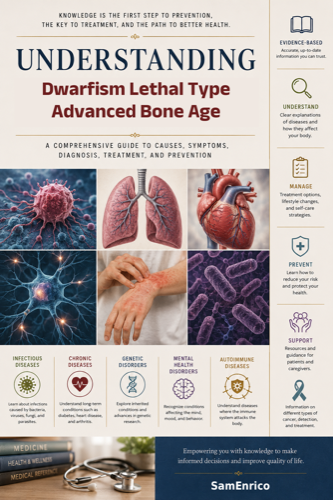
Understanding Dwarfism Lethal Type Advanced Bone Age eBook
This disease publication, published by SamEnrico,
This disease publication, published by SamEnrico, covers Understanding Dwarfism Lethal Type Advanced Bone Age
Formats
Free sample
Chapter 1: Beyond the Diagnosis--–- The ultrasound room is quiet. Too quiet. The technician has stopped pointing out tiny fingers and a beating heart. Instead, she excuses herself to “check the images with the doctor.” You have been here before, in this suspended moment, though you have never been in this room. Every parent receiving a lethal diagnosis knows this silence.
It is the space between hope and knowledge, between the child you imagined and the medical reality you cannot yet comprehend. This book exists to fill that silence with something far more useful than fear: understanding.This chapter establishes the foundation for everything that follows. It acknowledges the terror and confusion that accompany a diagnosis of lethal dwarfism, then reframes the condition not as an inexplicable tragedy but as a specific biological pathology—primarily Blomstrand osteochondrodysplasia and related advanced bone age syndromes. Before we can discuss genetics, prenatal signs, or palliative care, we must first understand what we are actually facing. What does “lethal dwarfism” mean?
What is “advanced bone age”? And most importantly, where do you go from here?Let us begin with clarity. This chapter is written for both clinicians and families. If you are a medical professional, you will find the precise definitions you need to counsel patients. If you are a parent, you will find honest, compassionate information that does not hide behind jargon or false hope.
And if you are both—perhaps a genetic counselor facing this condition for the first time—you will find a roadmap for the chapters ahead.The Weight of Words: Defining Our Terms The term “dwarfism” carries significant cultural and emotional weight. In medical literature, dwarfism refers to disproportionate short stature resulting from a skeletal dysplasia—a disorder of bone and cartilage development. Not all dwarfism is lethal. In fact, the vast majority of people with dwarfism live full, healthy lives. Conditions like achondroplasia, the most common form of disproportionate short stature, are compatible with normal lifespan, independent living, and excellent quality of life.But this book is not about those conditions.We are concerned with a specific, devastating subset of skeletal dysplasias: those that are lethal in the prenatal or neonatal period.
The word “lethal” is not used lightly. In medical terms, a lethal skeletal dysplasia is one that is incompatible with sustained extrauterine life. Most affected infants die before birth or within the first hours or days of life. The primary cause is almost always respiratory failure: the chest cavity is too small and rigid to allow the lungs to expand sufficiently for gas exchange. In some cases, the lungs themselves are underdeveloped—a condition called pulmonary hypoplasia.
In others, the heart cannot function properly due to the same thoracic constraint.Here we must introduce an important clarification. The term “lethal” exists on a spectrum. For the vast majority of cases of Blomstrand osteochondrodysplasia and related advanced bone age syndromes, survival beyond the neonatal period is not possible. However, as we will explore in Chapter 12, rare hypomorphic mutations in the PTH1R gene—the genetic culprit behind this condition—have been associated with survival beyond the first year of life. These individuals have severe short stature and significant medical challenges, but they live.
This does not make the term “lethal” inaccurate for the typical presentation, but it does mean we must avoid absolute language. When we say “lethal,” we mean “lethal for the vast majority, with rare exceptions that teach us about the underlying biology.”The prognosis spectrum includes three possibilities: intrauterine demise (the baby dies before birth), live birth with survival measured in hours to days (the most common outcome for live births), and, rarely, extended survival with severe disability. Setting realistic expectations means preparing for the most likely outcome while acknowledging the full range of possibilities.The Paradox of Premature Aging The phrase “advanced bone age” sounds contradictory. How can a fetus or newborn have bones that are older than they are? The answer lies in the difference between chronological age (how long a person has been alive or developing in the womb) and skeletal age (how mature the bones appear on imaging).Normally, bones ossify—turn from cartilage into hard bone—in a predictable sequence.
A fetus at 20 weeks gestation has certain bones that are still mostly cartilage, with only the beginnings of ossification in the long bones and skull. The small bones of the hands and feet, the carpals and tarsals, typically do not begin to ossify until the third trimester or even after birth. This is part of the normal developmental timetable.In the condition we are examining, that timetable is catastrophically accelerated. Bones that should be soft and growing are hard and mature. Bones that should not yet be visible on X-ray are fully formed.
The skeleton looks like that of an older fetus or even a young child, but contained within a body that is tiny and struggling to survive.This is the paradox: the bones are old, but the body is young. The skeleton has raced ahead, leaving the rest of the organs behind. And because the bones have matured too quickly, they have also stopped growing too quickly. Lengthening requires growth plates—cartilaginous zones at the ends of long bones where new bone cells are produced. In this condition, those growth plates are absent or severely disorganized.
The result is extreme shortening of the limbs, a narrow chest that cannot support breathing, and a skeleton that is dense, thick, and inflexible.Chapter 3 will explain why this happens at the cellular level. Chapter 5 will show you exactly what it looks like on X-ray. For now, simply grasp the central paradox: advanced bone age does not mean a healthy, mature skeleton. It means a skeleton that has exhausted its potential for growth before the baby has even taken a first breath.A Brief History: From Mystery to Molecular Diagnosis For most of medical history, lethal skeletal dysplasias were lumped together as “dwarfism” or “monstrosity” with no understanding of underlying causes. Families were told nothing could be done, nothing was known, and nothing could be predicted for future pregnancies.
This was devastating enough, but it also prevented the kind of systematic study that leads to progress.The modern era of skeletal dysplasia classification began in the 1960s and 1970s, when radiologists and pathologists started carefully describing the differences between conditions based on X-ray and autopsy findings. Names like thanatophoric dysplasia (from the Greek thanatophoros, meaning “death-bringing”) emerged. But the condition we now call Blomstrand osteochondrodysplasia was not clearly identified until 1983, when a Swedish radiologist named K. Blomstrand published the first detailed description of a lethal skeletal dysplasia characterized by extreme bone density and advanced maturation.For years, this condition was considered exceptionally rare—a curiosity in medical journals. Only in 1998 did researchers discover the genetic cause: mutations in the PTH1R gene, which encodes the parathyroid hormone 1 receptor.
This discovery transformed understanding from a descriptive diagnosis (based on what the bones look like) to a molecular diagnosis (based on the specific gene that is broken). As we will see in Chapter 2, this distinction has profound implications for genetic counseling, carrier testing, and future reproductive options.Today, the condition is sometimes called…
This is the end of the free sample. Get the eBook to keep going. Buy now
About this book
Details
- Author
- Mccue Reinaldo
- Publisher
- SamEnrico
- Language
- English
- Genre
- Non-Fiction, Informative, Educational
- Released
- 2026-06-02
- Pages (approx.)
- 146
- Available as
- eBook, Audiobook

Read better in the ZLOADR app
Your eBooks on your phone or tablet. Sign in with your SamEnrico account and start reading.
More by Mccue Reinaldo
 Spin Class Injury Comeback GuideMccue Reinaldo$11.99
 Bedtime Breath StillnessMccue Reinaldo$11.99
 Hypnotic Breathing TechniquesMccue Reinaldo$11.99
 Stalking Funeral Director CasesMccue Reinaldo$11.99
 VK Social Circle ComparisonMccue Reinaldo$11.99
 The Last Empress: How a 19th-Century Queen Defied an EmpireMccue Reinaldo$11.99
 The Last Broadcast: The Mysterious Death of DJ Alan FreemanMccue Reinaldo$11.99
 Cloud Data ArchitectMccue Reinaldo$11.99
 Pond5 Stock Phone GuideMccue Reinaldo$12.99
 AI Transcription Service GuideMccue Reinaldo$12.99
 How to Become a Control InspectorMccue Reinaldo$11.99
You may also like
 Hong Kong Handover 1997Dunn Johnnie$11.99
 Zumba For Postnatal Recovery CourseNeal Christian$11.99
 Zumba for BeginnersLadner Nikia$11.99
 YouTube Comment Mining GuideHumes Pandora$12.99
 Worry Box MeditationCarlin Rudy$11.99
 Workplace Stress MeditationNguyen Lynn$11.99
 Workplace Stress and Sleep RepairHawley Ivory$11.99
 Workplace Perfectionism CureDelaney Jeffry$11.99
 Workplace Injustice Anger GuideWallen Isabelle$11.99
 Work Addiction and Burnout LinkGreenwood Ester$11.99
 Women in Yoga and WellnessBeattie Galina$11.99
 Women in Stand Up ComedyChun Evangeline$11.99