
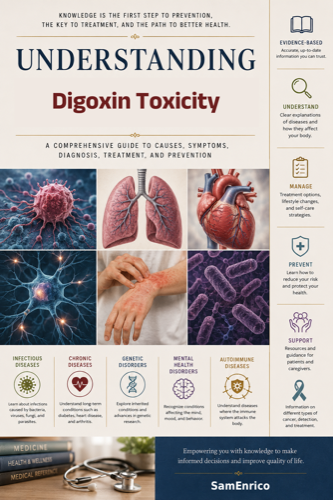
Non-FictionInformativeEducational
Understanding Digoxin Toxicity eBook
This disease publication, published by SamEnrico,
This disease publication, published by SamEnrico, covers Understanding Digoxin Toxicity
Formats
Free sample
Chapter 1: The Two-Edged Leaf--–- In the summer of 1775, a 34-year-old English physician named William Withering rode out from Stafford to attend to a patient suffering from an advanced case of dropsy—what modern medicine calls congestive heart failure. The man's legs were swollen to twice their normal size, his abdomen distended with fluid, and his breathing so labored that he could not lie flat to sleep. Withering, a respected doctor and botanist trained at the University of Edinburgh, had exhausted the standard remedies of his era: bloodletting, blistering, purging, and the administration of various mineral and herbal preparations. Nothing worked. Desperate and facing the certain death of his patient, Withering made an inquiry that would alter the course of cardiovascular medicine forever.
He asked the patient about any local remedies he might have tried outside of formal medical care. The patient mentioned an old Shropshire woman—an herbalist without any formal training—who had brewed a tea from a common garden plant. The tea, the patient reported, had produced dramatic diuresis and temporary relief on several occasions, though the woman refused to share her complete recipe. Intrigued rather than dismissive, Withering set out to find this woman and unlock her secret.What he discovered over the next decade would become one of the most enduring and dangerous relationships in all of medicine: the bond between the foxglove plant and the failing human heart. The active compound he helped isolate—digitoxin, and later its more refined cousin digoxin—remains in clinical use more than 240 years later, a longevity matched by few other drugs in the pharmacopoeia.
Aspirin has its century. Penicillin has its decades. But digitalis has centuries. And yet, for all its longevity, digoxin has never shed its original curse: the narrowest therapeutic index of any commonly prescribed cardiovascular medication. The same leaf that lifts the failing heart can stop it.
The same molecule that restores rhythm can scramble it into fatal chaos. This book is about that narrow path—the clinical tightrope between efficacy and toxicity, between healing and harm. Before we can understand how to manage digoxin toxicity, we must first understand why this ancient remedy has persisted into the era of modern cardiology, and why its history holds the keys to its safe use today.The Botanical Origins of a Cardiovascular Mainstay The foxglove plant, known scientifically as Digitalis purpurea, is a striking biennial native to Europe and parts of western Asia. Its tall stalks bear tubular, spotted flowers in shades of purple, pink, and white—flowers shaped exactly like the fingers of a glove, hence the name "foxglove" (folk etymology suggests "folk's glove" or "fairy glove"). Every part of the plant contains cardiac glycosides, but the highest concentrations reside in the leaves, which have been used in folk medicine for centuries.
The plant's toxicity was well known to rural communities: livestock that grazed on foxglove died suddenly, and children who sucked the nectar from the flowers developed nausea, vomiting, and sometimes fatal heart rhythms. Yet paradoxically, the same plant that killed also healed. Traditional herbalists had long used foxglove preparations to treat "dropsy"—the generalized edema that results from heart failure—though they did so with fear and imprecision, often starting with vanishingly small doses and increasing cautiously until the patient either improved or developed poisoning.What these herbalists observed empirically, we now understand mechanistically. The cardiac glycosides in foxglove increase the force of myocardial contraction (positive inotropy), which improves cardiac output and relieves the backup of blood that causes peripheral and pulmonary edema. But the margin between a therapeutic dose and a toxic dose is extraordinarily narrow—often a mere doubling of the serum concentration can transform a life-saving drug into a life-ending poison.
This narrow therapeutic index, as it came to be called, frustrated physicians for generations. It was not until the development of serum drug level monitoring in the mid-20th century that clinicians gained any reliable tool for navigating this dangerous terrain.Withering's Decade of Discovery After learning of the Shropshire herbalist's success, Withering spent the next ten years systematically investigating the foxglove. His approach was remarkably rigorous for the 18th century. He obtained multiple samples of the plant, prepared them in standardized ways (drying the leaves, grinding them into powder, and steeping them in water to create an infusion), and then carefully documented his results in 163 patients with dropsy. He noted that the plant worked best in patients whose edema was clearly cardiac in origin rather than renal or hepatic.
He also noted, with striking honesty, the plant's toxicity: nausea, vomiting, diarrhea, confusion, and—in several cases—death. Withering's 1785 monograph, An Account of the Foxglove and Some of Its Medical Uses, represents one of the first systematic clinical trials in medical history. In it, he wrote a sentence that every modern prescriber of digoxin should memorize: "The medicine is truly a two-edged sword, which cuts both ways. Given in too large a dose, it produces vomiting, purging, and death; given in too small a dose, it produces no effect at all."Withering understood something that many physicians today still struggle with: the dose-response curve for digitalis is not gentle. There is no wide plateau of safety.
There is only a steep hill that rises from ineffectiveness to efficacy to toxicity to death within a very narrow range of doses. He also recognized the critical importance of patient-specific factors, noting that elderly patients and those with kidney disease required much smaller doses than young, healthy individuals—an observation that modern pharmacokinetics has fully validated.From Plant to Purified Molecule For more than a century after Withering's monograph, physicians continued to use crude digitalis preparations—dried foxglove leaves, powdered leaf extracts, and various tinctures and infusions. The potency of these preparations varied wildly from batch to batch, from season to season, and even from plant to plant. A patient stabilized on one batch of digitalis leaf powder could be poisoned by the next refill if the new batch had a higher concentration of active glycosides. This unpredictability claimed countless lives and drove many physicians away from the drug altogether, despite its undeniable efficacy in heart failure and atrial fibrillation.The breakthrough came in the 1930s at the Wellcome Research Laboratories in England, where chemist Sydney Smith undertook the challenging task of isolating the pure cardiac glycosides from digitalis plants.
Smith focused on Digitalis lanata, a species that had been introduced to England from central Europe and that contained a more predictable profile of glycosides than the common Digitalis purpurea. In 1930, Smith isolated a pure crystalline glycoside that he named digoxin—distinct from the previously isolated digitoxin. Digoxin had several advantages over its predecessors: it was more rapidly absorbed, had a shorter half-life (making toxicity easier to manage), and could be reliably dosed because each tablet contained a precisely measured amount of the pure compound.The introduction of pure digoxin revolutionized cardiac pharmacotherapy. For the first time, physicians could prescribe a digitalis preparation with consistent potency. The drug's pharmacokinetics could be studied, its therapeutic range defined, and its toxic effects correlated with serum concentrations.
Yet even with pure digoxin, the narrow therapeutic index remained. The drug was (and remains) a demanding master, requiring careful…
This is the end of the free sample. Get the eBook to keep going. Buy now
About this book
Details
- Author
- Dunlap Eldridge
- Publisher
- SamEnrico
- Language
- English
- Genre
- Non-Fiction, Informative, Educational
- Released
- 2026-06-02
- Pages (approx.)
- 139
- Available as
- eBook, Audiobook

Read better in the ZLOADR app
Your eBooks on your phone or tablet. Sign in with your SamEnrico account and start reading.
More by Dunlap Eldridge
 Anger Affirmation GuideDunlap Eldridge$11.99
 Mindfulness For Busy ProfessionalsDunlap Eldridge$11.99
 The Friendship Deepener GuideDunlap Eldridge$11.99
 Retirement Home Sale TimingDunlap Eldridge$11.99Retirement Home Sale TimingDunlap Eldridge$11.99
 The Fencing Focus GuideDunlap Eldridge$11.99
 The Clockwork Rebellion: How a 19th-Century Automaton Sparked a RevolutionDunlap Eldridge$11.99
 Seams of Power: The Untold Story of Dior’s New LookDunlap Eldridge$11.99
 Associate Financial AdvisorDunlap Eldridge$11.99
 UBA Buenos Aires GuideDunlap Eldridge$12.99
 H-1B Cap Gap ExtensionDunlap Eldridge$12.99
 10 Ways to Use Cream Of Tartar (Recipe Book)Dunlap Eldridge$11.99
You may also like
 Hong Kong Handover 1997Dunn Johnnie$11.99
 Zumba For Postnatal Recovery CourseNeal Christian$11.99
 Zumba for BeginnersLadner Nikia$11.99
 YouTube Comment Mining GuideHumes Pandora$12.99
 Worry Box MeditationCarlin Rudy$11.99
 Workplace Stress MeditationNguyen Lynn$11.99
 Workplace Stress and Sleep RepairHawley Ivory$11.99
 Workplace Perfectionism CureDelaney Jeffry$11.99
 Workplace Injustice Anger GuideWallen Isabelle$11.99
 Work Addiction and Burnout LinkGreenwood Ester$11.99
 Women in Yoga and WellnessBeattie Galina$11.99
 Women in Stand Up ComedyChun Evangeline$11.99