
Non-FictionInformativeEducational
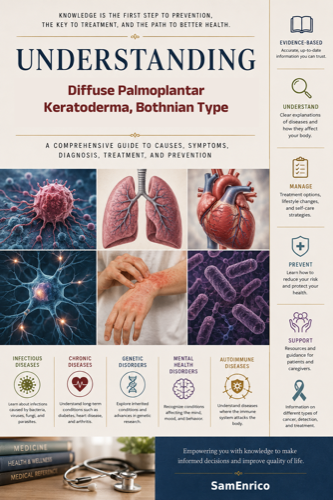
Understanding Diffuse Palmoplantar Keratoderma, Bothnian Type eBook
This disease publication, published by SamEnrico,
This disease publication, published by SamEnrico, covers Understanding Diffuse Palmoplantar Keratoderma, Bothnian Type
Formats
Free sample
Chapter 1: The Skin We Live In...--The first thing you notice about Erik’s hands is not the thickness. It is not the yellowish-brown color, nor the way the skin seems to form its own geography of ridges and fissures. What you notice first is how carefully he places them—resting on a dark cloth napkin at dinner, never flat on a table, never reaching across a stranger’s line of sight. When he shakes your hand, which he does infrequently, he offers only two fingers, a delicate grip that minimizes contact. For fifty-three years, Erik has lived in the coastal region of Northern Sweden, in a small town called Skellefteå, where the winter air is so dry it cracks wood and the summer sun barely sets.
And for fifty-three years, Erik has been hiding his palms.“I don’t remember a time when my hands looked normal,” he tells me when I visit. We are sitting in his kitchen, a modest room with blue curtains and the smell of cardamom buns cooling on a rack. He holds his coffee mug with his fingertips, a practiced motion that keeps his palms visible only to himself. “As a child, the other kids called me ‘grodman’—frog man—because my hands would turn white and spongy after swimming. I stopped swimming when I was seven.
I stopped shaking hands when I was twelve. I never told a single romantic partner about my condition until after we were already in love, because I was terrified they would leave.”Erik has Diffuse Palmoplantar Keratoderma, Bothnian Type. He shares this diagnosis with approximately one in every two hundred to three hundred people in the region where he was born—a prevalence rate that would be extraordinary for any rare disease. Outside of Northern Sweden, his condition affects fewer than one in a million people. Statistically, if you are reading this book and you do not have Swedish ancestry tracing back to the coastal parishes of Ostrobothnia, you have almost certainly never met another person with Erik’s condition.
But statistics are cold comfort when you are the one who cannot hold your child’s hand without wincing, who cannot wash dishes without your skin turning into something that looks diseased, who has built an entire life around the careful architecture of concealment.This book is written for Erik. It is written for his daughter, who carries the gene but has not yet developed symptoms. It is written for the dermatologist in London who sees one Bothnian patient per decade and needs a reliable reference. It is written for the genetic counselor in Stockholm who helps families navigate the fifty percent inheritance risk. And it is written for you, whoever you are—patient, parent, partner, or simply a curious reader—who has picked up this book because you want to understand what it means to live inside skin that does not work quite like everyone else’s.Before we can understand the Bothnian type, we must first understand what Palmoplantar Keratoderma means at all.
The term comes from three Greek roots: palma (palm of the hand), planta (sole of the foot), and keratoderma (thickened skin, from kerato meaning horn and derma meaning skin). Put simply, Palmoplantar Keratoderma—abbreviated as PPK throughout this book—refers to a group of disorders characterized by abnormal thickening of the epidermis on the palms of the hands and the soles of the feet. But this simplicity is deceptive. PPK is not one disease but dozens, maybe hundreds, of distinct genetic and acquired conditions that share a common appearance while differing radically in their causes, their prognoses, and their implications for patients and families.Think of PPK as a family of architectural mistakes. The human skin is a marvel of engineering: a stratified squamous epithelium that renews itself every twenty-eight days, forming a barrier between your internal organs and a world full of pathogens, ultraviolet radiation, physical trauma, and chemical irritants.
The outermost layer, the stratum corneum, is composed of dead keratinocytes—cells that have filled themselves with keratin proteins, lost their nuclei, and flattened into scale-like structures that interlock like shingles on a roof. In normal skin, this layer is about ten to thirty cells thick on the palms and soles, which already have the thickest stratum corneum in the body because they bear the greatest mechanical load. In PPK, that layer becomes pathologically thickened—fifty, one hundred, sometimes two hundred cells thick—creating a rigid, inelastic surface that cracks under pressure, fissures along lines of movement, and loses its ability to sense fine touch or regulate moisture.The body’s response to this thickening is paradoxical. The stratum corneum is supposed to be waterproof, but when it becomes excessively thick, it actually becomes more permeable to water in some ways while losing its ability to retain moisture in others. This is why people with PPK often have skin that is simultaneously dry and cracked and prone to maceration and fungal infections.
The normal balance of hydration is destroyed not by too much water or too little, but by a structural disorganization that prevents the skin from managing water properly.The Classification Problem: Why Patterns Matter Not all thickened skin is the same. Dermatologists classify PPK by three primary patterns, and understanding these patterns is the first step toward diagnosis because each pattern points toward a different set of genetic mutations, a different prognosis, and different treatment approaches.Diffuse PPK affects the entire palm and sole surface. There is no normal skin interspersed between areas of thickening. The hyperkeratosis covers the palm from the thenar eminence (the fleshy base of the thumb) to the hypothenar eminence (the fleshy base of the little finger) and extends across the entire palm in a glove-like distribution. On the feet, the entire plantar surface is involved, often including the arch, which is typically spared in other forms of PPK.
Diffuse patterns are further subdivided into those that are transgrediens (extending beyond the palm and sole onto the backs of the hands and feet, the wrists, and the Achilles tendon area) and those that are non-transgrediens (confined strictly to the palmar and plantar surfaces). The Bothnian type is diffuse and transgrediens—a distinction that will become clinically important when we discuss differential diagnosis in Chapter 4.Focal PPK is different. In focal patterns, the thickening is confined to pressure points: the heels, the balls of the feet, the thenar and hypothenar eminences of the palms, and the tips of the fingers. Between these pressure points, the skin appears normal or only mildly affected. Focal PPK is often mechanically induced—the hyperkeratosis forms because of pressure and friction, not independently of them—and it frequently overlaps with conditions like pachyonychia congenita (which also affects the nails) and epidermolysis bullosa simplex (which causes blistering).
The distinction between diffuse and focal is not merely descriptive; it has genetic implications. Diffuse patterns are more likely to involve genes expressed throughout the entire palmoplantar epidermis, while focal patterns often involve genes related to mechanical stress responses.Punctate PPK is the rarest of the three patterns. Here, the hyperkeratosis takes the form of numerous small, dot-like papules—one to five millimeters in diameter—scattered across the…
This is the end of the free sample. Get the eBook to keep going. Buy now
About this book
Details
- Author
- Clanton Nelia
- Publisher
- SamEnrico
- Language
- English
- Genre
- Non-Fiction, Informative, Educational
- Released
- 2026-05-11
- Pages (approx.)
- 152
- Available as
- eBook, Audiobook

Read better in the ZLOADR app
Your eBooks on your phone or tablet. Sign in with your SamEnrico account and start reading.
More by Clanton Nelia
 Progressive Relaxation AngerClanton Nelia$11.99
 Spin Class Metrics Tracking WorkbookClanton Nelia$11.99
 The Speed Visualization GuideClanton Nelia$11.99
 Theranos Securities FraudClanton Nelia$11.99
 Family Gifting Home EquityClanton Nelia$11.99
 The Last Dance of the DodoClanton Nelia$11.99
 The Ghost in the Lab: How a Forgotten Scientist Fooled the WorldClanton Nelia$11.99
 Assistant DesignerClanton Nelia$11.99
 Argentina Free University GuideClanton Nelia$12.99
 UK Sponsor Compliance AuditClanton Nelia$12.99
 How to Become a Molasses PreparerClanton Nelia$11.99
You may also like
 Hong Kong Handover 1997Dunn Johnnie$11.99
 Zumba For Postnatal Recovery CourseNeal Christian$11.99
 Zumba for BeginnersLadner Nikia$11.99
 YouTube Comment Mining GuideHumes Pandora$12.99
 Worry Box MeditationCarlin Rudy$11.99
 Workplace Stress MeditationNguyen Lynn$11.99
 Workplace Stress and Sleep RepairHawley Ivory$11.99
 Workplace Perfectionism CureDelaney Jeffry$11.99
 Workplace Injustice Anger GuideWallen Isabelle$11.99
 Work Addiction and Burnout LinkGreenwood Ester$11.99
 Women in Yoga and WellnessBeattie Galina$11.99
 Women in Stand Up ComedyChun Evangeline$11.99