
Non-FictionInformativeEducational
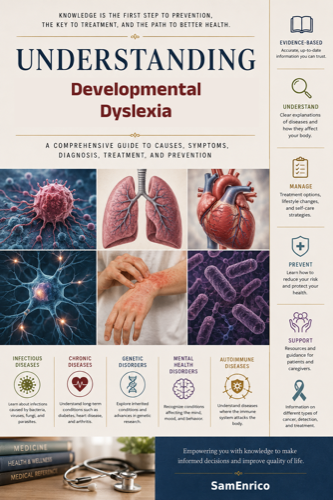
Understanding Developmental Dyslexia eBook
This disease publication, published by SamEnrico,
by Bills Sylvie
This disease publication, published by SamEnrico, covers Understanding Developmental Dyslexia
Formats
Free sample
Chapter 1: The Unexpected Paradox--–- The email arrived on a Tuesday afternoon, three weeks into second grade. Sarah’s mother, Jennifer, had been expecting a routine progress report—maybe a note about talking too much in class or forgetting to turn in homework. Instead, the subject line read: “Concerns About Reading.” The teacher’s message was polite but puzzled: “Sarah is a delight in class. She participates in discussions, asks thoughtful questions, and her verbal answers show she understands everything we read aloud. But when I ask her to read a simple sentence independently, she guesses at words, skips others, and seems exhausted after just a few lines.
I’m not sure if she’s not trying or if something else is going on.”Jennifer stared at the screen, confused. Something else? Sarah could name every dinosaur that ever lived. She built elaborate marble runs that would impress an engineer. She could argue her way out of bedtime with logic that would make a lawyer proud.
But when Jennifer asked Sarah to read the word “cat” on a flashcard the night before, her daughter had stared at it for eight seconds before guessing “dog.”This is the paradox of dyslexia—the child who speaks eloquently, solves complex puzzles, but cannot spell simple words or decode a basic sentence. The child who is labeled “lazy” while working ten times harder than everyone else. The child who is told to “try harder” when they are already trying so hard that they fall asleep in tears.Sarah’s story is not unusual. It is, in fact, the most common story of dyslexia. And it is the story this book exists to change.The Face of Unexpected Struggle Dyslexia is defined by what researchers call the “unexpected” nature of the reading difficulty.
A child who struggles with reading despite having average or above-average intelligence, despite receiving adequate instruction, despite having no obvious sensory impairments, and despite having every opportunity to succeed—that is the hallmark of dyslexia.Imagine two children in the same second-grade classroom. Both struggle to read the sentence “The dog ran to the big red ball.” The first child has what educators call “garden variety” reading difficulties—low general cognitive ability, limited vocabulary, weak background knowledge, or inconsistent attendance. When you teach this child phonics, they learn, but progress is slow because the underlying cognitive infrastructure is limited across multiple domains.The second child—the dyslexic child—has strong verbal skills, an extensive vocabulary, and a sharp mind. In a discussion about the story, this child can explain character motivation, predict plot twists, and ask insightful questions. But put a printed page in front of them, and they freeze.
They guess “horse” for “house,” “ran” for “run,” and “ball” for “bounce.” When you teach this child phonics, they learn—but the learning requires intense, systematic, multi-sensory instruction that is rarely provided in typical classrooms.The first child’s reading difficulty is “expected” given their overall cognitive profile. The second child’s difficulty is “unexpected” because every other indicator predicts they should be reading well. This unexpectedness is the fingerprint of dyslexia.As Dr. Sally Shaywitz, one of the world’s leading dyslexia researchers, writes in Overcoming Dyslexia, “Dyslexia is an island of weakness surrounded by a sea of strengths.” The weakness is in phonological processing—the ability to break words into their constituent sounds. The strengths are everywhere else: problem-solving, creativity, spatial reasoning, verbal communication, big-picture thinking, and more.But here is the tragedy: Because the difficulty is “unexpected,” the dyslexic child is often mislabeled.
Teachers assume the child isn’t trying. Parents assume the child is being lazy. And the child themselves internalizes the most damaging message of all: “I must be stupid.”They are not stupid. They are wired differently.The 1-in-5 Reality: Why This Book Matters to You Before we go any further, let’s establish one critical fact: Developmental dyslexia is the most common neurobiological learning disorder in the world. Conservative estimates place prevalence at 1 in 5 individuals.
Some studies suggest the number may be closer to 1 in 4 when you include milder presentations and individuals who have compensated successfully.Let that sink in. In every classroom of 25 children, 5 are likely dyslexic. In a typical American elementary school of 500 students, 100 are dyslexic. In a company of 1,000 employees, 200 are dyslexic. In your extended family—your children, nieces, nephews, grandchildren—the odds are overwhelming that someone you love is dyslexic right now, and you may not even know it.The prevalence data alone makes dyslexia a public health issue.
But when you add the consequences of missed or delayed diagnosis—academic failure, school dropout, unemployment, depression, anxiety, substance abuse, and even incarceration—the urgency becomes undeniable.A landmark study by the National Institutes of Health found that 35% of children with untreated reading difficulties develop significant emotional or behavioral problems by middle school. Another study found that 48% of juvenile offenders have undiagnosed learning disabilities, with dyslexia being the most common. The “school-to-prison pipeline” is not hyperbole; it is a documented pathway where reading failure in early elementary school leads to behavior problems, then truancy, then suspension, then expulsion, then arrest.But here is the hopeful news: When dyslexia is identified early—in kindergarten or first grade—and when effective intervention begins immediately, the outcomes are dramatically different. The brain can be rewired. Neural pathways can be strengthened.
Children who would have failed can not only learn to read but can go on to thrive in school, careers, and life.This book exists to give you the knowledge and tools to make that outcome happen for the dyslexic person in your life—or for yourself.The Myth of the “Disease”: Introducing Neurodiversity One of the most important shifts in understanding dyslexia over the past decade has been the move away from the “disease” or “disorder” model and toward what is called the neurodiversity paradigm.Neurodiversity is the idea that differences in brain wiring—such as those seen in dyslexia, ADHD, autism, and other conditions—are not defects or deficits but natural variations in human cognition. Just as biodiversity is essential to a healthy ecosystem, neurodiversity is essential to a healthy human community. Different brains solve different problems. Different brains see different patterns. Different brains create different art, build different structures, and imagine different futures.This does not mean that dyslexia has no challenges.
It does. The phonological processing difficulty is real, and it makes learning to read in a print-based society genuinely hard. But framing dyslexia as a “disease” implies that the goal is to cure it, to eliminate it, to make the dyslexic brain into a non-dyslexic brain. That is neither possible nor desirable.Instead, the goal is to understand the dyslexic brain—its challenges and its strengths—and to build environments, teaching methods, and assistive technologies that allow dyslexic individuals to access their strengths while compensating for their challenges. This is the difference between a medical model (fix the person) and a social model (fix the environment).Throughout this book, we will use the language of neurodiversity.
Dyslexia is not a deficit. It is a different wiring pattern that creates a trade-off: challenges in phonological processing and automatic reading fluency, but…
This is the end of the free sample. Get the eBook to keep going. Buy now
About this book
Details
- Author
- Bills Sylvie
- Publisher
- SamEnrico
- Language
- English
- Genre
- Non-Fiction, Informative, Educational
- Released
- 2026-06-02
- Pages (approx.)
- 158
- Available as
- eBook, Audiobook

Read better in the ZLOADR app
Your eBooks on your phone or tablet. Sign in with your SamEnrico account and start reading.
More by Bills Sylvie
 Zumba Gold Low Impact HandbookBills Sylvie$11.99
 Terrorism Insurance Agency ListBills Sylvie$11.99
 Beginner Fitness Journal GuideBills Sylvie$11.99
 The Loneliness Epidemic Survival GuideBills Sylvie$11.99
 Antwerp Diamond Heist Forensic BreakthroughBills Sylvie$11.99
 The Iron Lung of Mumbai: Engineering a Miracle in the Time of CrisisBills Sylvie$11.99
 Breaking Barriers: The Unseen Fight of Senator Edward BrookeBills Sylvie$11.99
 How to Become a Char-filter OperatorBills Sylvie$11.99
 Singapore BOI RegisterBills Sylvie$12.99
 SEO Certification GuideBills Sylvie$12.99
 Transfusion MedicineBills Sylvie$11.99
You may also like
 Hong Kong Handover 1997Dunn Johnnie$11.99
 Zumba For Postnatal Recovery CourseNeal Christian$11.99
 Zumba for BeginnersLadner Nikia$11.99
 YouTube Comment Mining GuideHumes Pandora$12.99
 Worry Box MeditationCarlin Rudy$11.99
 Workplace Stress MeditationNguyen Lynn$11.99
 Workplace Stress and Sleep RepairHawley Ivory$11.99
 Workplace Perfectionism CureDelaney Jeffry$11.99
 Workplace Injustice Anger GuideWallen Isabelle$11.99
 Work Addiction and Burnout LinkGreenwood Ester$11.99
 Women in Yoga and WellnessBeattie Galina$11.99
 Women in Stand Up ComedyChun Evangeline$11.99