
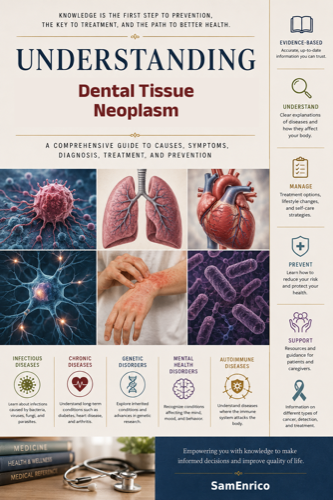
Understanding Dental Tissue Neoplasm
This disease publication, published by SamEnrico,
by Lin Cherrie
This disease publication, published by SamEnrico, covers Understanding Dental Tissue Neoplasm
Formats
About this book
Free sample
Chapter 1: The Benign Lie...--It is a strange comfort, the word "benign." Patients hear it and exhale. Dentists read it on a pathology report and close the chart. Surgeons nod, schedule a follow-up in six months, and move on to the next case. Everyone agrees: benign means safe. Benign means nothing to worry about.
Benign means the story is over.That is a lie.In the jaws and facial skeleton, benign tumors kill. Not through metastasis—that is the domain of their malignant cousins—but through geography. The mandible and maxilla are finite spaces, no larger than a fist, carved through with nerves that transmit sensation, arteries that supply the brain, and roots that anchor every tooth. Into this crowded territory comes a benign neoplasm. It does not invade in the oncologic sense, but it expands.
It pushes. It erodes. It displaces the inferior alveolar canal superiorly until the patient notices a numb lip. It lifts the floor of the maxillary sinus until the eye feels pressure. It grows into the coronoid process until the mouth cannot open more than a finger's width.
By the time a pathologist calls it benign, the patient may have already lost teeth, sensation, jaw continuity, and in some cases, the ability to close their lips or swallow without choking.This is the central paradox of dental tissue neoplasms: they are rarely lethal, but they are never trivial. A conventional ameloblastoma—the most common and most feared of the odontogenic tumors—has a recurrence rate of fifteen to thirty percent after simple enucleation, and each recurrence tends to be more aggressive than the last. The patient who undergoes a third surgery for a recurrent tumor is not consoled by the word "benign." The forty-two-year-old who wakes up from a segmental mandibulectomy with a fibula free flap and a tracheostomy tube is not reassured that her tumor lacked malignant cytology. She is grieving the loss of her lower face.This book exists because that grief is often preventable. Dental tissue neoplasms are rare—collectively accounting for less than one percent of all human tumors—but they are disproportionately mismanaged.…
This is the end of the free sample. Get the eBook to keep going. Buy now
Contents
- Chapter 1
- Chapter 2
- Chapter 3
- Chapter 4
- Chapter 5
- Chapter 6
- Chapter 7
- Chapter 8
- Chapter 9
- Chapter 10
- Chapter 11
- Chapter 12
Details
- Author
- Lin Cherrie
- Publisher
- SamEnrico
- Language
- English
- Genre
- Non-Fiction, Informative, Educational
- Released
- 2026-06-03
- Pages (approx.)
- 159
- Available as
- eBook, Audiobook

Read better in the ZLOADR app
Your eBooks on your phone or tablet. Sign in with your SamEnrico account and start reading.
More by Lin Cherrie
 Aviation Insurance Agency DatabaseLin Cherrie$11.99
 Recovery From GaslightingLin Cherrie$11.99
 Loving Kindness for Insomnia HandbookLin Cherrie$11.99
 Purposeful Living LongevityLin Cherrie$11.99
 Pain Acceptance Meditation HandbookLin Cherrie$11.99
 The Last of the Saami: Survival and Science in the Frozen NorthLin Cherrie$11.99
 The Last Goodbye: The Heartbreaking Farewell of the Titanic's BandLin Cherrie$11.99
 How to Become a Spice CleanerLin Cherrie$11.99
 Turkish Student Packing GuideLin Cherrie$12.99
 Special Education ComplianceLin Cherrie$12.99
 Production Line LeaderLin Cherrie$11.99