
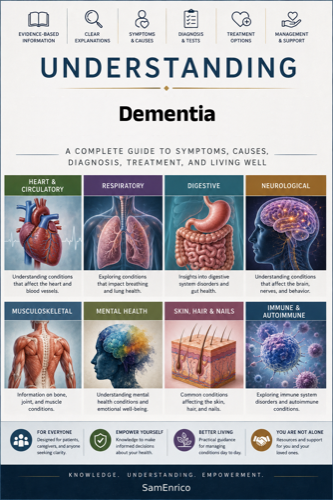
Non-FictionInformativeEducational
Understanding Dementia eBook
This condition publication, published by SamEnrico
This condition publication, published by SamEnrico, covers Understanding Dementia
Formats
Free sample
Chapter 1: The Shattered Mirror...--– When Margaret, a 68-year-old retired schoolteacher, stood in her own kitchen and could not name the object in her hand—a fork, a thing she had used three times daily for six decades—she did not cry. She laughed. A small, tight laugh that fooled no one, least of all herself. "I'm just tired," she told her daughter on the phone that evening. "You know how it is." But Margaret knew, in the quiet space between wakefulness and sleep, that this was not tiredness.
Something was wrong. Something was unraveling.This book is written for the Margarets of the world and for the people who love them. It is written for the son who watches his father forget his own birthday, for the spouse who becomes a stranger overnight, for the professional caregiver who pours out compassion until the cup runs dry. It is written for everyone who has asked the question that has no easy answer: What is happening to the person I love? And the question that follows, even more terrifying: What happens next?Understanding Dementia is not a textbook, though it contains clinical rigor.
It is not a memoir, though it is filled with human stories. It is, instead, a biopsychosocial journey—a map for a territory no one asked to enter. The chapters ahead will guide you through the landscape of cognitive decline: from the first confusing symptoms to the final stages of care, from the biology of brain cells to the psychology of loss, from the isolation of diagnosis to the possibility of community. But before we can navigate that journey, we must first understand what we are actually facing. And that begins with shattering our most dangerous assumption: that dementia is simply "getting old."The Most Dangerous Word: "Normal"The single most harmful phrase in the English language, when it comes to dementia, is this: "It's just old age."People say it to comfort themselves.
They say it to comfort others. They say it because they do not know what else to say. A man in his seventies forgets where he parked the car, and a well-meaning friend pats his shoulder: "Don't worry, it happens to all of us." A woman loses track of a conversation halfway through a sentence, and her husband smiles: "You've always been scatterbrained." These are not acts of kindness. They are acts of erasure. They take something real and terrifying—a potential medical condition—and dissolve it into the vague, shapeless mist of "normal aging."Let us be absolutely clear: dementia is not normal aging.
It is not a universal, inevitable consequence of growing older. The vast majority of older adults—even those in their nineties—do not develop dementia. Approximately 10-15% of people over 65 meet the criteria for some form of dementia, and while that percentage rises with age (to roughly 30-40% of those over 85), it is never universal. That means the majority of older adults, even the very old, retain their cognitive independence. They may forget a name occasionally.
They may take longer to recall a word. They may misplace their reading glasses. But they do not, as Margaret did, stand in their own kitchen and fail to recognize a fork.The distinction between normal age-related cognitive change and pathological cognitive decline is not merely academic. It is the difference between reassurance and intervention, between waiting and acting, between a life lived with manageable forgetfulness and a life consumed by progressive disability. This chapter provides the tools to understand that difference—and the courage to stop dismissing warning signs as "just old age."What Dementia Actually Is (And Is Not)Let us begin with precision.
Dementia is not a single disease. It is a clinical syndrome—a collection of symptoms caused by various underlying diseases of the brain. The word itself comes from the Latin de (out of) and mens (mind): "out of one's mind." Historically, it carried a heavy stigma, and for good reason: before modern medicine, a person with dementia was often feared, institutionalized, or simply hidden away. Today, we know better.The core diagnostic features of dementia are:Cognitive decline in one or more domains (memory, language, executive function, attention, visuospatial ability, social cognition)Functional impairment—the decline interferes with daily life (managing finances, driving, cooking, dressing, bathing)Decline from a previous level of functioning—this is not a lifelong difficulty but a change Not better explained by delirium (acute, fluctuating confusion) or major psychiatric disorder (e.g., untreated depression)If you are a family caregiver reading this, pause for a moment. Notice that the third criterion—decline from a previous level—is often the first clue.
It is not that your mother cannot remember where she put her keys. It is that she used to have a system, and now she does not. It is not that your husband cannot find the right word. It is that he used to be a storyteller, and now the stories stall halfway through.What dementia is NOT:Normal aging (as discussed above)Depression—which can mimic dementia (the "pseudodementia" of major depression) but is treatable and often reversible Delirium—an acute, fluctuating state of confusion typically triggered by infection, medication, dehydration, or metabolic disturbance; unlike dementia, delirium has a sudden onset and can resolve completely Mild Cognitive Impairment (MCI)—a risk state where cognitive decline is measurable but function is largely preserved; not everyone with MCI progresses to dementia One of the most common clinical errors is mistaking delirium for dementia in an older adult. An 82-year-old with mild baseline cognitive changes develops a urinary tract infection, becomes acutely confused and agitated, and is sent to the hospital with a diagnosis of "dementia exacerbation." The infection goes untreated for days.
This is a catastrophic mistake because delirium is often reversible. Any sudden change in cognition—over hours or days—is a medical emergency until proven otherwise. This point will be revisited throughout the book and is summarized in the Appendix's "3 D's" Quick Assessment Guide.The Many Names of Dementia: Beyond Alzheimer's When most people hear "dementia," they think "Alzheimer's." This is understandable: Alzheimer's disease accounts for approximately 60-80% of all dementia cases. But it is not the only type, and the differences between types matter enormously for prognosis, treatment, and care planning.Alzheimer's disease is characterized by the accumulation of two abnormal proteins in the brain: amyloid-beta (forming plaques outside neurons) and tau (forming tangles inside neurons). The earliest and most prominent symptom is typically episodic memory loss—difficulty learning and recalling new information.
A person with early Alzheimer's may ask the same question repeatedly, forget recent conversations, lose track of appointments, or become lost in familiar places. The progression is typically gradual, over 8-12 years on average, with a slow, steady decline.Vascular dementia (10-20% of cases) results from reduced blood flow to the brain, often due to a series of small strokes ("silent strokes") or chronic small vessel disease. Unlike Alzheimer's gradual slope, vascular dementia often shows a stepwise decline—sudden drops in function following each stroke, with periods of stability in between. The earliest symptoms frequently involve executive function (planning, organizing, multitasking) and processing speed rather than memory per se.…
This is the end of the free sample. Get the eBook to keep going. Buy now
About this book
Details
- Author
- Bustos Kimiko
- Publisher
- SamEnrico
- Language
- English
- Genre
- Non-Fiction, Informative, Educational
- Released
- 2026-05-11
- Pages (approx.)
- 158
- Available as
- eBook, Audiobook

Read better in the ZLOADR app
Your eBooks on your phone or tablet. Sign in with your SamEnrico account and start reading.
More by Bustos Kimiko
 Dating Across Cultures GuideBustos Kimiko$11.99
 Jason Aldean Small Town BoyBustos Kimiko$11.99
 The Solo Stress RechargeBustos Kimiko$11.99
 Jimi Hendrix Monterey PopBustos Kimiko$11.99
 Phenobarbital Detox UseBustos Kimiko$11.99
 Cambodia Therapy After GenocideBustos Kimiko$11.99
 Gerald Ford PresidencyBustos Kimiko$11.99
 CBD Subscription Retention DriversBustos Kimiko$11.99
 The Deep Song of the Diaspora: Black Poets Who Charted the Seas of the ImaginationBustos Kimiko$11.99
 The Sydney Mafia Wars: Blood on the Streets of the Harbour CityBustos Kimiko$11.99
 How to Produce Shuffleboard TablesBustos Kimiko$11.99
 Peer Review AI Prompt GuideBustos Kimiko$12.99
You may also like
 Hong Kong Handover 1997Dunn Johnnie$11.99
 Zumba For Postnatal Recovery CourseNeal Christian$11.99
 Zumba for BeginnersLadner Nikia$11.99
 YouTube Comment Mining GuideHumes Pandora$12.99
 Worry Box MeditationCarlin Rudy$11.99
 Workplace Stress MeditationNguyen Lynn$11.99
 Workplace Stress and Sleep RepairHawley Ivory$11.99
 Workplace Perfectionism CureDelaney Jeffry$11.99
 Workplace Injustice Anger GuideWallen Isabelle$11.99
 Work Addiction and Burnout LinkGreenwood Ester$11.99
 Women in Yoga and WellnessBeattie Galina$11.99
 Women in Stand Up ComedyChun Evangeline$11.99