
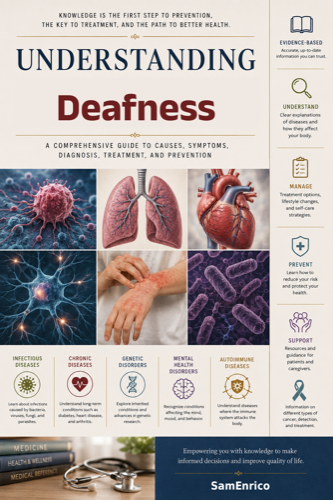
Understanding Deafness eBook
This disease publication, published by SamEnrico,
by Thrash Signe
This disease publication, published by SamEnrico, covers Understanding Deafness
Formats
Free sample
Chapter 1: Two Lenses, One Reality...--Imagine standing in an art gallery before a painting that shifts depending on where you stand. Step close, and you see brushstrokes, cracks in the pigment, the weave of the canvas. Step back, and suddenly a face emerges—eyes that follow you, a landscape that stretches toward a distant horizon. Neither view is false. The close view reveals the material truth of paint and fabric.
The distant view reveals the intended image, the meaning the artist sought to convey. To truly understand the painting, you must learn to move between these perspectives, holding both in your mind at once.This book is about a painting called deafness. And just like that painting, it cannot be understood from a single vantage point.If you ask an audiologist to define deafness, she will speak in decibels and frequencies. She will show you an audiogram—a grid of numbers that plots your hearing thresholds across different pitches. She will tell you about conductive loss in the middle ear, sensorineural damage in the cochlea, the irreversible death of hair cells that never regenerate.
She will hand you a pamphlet about hearing aids, cochlear implants, and assistive listening devices. From where she stands, deafness is a medical condition—a measurable deviation from normal function that can be diagnosed, treated, and managed.If you ask a geneticist, he will talk about mutations on the Connexin 26 gene, the most common cause of inherited deafness. He will explain how a single typo in your DNA—one misplaced letter among three billion—can silence the delicate hair cells that should vibrate like piano strings struck by hammers. He will describe Usher syndrome, Waardenburg syndrome, and dozens of other genetic conditions for which deafness is one feature among many. From where he stands, deafness is a biological inheritance, a thread woven into the fabric of a family's genome.But if you ask a sign language interpreter, she might pause before answering.
She might shift her weight and look at you with an expression that is part caution, part invitation. Then she will say something surprising: deafness is not a problem to be solved. It is a way of being in the world—a sensory orientation that comes with its own language, its own art, its own humor, its own way of falling in love and arguing about politics and telling bedtime stories. From where she stands, deafness is a culture, a community, an identity.Three answers. All true.
All incomplete on their own.This chapter introduces the two foundational frameworks that will appear throughout this book. The first is the medical lens—the perspective of doctors, audiologists, geneticists, and therapists. The second is the cultural lens—the perspective of Deaf people themselves, understood not as patients but as members of a linguistic minority. These two lenses have been at war for more than a century. The war has caused immense suffering, especially for deaf children caught between competing ideologies.
But this book is not designed to declare a winner. It is designed to help you see clearly through both lenses, to understand where each comes from, what each offers, and where each falls short. The goal is not to resolve the tension but to help you hold it wisely—applying the right lens to the right problem at the right time in your life or the life of someone you love.By the end of this chapter, you will understand why a deaf person might say "I am not disabled" and also request a sign language interpreter under the Americans with Disabilities Act. You will understand why a parent might choose a cochlear implant for their child and still enroll that child in a bilingual school that teaches sign language. You will understand that the question "What is deafness?" has no single answer—only answers that are more or less useful depending on the question you are really asking.The Medical Lens: Decibels, Frequencies, and the Audiogram Let us begin with the framework that most people encounter first.
The medical model is not a conspiracy to pathologize deafness. It is a way of thinking that has produced extraordinary benefits: hearing aids that can be programmed to amplify only the frequencies you have lost; cochlear implants that restore enough hearing for telephone conversations; newborn hearing screening programs that identify deafness in the first days of life, allowing early intervention before language delay sets in. These are genuine achievements. They have changed millions of lives.But the medical model is not value-neutral. It carries assumptions that shape how we see deaf people and how deaf people see themselves.The medical model defines hearing as normal and its absence as abnormal.
It measures hearing loss along two dimensions: volume (loudness, measured in decibels) and frequency (pitch, measured in hertz). A person with "normal hearing" can detect sounds as soft as 10 to 20 decibels across the frequency range of human speech, roughly 250 to 8000 hertz. A person with mild hearing loss cannot hear sounds below 25 to 40 decibels. A person with moderate loss cannot hear below 40 to 70 decibels. Severe loss begins at 70 decibels; profound loss at 90 decibels or more.
These numbers translate directly into lived experience. A person with mild loss might miss the soft consonants of speech—the s, th, f, and sh sounds that carry most of the information in English—when someone speaks quietly. A person with profound loss might not hear a jet engine at takeoff.The medical model also classifies hearing loss by location in the auditory system. Conductive hearing loss occurs when sound cannot travel efficiently through the outer or middle ear. The cause might be earwax blocking the ear canal, fluid in the middle ear, a perforated eardrum, or damage to the three tiny bones called ossicles.
Conductive loss is often surgically reversible. Sensorineural hearing loss occurs when the hair cells in the inner ear or the auditory nerve itself are damaged. These hair cells do not regenerate in humans. Once they die, they are gone forever. Sensorineural loss is permanent.
Mixed hearing loss is simply a combination of both.The medical model catalogues the causes of hearing loss with impressive precision. Genetic mutations account for more than half of all congenital deafness. More than 100 genes have been linked to hearing loss, with Connexin 26 mutations alone responsible for 20 to 30 percent of cases. Noise exposure is the leading cause of acquired hearing loss in adults. A single gunshot can cause permanent threshold shift.
Repeated exposure to sounds above 85 decibels—the level of heavy traffic or a lawn mower—accumulates damage over time. Presbycusis is age-related hearing loss, the slow erosion of high-frequency hearing that begins in middle age and affects nearly half of people over 75. Ototoxic medications include certain chemotherapy drugs (cisplatin), antibiotics (gentamicin), and loop diuretics (furosemide), all of which can poison hair cells. Infections such as meningitis, measles, and cytomegalovirus can cause sudden, severe hearing loss. Physical trauma and tumors such as acoustic neuroma complete the list.The medical model is extraordinarily useful when you need to answer specific questions: What is causing this hearing loss?
Can it be treated? What device will help me hear my grandchildren's voices? What accommodations should I request at work?…
This is the end of the free sample. Get the eBook to keep going. Buy now
About this book
Details
- Author
- Thrash Signe
- Publisher
- SamEnrico
- Language
- English
- Genre
- Non-Fiction, Informative, Educational
- Released
- 2026-05-11
- Pages (approx.)
- 159
- Available as
- eBook, Audiobook

Read better in the ZLOADR app
Your eBooks on your phone or tablet. Sign in with your SamEnrico account and start reading.
More by Thrash Signe
 Parent Anger In Blended FamiliesThrash Signe$11.99
 Self Hypnosis Skin Picking GuideThrash Signe$11.99
 Remote Communication For Deaf TeamsThrash Signe$11.99
 Sex Addiction in MarriageThrash Signe$11.99
 Franchising Your Local Brand Across Borders Tech Transfer OfficesThrash Signe$11.99
 The Alchemist of the East: How a Japanese Chemist Unlocked the Secrets of Rare EarthsThrash Signe$11.99
 Echoes of the Unsub: How a Killer’s Playlist Sparked a Crime WaveThrash Signe$11.99
 Ultimate Handbook Guide to Stanley : (Falkland Islands) Travel GuideThrash Signe$11.99
 Circle vs Discord vs MightyThrash Signe$12.99
 Schedule O Supplemental InfoThrash Signe$12.99