
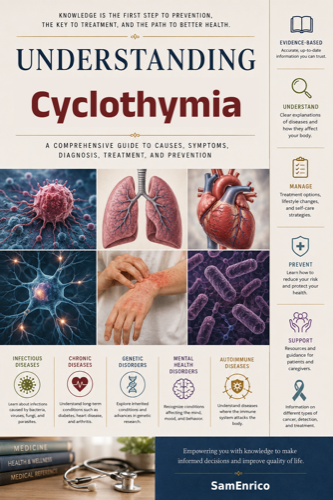
Non-FictionInformativeEducational
Understanding Cyclothymia eBook
This disease publication, published by SamEnrico,
This disease publication, published by SamEnrico, covers Understanding Cyclothymia
Formats
Free sample
Chapter 1: The Kindling Brain...-- Cyclothymia does not arrive like a thunderstorm. There is no single day you can point to and say, “Before this, I was fine. After this, I was not.” Instead, it creeps in like a slow leak in a boat you did not know you were sailing. One year, you are a moody teenager—intense, yes, but gifted, creative, passionate. The next, you are an adult who cannot explain why three good days are always followed by two bad ones, why your relationships follow a predictable arc of idealization and withdrawal, why your career feels like a series of brilliant sprints followed by humiliating collapses.
You have been called dramatic, sensitive, difficult, bipolar-light, or simply “a lot.” You have wondered, in your darkest moments, if this is just who you are—a fundamentally broken person with a defective personality. You have been told to try yoga, to meditate, to eat better, to try harder. And you have tried. God knows you have tried.But cyclothymia is not a personality flaw. It is not a lack of willpower.
It is not something you can think your way out of any more than you can think your way out of having a pancreas. Cyclothymia is a neurobiological condition of the brain’s mood regulation systems, and it has a history, a genetic signature, and a predictable course. Understanding that course begins with a single, powerful idea: the kindling brain.The Long Arc of a Forgotten Diagnosis Before we can understand what cyclothymia is, we must understand where it came from. The word itself sounds ancient because it is. The Greek physician Hippocrates, writing in the fourth century BCE, described patients who oscillated between what he called melancholia (black bile, or depression) and mania (divine frenzy, or excitation).
He believed these states were caused by imbalances in the four humors—blood, phlegm, yellow bile, and black bile—and that the people who cycled between them had a particular temperament: the cyclothymic temperament, from the Greek kyklos (circle or cycle) and thymos (spirit or mood). The term wandered through medical history for two thousand years, appearing in the writings of Galen, then vanishing, then reappearing in the 19th century as German psychiatrists began to classify mood disorders with scientific rigor.In 1882, the German psychiatrist Karl Ludwig Kahlbaum described a condition he called cyclothymia—a chronic, mild, circular mood disorder that did not reach the severity of full mania or major depression. His student, Ewald Hecker, refined the description, noting that cyclothymic patients seemed to live their entire lives on a low-grade seesaw, never fully stable but never fully incapacitated. For decades, cyclothymia was considered a “temperament” rather than a disorder—a personality variant that made someone artistic, mercurial, and difficult but not truly ill. This distinction mattered enormously.
Temperaments were inherited, stable, and essentially unchangeable. Disorders were medical conditions that could be treated. To call cyclothymia a temperament was to say, in effect, “This is just who you are. Learn to live with it.”That changed in 1980 with the publication of the third edition of the Diagnostic and Statistical Manual of Mental Disorders (DSM-III). For the first time, cyclothymia was formally classified as a mood disorder, distinct from bipolar I and II, with specific diagnostic criteria: at least two years of numerous hypomanic and mild depressive episodes, with no more than two consecutive months of stability.
The shift from temperament to disorder was not merely semantic. It was a declaration that cyclothymic people were not morally flawed or constitutionally weak. They had a brain condition worthy of study, treatment, and compassion.Yet even today, cyclothymia remains the forgotten child of the bipolar spectrum. Bipolar I and II receive the funding, the research attention, the celebrity spokespeople. Cyclothymia is mentioned in textbooks as a footnote—a “mild form” or a “subsyndromal condition.” This marginalization has real consequences.
Most cyclothymic patients are misdiagnosed for an average of seven to ten years. They are told they have major depression (antidepressants alone often make them worse), borderline personality disorder (their mood swings are internal, not triggered by abandonment), or ADHD (they are distractible, but only during hypomanic highs). They cycle through therapists, medications, and relationships, accumulating shame and frustration, all while being told their problem is not “serious enough” for aggressive treatment.This book rejects that framing. Cyclothymia is not mild. It is chronic.
It is not low-grade. It is fluctuating—sometimes barely noticeable, other times absolutely devastating. And its roots run deep, into the very structure of the brain.The Genetic Inheritance: What Your Family Tree Can Tell You If you have cyclothymia, you almost certainly did not develop it in a vacuum. The evidence for genetic transmission is among the strongest in all of psychiatry. Family studies consistently show that first-degree relatives (parents, siblings, children) of people with cyclothymia have a significantly elevated risk of developing a bipolar spectrum disorder themselves—not just cyclothymia, but bipolar I and II as well.
The numbers are striking: the general population risk for bipolar I is about 1 percent. If you have a first-degree relative with cyclothymia, your risk of developing a bipolar spectrum disorder climbs to approximately 5 to 10 percent. If you have a twin, the numbers tell an even clearer story. Identical twins (who share 100 percent of their DNA) have a concordance rate for cyclothymia and related bipolar conditions of 50 to 70 percent. Fraternal twins (who share about 50 percent of their DNA, like any siblings) have a concordance rate of only 10 to 20 percent.
This gap—the difference between identical and fraternal twins—is the gold standard evidence for genetic influence.But genetics are not destiny. Heritability estimates for cyclothymia typically fall between 60 and 80 percent, meaning that while genes play a major role, environmental factors matter too. You can inherit a genetic vulnerability without ever developing the full disorder. You can also develop cyclothymia without any known family history—spontaneous mutations, epigenetic changes, or simply the roll of the genetic dice.What exactly is being inherited? Researchers have identified several candidate genes involved in circadian rhythm regulation (CLOCK, ARNTL, PER3), neurotransmitter transport (SLC6A4 for serotonin, DAT1 for dopamine), and intracellular signaling pathways (GSK3B, BDNF).
These genes do not cause cyclothymia directly. Instead, they create a brain that is exquisitely sensitive to stress, light, sleep disruption, and other environmental triggers. Think of it as a genetic predisposition for a sensitive thermostat. In a calm environment, the thermostat holds steady. In a chaotic environment, it swings wildly—too hot, too cold, never comfortable.This genetic sensitivity explains a phenomenon that every cyclothymic person knows intimately: the feeling that you are allergic to normal life.
A minor criticism that rolls off another person’s back sends you into a three-day depressive spiral. A late night working on an exciting project triggers a week of hypomanic agitation. A change in seasons shifts your entire mood landscape. You are not weak. You are not overreacting.
Your genes have equipped you with a nervous system that amplifies every signal.The Kindling Theory: How Stress Changes Your Brain Forever Here is the most important biological concept you will learn in this book, and it will reappear in Chapter 11 when we discuss the…
This is the end of the free sample. Get the eBook to keep going. Buy now
About this book
Details
- Author
- Kelso Latonya
- Publisher
- SamEnrico
- Language
- English
- Genre
- Non-Fiction, Informative, Educational
- Released
- 2026-05-09
- Pages (approx.)
- 144
- Available as
- eBook, Audiobook

Read better in the ZLOADR app
Your eBooks on your phone or tablet. Sign in with your SamEnrico account and start reading.
More by Kelso Latonya
 The Remote Work Morning MirrorKelso Latonya$11.99
 Ramirez Courtroom AnticsKelso Latonya$11.99
 Meeting Recording PolicyKelso Latonya$11.99
 Weight Loss Plateau TrackerKelso Latonya$11.99
 Harry Truman Little Man GuideKelso Latonya$11.99
 The Lost Kingdoms of Java: Uncovering Homo erectus' Ancient WorldKelso Latonya$11.99
 Ecommerce Marketing One PageKelso Latonya$12.99
 Carbon Offset Tax BenefitsKelso Latonya$12.99Carbon Offset Tax BenefitsKelso Latonya$12.99
 Breakfast AttendantKelso Latonya$11.99
 How to Become a Treating InspectorKelso Latonya$11.99
You may also like
 Hong Kong Handover 1997Dunn Johnnie$11.99
 Zumba For Postnatal Recovery CourseNeal Christian$11.99
 Zumba for BeginnersLadner Nikia$11.99
 YouTube Comment Mining GuideHumes Pandora$12.99
 Worry Box MeditationCarlin Rudy$11.99
 Workplace Stress MeditationNguyen Lynn$11.99
 Workplace Stress and Sleep RepairHawley Ivory$11.99
 Workplace Perfectionism CureDelaney Jeffry$11.99
 Workplace Injustice Anger GuideWallen Isabelle$11.99
 Work Addiction and Burnout LinkGreenwood Ester$11.99
 Women in Yoga and WellnessBeattie Galina$11.99
 Women in Stand Up ComedyChun Evangeline$11.99