
Non-FictionInformativeEducational
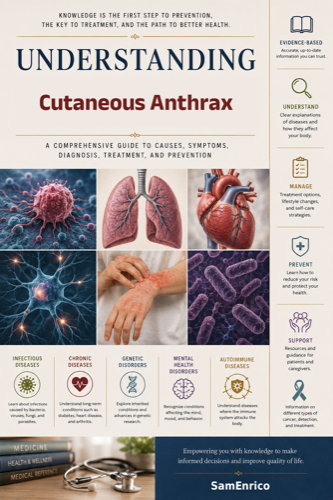
Understanding Cutaneous Anthrax eBook
This disease publication, published by SamEnrico,
This disease publication, published by SamEnrico, covers Understanding Cutaneous Anthrax
Formats
Free sample
Chapter 1: The Mark of Pharaohs...--The first time Dr. Elena Vasquez saw a case of cutaneous anthrax, she almost sent the patient home.It was a Tuesday in late summer 2018, and a 34-year-old rancher from rural South Dakota sat in her emergency department with what looked like a spider bite on his right forearm. The lesion was small—maybe two centimeters across—with a dark center and a ring of redness around it. He complained of mild itching but no pain. He had a low-grade fever of 100.8°F and mentioned that his arm felt "heavy" near the armpit.
She prescribed antibiotics for cellulitis and was reaching for the discharge papers when the patient said something that stopped her cold."My neighbor lost three cows last week," he said. "The vet said it was some kind of bacteria in the soil. Said it's been there for decades."Dr. Vasquez put down the pen. She looked again at the black center of the wound, the ring of tiny blisters around its edge, the way the swelling seemed to spread beyond the redness.
She remembered a single lecture from medical school—a slide she had barely glanced at during infectious disease rotation. The slide showed a black eschar on a farmer's hand. The caption read: Cutaneous anthrax. Painless ulcer with surrounding vesicles. History of livestock exposure.Three hours later, the state public health laboratory confirmed it: Bacillus anthracis, PCR positive.
The patient was started on the correct antibiotics. He survived. But Dr. Vasquez never forgot the lesson that almost killed him: the most dangerous thing about cutaneous anthrax is not the bacterium itself. It is the fact that almost no one recognizes it until it is too late.This book is written to ensure that you will.The Invisible Threat That Refuses to Die Cutaneous anthrax is the oldest known infectious disease of humans and animals, and yet it remains one of the most misunderstood.
Unlike the dramatic, headline-grabbing inhalational form that killed five Americans during the 2001 letter attacks, cutaneous anthrax is the version that most people survive—provided they receive treatment in time. But survival is not guaranteed. Before the era of antibiotics, the "malignant pustule" killed approximately 10 to 20 percent of those it infected. Even today, in the remote corners of sub-Saharan Africa, Central Asia, and rural South America, farmers, herders, and their families die from a disease that most Western physicians have never seen and would not recognize if it walked into their examination rooms.The paradox of cutaneous anthrax is that it is both ancient and modern, both terrifying and treatable, both a relic of agricultural history and a weapon of bioterrorism. To understand this disease is to understand the story of human civilization itself—our relationship with domesticated animals, our vulnerability to the microscopic world, and our endless struggle to outsmart a bacterium that has been perfecting its survival strategy for millions of years before we even stood upright.This chapter introduces the central arguments of this book.
First, that cutaneous anthrax cannot be understood in isolation from its historical, ecological, and political contexts. Second, that the unique biology of Bacillus anthracis—its spore, its toxins, its capsule—dictates every aspect of the disease, from the appearance of the skin lesion to the risk of fatal complications. Third, that despite being readily curable with cheap, generic antibiotics, cutaneous anthrax continues to kill because of delayed diagnosis, lack of access to healthcare, and the failure of public health systems to control the disease in livestock. And finally, that the threat of bioterrorism has transformed our understanding of this ancient scourge, forcing clinicians and public health officials to prepare for a scenario in which cutaneous cases are the first warning of a much larger attack.This book is organized into five parts, moving from the foundational science to the clinical presentation, diagnosis and treatment, prevention and public health, and finally to the future of research and eradication. But before we dive into the microbiology and the clinical protocols, we must first understand where this disease came from—and why it has been a companion to humanity for longer than recorded history.The Plagues of Egypt: Fact or Fiction?The first documented descriptions of what we now recognize as anthrax appear in the biblical Book of Exodus, in the story of the Fifth and Sixth Plagues of Egypt.
The Fifth Plague was a pestilence that killed the livestock of the Egyptians while sparing the animals of the Israelites. The Sixth Plague was an outbreak of painful boils that afflicted both humans and animals. For centuries, biblical scholars and medical historians have debated whether these plagues were literal events, allegorical narratives, or some combination of both. But a growing body of evidence suggests that the descriptions match the epidemiology and clinical presentation of anthrax with remarkable precision.The Fifth Plague, as described in Exodus 9:3, was "a very severe pestilence" that struck "the horses, donkeys, camels, cattle, sheep and goats." The Hebrew word used for this pestilence is dever, which implies a deadly epidemic disease. Significantly, the plague was geographically selective—it struck the Egyptians but not the Israelites.
This pattern matches the ecology of anthrax, which is not uniformly distributed across the landscape but rather concentrated in specific "anthrax zones" where soil conditions (high calcium, high organic content, neutral p H) favor spore survival. It is entirely plausible that the Israelites, living in a different part of the Nile Delta, occupied an area without endemic anthrax spores.The Sixth Plague followed immediately. Exodus 9:9 describes "boils that break out in sores on man and beast throughout the land of Egypt." The Hebrew word shechin means inflamed boils, furuncles, or ulcers—a perfect description of the cutaneous anthrax lesion. The timing is also consistent: after the death of livestock (the Fifth Plague), people who handled contaminated carcasses or meat would have developed cutaneous anthrax approximately 5 to 7 days later, matching the progression described in Chapter 4 of this book.Skeptics argue that biblical accounts cannot be taken as literal history, and they are correct to be cautious. But regardless of whether the Exodus narrative describes actual events, it demonstrates that ancient peoples understood the connection between sick animals and skin lesions in humans.
The Bible does not explain the mechanism—germ theory was still three thousand years away—but it records the observation that would become the foundation of anthrax epidemiology for millennia: dead livestock precede sick humans.From Virgil to the Industrial Revolution: A Disease With Many Names After the biblical era, references to what we now call anthrax appear intermittently in the medical literature of the ancient world. The Roman poet Virgil, writing in the first century BCE, described a "bloody murrain" (a term for infectious disease in cattle) that devastated herds in the Alps. His account in the Georgics is remarkably detailed: the animals' blood turned to water, their hides erupted with sores, and anyone who wore clothing made from their wool developed painful skin lesions. Virgil did not understand the mechanism, but he understood the consequence: the disease moved from animals to the environment to humans through contaminated products.The Roman physician Galen (129–216 CE) wrote about a condition he called anthrax, from the Greek word for…
This is the end of the free sample. Get the eBook to keep going. Buy now
About this book
Details
- Author
- Faber Elenore
- Publisher
- SamEnrico
- Language
- English
- Genre
- Non-Fiction, Informative, Educational
- Released
- 2026-06-02
- Pages (approx.)
- 154
- Available as
- eBook, Audiobook

Read better in the ZLOADR app
Your eBooks on your phone or tablet. Sign in with your SamEnrico account and start reading.
More by Faber Elenore
 The Remote Work Transition PeriodsFaber Elenore$11.99
 Meeting Notes SystemFaber Elenore$11.99
 The Groin Strain PreventionFaber Elenore$11.99
 Vegan Food Allergy Cooking CourseFaber Elenore$11.99
 Franchising Your Local Brand Across Borders Tax GuideFaber Elenore$11.99
 The Quantum Crown Heist: How a Parallel Universe King Stole the British MonarchyFaber Elenore$11.99
 CRISPR: The Genetic ScalpelFaber Elenore$11.99
 Sales Scripts for StartupsFaber Elenore$12.99
 IP Fee Payment MethodsFaber Elenore$12.99
 After School Program LeaderFaber Elenore$11.99
 How to Become a Tree PlanterFaber Elenore$11.99
You may also like
 Hong Kong Handover 1997Dunn Johnnie$11.99
 Zumba For Postnatal Recovery CourseNeal Christian$11.99
 Zumba for BeginnersLadner Nikia$11.99
 YouTube Comment Mining GuideHumes Pandora$12.99
 Worry Box MeditationCarlin Rudy$11.99
 Workplace Stress MeditationNguyen Lynn$11.99
 Workplace Stress and Sleep RepairHawley Ivory$11.99
 Workplace Perfectionism CureDelaney Jeffry$11.99
 Workplace Injustice Anger GuideWallen Isabelle$11.99
 Work Addiction and Burnout LinkGreenwood Ester$11.99
 Women in Yoga and WellnessBeattie Galina$11.99
 Women in Stand Up ComedyChun Evangeline$11.99