
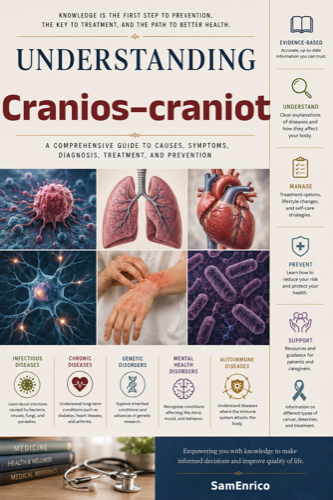
Non-FictionInformativeEducational
Understanding Cranios–craniot eBook
This disease publication, published by SamEnrico,
This disease publication, published by SamEnrico, covers Understanding Cranios–craniot
Formats
Free sample
Chapter 1: The First Whisper...–- The pediatrician’s words arrive like a stone dropped into still water. “I think your baby’s head shape is abnormal.” In that single sentence, the world you knew fractures into two distinct timelines: the before and the after. This chapter is not a clinical overview. It is a field manual for the first 48 hours after you hear those words—a period of terror, confusion, second-guessing, and, if you are lucky, decisive action. Here, you will learn what craniosynostosis actually is (and is not), why the common advice to “wait and see” can be dangerous, and exactly what to say and do before you leave the doctor’s office.
You are not overreacting. You are not a hysterical parent. You are the only advocate your child has, and the next two days will matter more than you can yet imagine.The Moment Everything Changes Let me tell you what you are feeling right now, because naming it is the first step toward mastering it.You are afraid. Not the abstract fear of a late-night news story about something that happens to other people. This is the cold, specific fear that lodges behind your sternum and makes it hard to breathe.
You are also confused—because the pediatrician used words you have never heard (“suture,” “plagiocephaly,” “scaphocephaly”) and then, paradoxically, told you not to worry. You are guilty, perhaps irrationally, wondering if you did something during pregnancy to cause this. (You did not. I will say that again: you did not.) And you are angry, though you may not recognize the anger yet—angry at the doctor for being vague, at your partner for not looking as scared as you feel, at the universe for handing you this when you were supposed to be enjoying baby smiles and middle-of-the-night feedings.All of these emotions are normal. All of them are, in their own way, useful.
Fear sharpens attention. Confusion signals that you need information. Guilt, misplaced though it may be, shows how much you love your child. And anger—well, anger is the fuel that will get you to the right specialist before anyone else’s baby gets that appointment.Here is what you need to know immediately, before we go any further: the vast majority of children with craniosynostosis who receive timely treatment go on to live completely normal lives. They play sports, win academic awards, fall in love, build careers.
The scar fades. The head shape normalizes. What determines that outcome more than anything else is not the severity of the condition but the speed and quality of the intervention. And speed begins with the next 48 hours.What Craniosynostosis Actually Is (And Is Not)Let me give you a definition so clear that you could explain it to your mother-in-law over the phone in thirty seconds.Craniosynostosis (crane-ee-oh-sin-oh-STO-sis) is the premature fusion of one or more of the fibrous joints—called sutures—that separate the bony plates of an infant’s skull.That is the medical definition. Here is the human definition: your baby’s skull is not one solid bone, like a bowl.
It is a collection of bony plates connected by flexible, stretchy seams. Those seams are supposed to stay open and flexible for the first year or two of life because the brain is growing very fast—it doubles in size during the first twelve months. The skull has to grow with it. When a seam fuses too early, the brain keeps growing but the skull cannot expand in that direction. So the brain pushes the skull to expand somewhere else, creating an abnormal head shape.Think of a garden hose with your thumb partially covering the opening.
The water still comes out, but it sprays in an abnormal pattern because the normal exit is blocked. That is craniosynostosis: the brain is still growing, but the skull grows in a distorted way because one of its expansion joints has locked.What craniosynostosis is NOT:It is not positional plagiocephaly (often called “flat head syndrome”). That is a completely different condition caused by a baby spending too much time lying on one spot. Positional plagiocephaly has no suture fusion. It improves with repositioning, tummy time, and sometimes a helmet.
Craniosynostosis does not improve on its own and almost always requires surgery.It is not a brain disease. The brain itself is typically normal, especially in non-syndromic cases.It is not caused by anything you did or did not do during pregnancy. No medication, no sleeping position, no diet, no stress. This is a developmental anomaly that occurs very early in fetal development, usually for no identifiable reason.It is not a death sentence. Untreated craniosynostosis can lead to serious complications, but treated craniosynostosis has an excellent prognosis.What craniosynostosis IS:A structural problem with a structural solution (surgery).A condition that, when caught early, can be corrected with excellent results.A diagnosis that requires a specialist—not a general pediatrician, not a well-meaning family doctor, but a pediatric neurosurgeon or a craniofacial surgeon at a dedicated children’s hospital.Simple vs.
Syndromic: The Two Big Categories Craniosynostosis comes in two main flavors, and knowing which one you are dealing with changes everything about the road ahead.Simple (non-syndromic) craniosynostosis accounts for about 80-85% of all cases. In simple craniosynostosis, only one suture is fused. The child has no other physical anomalies, no genetic syndrome, and typically no developmental issues beyond the small increased risk of learning disabilities that we will discuss in Chapter 10. The treatment is surgery on that single suture, usually one operation, and then regular follow-up. That is it.
One chapter of your lives, not the whole book.Complex (syndromic) craniosynostosis accounts for the remaining 15-20% of cases. In syndromic craniosynostosis, multiple sutures are fused, and the child has a genetic syndrome that affects other parts of the body. The most common syndromes are Crouzon, Apert, Pfeiffer, and Saethre-Chotzen, which we will explore in depth in Chapter 3. These children typically need multiple surgeries over many years, not just one. They also need ongoing monitoring for issues with breathing, vision, hearing, and development.
This is a longer road, but it is a road that thousands of families have walked before you.The critical point right now: you do not yet know which category your child falls into. Do not borrow worry from the future. Many parents hear “craniosynostosis” and immediately assume the worst—multiple surgeries, intellectual disability, a lifetime of struggle. But the statistics are on your side: four out of five cases are simple, single-suture, non-syndromic, and have excellent outcomes. Focus on getting the correct diagnosis first.
The rest will follow.The Glossary You Actually Need (Not the One That Overwhelms)Doctors love jargon. It makes them feel smart. But you do not need to memorize fifty Greek and Latin terms to be an effective advocate. You need about eight. Here they are, with translations.Term Pronunciation What It Means Suture SOO-chur The flexible seam between skull bones Craniosynostosiscrane-ee-oh-sin-oh-STO-sis Premature fusion of a suture Scaphocephalyskaff-oh-SEFF-uh-lee Long, narrow, boat-shaped head (sagittal suture)Trigonocephalytry-gone-oh-SEFF-uh-lee Triangular forehead with a ridge (metopic suture)Plagiocephalyplay-jee-oh-SEFF-uh-lee Asymmetric, flattened head (can be positional or true cranio)Brachycephalybray-kee-SEFF-uh-lee Short, wide head (bilateral coronal suture)Positional…
This is the end of the free sample. Get the eBook to keep going. Buy now
About this book
Details
- Author
- Sheffield Brain
- Publisher
- SamEnrico
- Language
- English
- Genre
- Non-Fiction, Informative, Educational
- Released
- 2026-06-03
- Pages (approx.)
- 159
- Available as
- eBook, Audiobook

Read better in the ZLOADR app
Your eBooks on your phone or tablet. Sign in with your SamEnrico account and start reading.
More by Sheffield Brain
 TM Practice CheckingSheffield Brain$11.99
 Night Stalker Trial TranscriptsSheffield Brain$11.99
 Imposter Syndrome in Nonprofit SectorSheffield Brain$11.99
 Dealing With Parental DisappointmentSheffield Brain$11.99
 Native American OUD GuideSheffield Brain$11.99
 The Great Bitcoin Heist: How a Rogue Insider Stole $80 Million in a Single NightSheffield Brain$11.99
 Infrastructure ArchitectSheffield Brain$11.99
 How to Become a Treating-plant SupervisorSheffield Brain$11.99
 World Bank Junior ProfessionalSheffield Brain$12.99
 Green Lease Provisions UpdateSheffield Brain$12.99
You may also like
 Hong Kong Handover 1997Dunn Johnnie$11.99
 Zumba For Postnatal Recovery CourseNeal Christian$11.99
 Zumba for BeginnersLadner Nikia$11.99
 YouTube Comment Mining GuideHumes Pandora$12.99
 Worry Box MeditationCarlin Rudy$11.99
 Workplace Stress MeditationNguyen Lynn$11.99
 Workplace Stress and Sleep RepairHawley Ivory$11.99
 Workplace Perfectionism CureDelaney Jeffry$11.99
 Workplace Injustice Anger GuideWallen Isabelle$11.99
 Work Addiction and Burnout LinkGreenwood Ester$11.99
 Women in Yoga and WellnessBeattie Galina$11.99
 Women in Stand Up ComedyChun Evangeline$11.99