
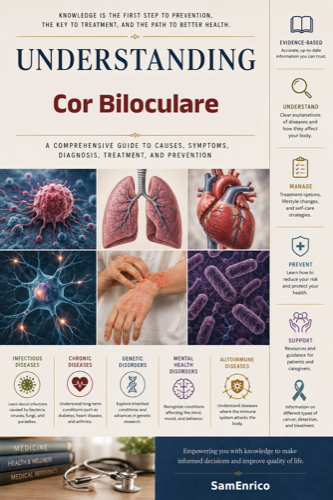
Non-FictionInformativeEducational
Understanding Cor Biloculare eBook
This disease publication, published by SamEnrico,
by Lo Edyth
This disease publication, published by SamEnrico, covers Understanding Cor Biloculare
Formats
Free sample
Chapter 1: The Vanished Septum...--– In the silent, fluid world of the developing human heart, a defect smaller than a grain of rice can unravel the architecture of an entire lifetime. Cor biloculare—literally "two-chambered heart"—is not merely a rare congenital anomaly; it is a remarkable failure of nature's most elegant septation process, a biological vanishing act in which the walls that normally divide the heart into four chambers simply never form. To understand this condition is to grasp the profound fragility of early cardiac development, the resilience of the human body when forced to adapt, and the heroic limitations of modern medicine in the face of anatomy that defies surgical correction. This chapter establishes the foundational definition of cor biloculare, distinguishes it from other single-ventricle defects, reviews its historical discovery, and presents the corrected prognostic framework that will guide the remainder of this book. What follows is not merely an anatomical description but an invitation to see this rare malformation as a window into the very essence of congenital heart disease—a condition that challenges our assumptions about what a heart must be to sustain life.Defining the Two-Chambered Heart In the normal human heart, four chambers—two atria and two ventricles—work in precise coordination, separated by the interatrial septum and the interventricular septum.
These septa are not merely passive walls; they are dynamic structures that direct blood flow, maintain pressure gradients, and ensure that oxygen-rich blood returning from the lungs does not mix with oxygen-poor blood returning from the body. The right side of the heart pumps deoxygenated blood to the lungs; the left side pumps oxygenated blood to the body. This separation is so fundamental that we rarely pause to marvel at it—until it is absent.Cor biloculare represents the complete absence of both septa, leaving a single common atrium emptying into a single common ventricle. This is not a "hole in the heart" in the sense of a ventricular septal defect or an atrial septal defect—both of which presuppose existing septa with perforations. Rather, it is the congenital non-formation of the septa themselves, a failure so early in embryonic development that the heart never begins to divide into its normal chambers.
The result is a primitive, two-chambered structure that resembles the heart of a developing embryo at four to five weeks of gestation—arrested in time, unable to complete the journey to four-chambered maturity.To be precise, cor biloculare is defined by three mandatory anatomical findings that must be confirmed by autopsy, echocardiography, or cardiac magnetic resonance imaging. First, there is absence of the interatrial septum, resulting in a common atrial chamber that receives blood from both the venae cavae (systemic return) and the pulmonary veins (oxygenated return). Second, there is absence of the interventricular septum, resulting in a single ventricular cavity that pumps blood into both the aorta and the pulmonary artery. Third, there are either two separate atrioventricular valves that open into the common ventricle or, more commonly, a single common atrioventricular orifice that serves as the sole connection between the common atrium and the common ventricle. This trifecta distinguishes cor biloculare from every other congenital heart defect.The consequence of this anatomy is total mixing of blood.
Systemic venous return—deoxygenated, "blue" blood carrying metabolic waste products from the body—enters the common atrium alongside pulmonary venous return—oxygenated, "red" blood freshly oxygenated in the lungs. Because no septa separate these streams, they mix completely before entering the single ventricle. The ventricle then ejects this mixed blood into both the aorta and the pulmonary artery, meaning that the blood perfusing the brain, kidneys, liver, and every other organ is a hybrid—partially oxygenated at best. The result is systemic arterial oxygen saturations that typically range from 50% to 80%, compared to the normal 95% to 100%. This cyanosis, visible as a bluish discoloration of the skin, lips, and nail beds, is the clinical hallmark of cor biloculare, though its severity varies dramatically depending on associated anomalies, particularly the presence or absence of pulmonary stenosis or pulmonary atresia.Differentiating Cor Biloculare from Diagnostic Mimics The nosology of congenital heart disease is notoriously complex, and cor biloculare has historically been conflated with other single-ventricle lesions.
A rigorous differential diagnosis is essential for appropriate surgical planning, prognostic counseling, and research classification. The following conditions are most frequently confused with cor biloculare, and each is distinguished by specific anatomical features that this book will repeatedly emphasize.Single Ventricle with Normally Related Great Arteries: In this malformation, the interatrial septum is typically present but may be fenestrated, and the interventricular septum is either absent or severely hypoplastic, leaving a dominant ventricle and a rudimentary outlet chamber. The presence of any septal tissue, however rudimentary, excludes cor biloculare. In cor biloculare, there is no septal remnant—the common ventricle is a single, undivided chamber from base to apex, without even a ridge or shelf of tissue to suggest where the septum might have formed.Tricuspid Atresia: Here, the tricuspid valve fails to form, leading to hypoplasia of the right ventricle. The interatrial septum is intact but often has a stretched patent foramen ovale or an atrial septal defect that allows right-to-left shunting.
The interventricular septum is present, separating the hypoplastic right ventricle from the dominant left ventricle. The existence of two distinct ventricular chambers—even if one is tiny—distinguishes this condition from cor biloculare. In tricuspid atresia, the ventricular septum exists; in cor biloculare, it never formed.Hypoplastic Left Heart Syndrome: In this more common single-ventricle defect, the left ventricle is severely underdeveloped, and the mitral and aortic valves are atretic or stenotic. However, the interatrial septum is fully formed (though potentially restrictive and requiring intervention), and the interventricular septum is intact, dividing the hypoplastic left ventricle from the right ventricle. Again, the presence of a septal structure, even in the context of extreme chamber asymmetry, excludes cor biloculare.
The two conditions share the need for single-ventricle palliation, but their anatomy—and therefore some surgical details—differs.Double-Outlet Single Ventricle: In this rare anomaly, both great arteries arise from a single ventricle, but the interventricular septum is partially formed, creating a second rudimentary chamber. The distinction from cor biloculare hinges on the presence of any septal tissue. The 1981 Temple and Bloor series, which will be analyzed in detail in Chapter 6, emphasized that their four autopsied cases showed no identifiable septal remnants—a finding they argued was essential to the diagnosis of true cor biloculare as opposed to other forms of single ventricle.Double-Inlet Left Ventricle: In this condition, both atria connect to a dominant left ventricle, and a small right ventricular outlet chamber is present. The interventricular septum exists but is often deficient. The presence of a second chamber, however small, makes this a different condition with different surgical options—some patients with double-inlet left ventricle may be candidates for biventricular repair, whereas patients with cor biloculare have no such option.The clinical importance of this distinction cannot be overstated.
A child labeled with "single ventricle" may be a candidate for biventricular repair if the second ventricle is merely hypoplastic rather than absent; a child with true cor biloculare has no such option. As Chapter 8 will detail…
This is the end of the free sample. Get the eBook to keep going. Buy now
About this book
Details
- Author
- Lo Edyth
- Publisher
- SamEnrico
- Language
- English
- Genre
- Non-Fiction, Informative, Educational
- Released
- 2026-05-08
- Pages (approx.)
- 154
- Available as
- eBook, Audiobook

Read better in the ZLOADR app
Your eBooks on your phone or tablet. Sign in with your SamEnrico account and start reading.
More by Lo Edyth
 Congress Member Official StationeryLo Edyth$11.99
 Aromatherapy for NauseaLo Edyth$11.99
 Opioid Recovery Spirituality GuideLo Edyth$11.99
 Prostate Health Exercise ProtocolLo Edyth$11.99
 WTO Dispute Settlement GuideLo Edyth$11.99
 The Opal Hunters: Unearthing Australia's Hidden TreasuresLo Edyth$11.99
 Iron & Ice: The Rise of the Great Lakes FreightersLo Edyth$11.99
 How to Start a Felt Business (Beginners Guide)Lo Edyth$11.99
 Azure Cloud EngineerLo Edyth$11.99
 Venture Debt Default StatsLo Edyth$12.99Venture Debt Default StatsLo Edyth$12.99Venture Debt Default StatsLo Edyth$12.99
You may also like
 Hong Kong Handover 1997Dunn Johnnie$11.99
 Zumba For Postnatal Recovery CourseNeal Christian$11.99
 Zumba for BeginnersLadner Nikia$11.99
 YouTube Comment Mining GuideHumes Pandora$12.99
 Worry Box MeditationCarlin Rudy$11.99
 Workplace Stress MeditationNguyen Lynn$11.99
 Workplace Stress and Sleep RepairHawley Ivory$11.99
 Workplace Perfectionism CureDelaney Jeffry$11.99
 Workplace Injustice Anger GuideWallen Isabelle$11.99
 Work Addiction and Burnout LinkGreenwood Ester$11.99
 Women in Yoga and WellnessBeattie Galina$11.99
 Women in Stand Up ComedyChun Evangeline$11.99