
Non-FictionInformativeEducational
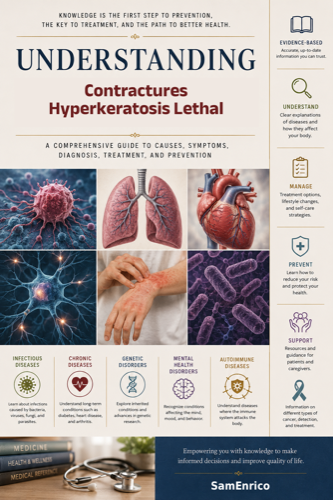
Understanding Contractures Hyperkeratosis Lethal eBook
This disease publication, published by SamEnrico,
This disease publication, published by SamEnrico, covers Understanding Contractures Hyperkeratosis Lethal
Formats
Free sample
Chapter 1: The Nuclear Cage...--The newborn did not cry. That was the first thing the delivery room team noticed—not the absence of a wail, which can be normal, but the complete stillness of a chest that should have been heaving with the first furious breaths of life. The second thing was the skin. It was not the soft, wrinkled, almost translucent skin of a full-term infant. It was tight.
Glossy. Waxy, as if someone had dipped the baby in paraffin and let it harden. And it was already splitting—fine cracks like a dried riverbed running across the abdomen, the backs of the hands, the fronts of the knees. The third thing was the mouth. A perfect, tiny O.
Not crying. Not smiling. Not opening wider. Not closing. Just frozen.The obstetrician, who had delivered more than ten thousand babies over a thirty-year career, paused.
She had seen arthrogryposis before—joint contractures, the fixed flexion deformities that made the baby's hands into tight fists and bent the knees into permanent flexion. She had seen unusual skin before. But she had never seen them together like this. She looked at the baby's face: the pinched nose, the low-set ears, the small jaw set back from the chin. She looked at the parents, whose expressions were shifting from anticipation to confusion to the first dawning edges of fear."We need to call genetics," she said.And with those four words, a family's journey into the rarest and most devastating diagnosis in perinatal medicine began.The Most Lethal Diagnosis You Have Never Heard Restrictive Dermopathy—also known historically as Contractures Hyperkeratosis Lethal, Lethal Tight Skin Contracture Syndrome, or Happle syndrome—is one of the rarest genetic disorders known to medicine.
Fewer than one in a million live births receive this diagnosis. Many cases are never diagnosed at all, lost to history as "unknown lethal condition" or "severe arthrogryposis with respiratory failure." Yet for the families who carry the diagnosis, for the clinicians who encounter it once in a career, and for the researchers who study it, Restrictive Dermopathy represents a perfect storm of medical mystery, genetic precision, and human tragedy.This book is about that condition. But more than that, this book is about what it means to understand a disease so rare that most doctors will never see it, so devastating that no child has ever survived it, and so scientifically rich that it has unlocked fundamental secrets about how our cells hold themselves together.Before we can understand Restrictive Dermopathy—before we can recognize it, diagnose it, counsel families about it, or hope to treat it—we must first understand a fundamental mistake that has colored thinking about this disease for decades. And that mistake begins with a single, understandable error: looking at the skin first.The Skin Is Not the Story When a baby is born with tight, rigid, translucent skin that cracks and erodes, the natural instinct is to assume a skin disease. Dermatologists call this a "genodermatosis"—a genetic disorder that primarily manifests in the skin.
And for decades, Restrictive Dermopathy was classified as exactly that: a lethal genodermatosis, a failure of the skin's mechanical integrity that secondarily affected the rest of the body.This is wrong.It is not merely outdated. It is backward. And understanding why it is backward is the single most important conceptual leap required to understand this condition.Restrictive Dermopathy is not primarily a skin disease. It is a laminopathy—a disorder of the nuclear envelope, the tiny protein cage that surrounds the nucleus of every cell in the human body. The skin findings, dramatic as they are, are not the cause of the disease.
They are a symptom. They are one manifestation of a cellular catastrophe that unfolds in every tissue, but becomes visible only in the tissues that experience the most mechanical stress: the skin, the muscles, the bones, and the lungs.Think of it this way. If a building's foundation fails, you might first notice the cracks in the walls. But the cracks are not the problem. The foundation is the problem.
The cracks are merely where the failure becomes visible. Similarly, in Restrictive Dermopathy, the nuclear envelope fails. The tight skin and the frozen joints are where that failure becomes visible.This distinction matters. It matters because it tells us where to look for treatments. It matters because it explains why the disease is uniformly lethal.
And it matters because it connects Restrictive Dermopathy to a family of related disorders—including Hutchinson-Gilford Progeria Syndrome (the "rapid aging" disease) and a range of muscular dystrophies and cardiomyopathies—that are caused by mutations in the same genes.So let us begin at the beginning. Not with the skin. Not with the joints. But with the nucleus.The Cell's Control Center Every cell in the human body contains a nucleus. The nucleus is the cell's command center: it holds the DNA, the genetic blueprint that directs everything the cell does.
But a blueprint is useless if it gets destroyed. The nucleus needs protection.That protection comes from the nuclear lamina—a meshwork of proteins that lines the inner surface of the nuclear membrane. The nuclear lamina is not a passive shield. It is an active, dynamic structure that gives the nucleus its shape, anchors the DNA in place, organizes the genetic material for reading and copying, and provides mechanical stability so that the nucleus can withstand the forces exerted upon it.Think of the nuclear lamina as the scaffolding inside a tent. Without the scaffolding, the tent collapses.
Without the nuclear lamina, the nucleus collapses. And without a functional nucleus, the cell dies.The nuclear lamina is composed primarily of proteins called lamins. There are several types, but the most important for our story are Lamin A and Lamin C. These two proteins are produced from the same gene, LMNA, through a process called alternative splicing. (One gene, two different proteins—a common trick in molecular biology that allows cells to fine-tune their responses to different conditions.)Lamin A, in particular, undergoes a remarkable journey from its initial synthesis to its final form.
It is born as a longer protein called Prelamin A. Prelamin A has a "tail" at one end—a fatty appendage called a farnesyl group that is added to help the protein attach to the nuclear membrane. But this farnesyl tail is only supposed to be temporary. Once Prelamin A is in place, an enzyme called ZMPSTE24 (zinc metalloproteinase STE24) comes along and snips off the farnesylated tail, releasing mature Lamin A into the nuclear lamina.This is the normal process. It happens billions of times every day in every cell of your body.
You are unaware of it, as you are unaware of your heartbeat or your breathing, but without it, you would not exist.In Restrictive Dermopathy, this process breaks.Two Genes, One Devastating Result Restrictive Dermopathy is caused by mutations in one of two genes: ZMPSTE24 or LMNA. Both mutations lead to the same final result, but through different routes.Route One: The ZMPSTE24 Mutation (Recessive, More Common)The ZMPSTE24 gene provides instructions for making the ZMPSTE24 enzyme—the molecular scissors that snip off the farnesyl tail from Prelamin A.…
This is the end of the free sample. Get the eBook to keep going. Buy now
About this book
Details
- Author
- Escamilla Meri
- Publisher
- SamEnrico
- Language
- English
- Genre
- Non-Fiction, Informative, Educational
- Released
- 2026-06-02
- Pages (approx.)
- 156
- Available as
- eBook, Audiobook

Read better in the ZLOADR app
Your eBooks on your phone or tablet. Sign in with your SamEnrico account and start reading.
More by Escamilla Meri
 Async Retrospective Process GuideEscamilla Meri$11.99
 Aromatherapy for AnxietyEscamilla Meri$11.99
 Self Hypnosis Bone PainEscamilla Meri$11.99
 Meth Craving Survival Kit ManualEscamilla Meri$11.99
 Customs Penalty Mitigation GuideEscamilla Meri$11.99
 Silent Storm: The Untold Battle of the 1918 Influenza Pandemic in the TrenchesEscamilla Meri$11.99
 The Silent Deep: William Beebe and the Birth of Deep-Sea Exploration (1930s)Escamilla Meri$11.99
 How to Become a Mottler-machine FeederEscamilla Meri$11.99
 Angel Investor Lead GuideEscamilla Meri$12.99
 Meta Attribution Window ChangeEscamilla Meri$12.99
 Accounting ProfessorEscamilla Meri$11.99
You may also like
 Hong Kong Handover 1997Dunn Johnnie$11.99
 Zumba For Postnatal Recovery CourseNeal Christian$11.99
 Zumba for BeginnersLadner Nikia$11.99
 YouTube Comment Mining GuideHumes Pandora$12.99
 Worry Box MeditationCarlin Rudy$11.99
 Workplace Stress MeditationNguyen Lynn$11.99
 Workplace Stress and Sleep RepairHawley Ivory$11.99
 Workplace Perfectionism CureDelaney Jeffry$11.99
 Workplace Injustice Anger GuideWallen Isabelle$11.99
 Work Addiction and Burnout LinkGreenwood Ester$11.99
 Women in Yoga and WellnessBeattie Galina$11.99
 Women in Stand Up ComedyChun Evangeline$11.99