
Non-FictionInformativeEducational
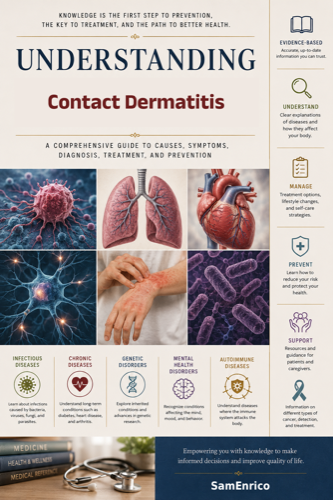
Understanding Contact Dermatitis eBook
This disease publication, published by SamEnrico,
by Guerin Ima
This disease publication, published by SamEnrico, covers Understanding Contact Dermatitis
Formats
Free sample
Chapter 1: The Rash That Knows Your Name...--–- Sarah’s hands had been red for three years. Not the kind of red that fades after a good night’s sleep or a weekend away from work. This was a deep, angry, blistering red that cracked when she made a fist, wept clear fluid onto her keyboard, and kept her awake at night with an itch that felt like fire ants marching beneath her skin. She had seen four doctors. The first told her it was eczema and prescribed a cream that burned on contact.
The second said it was “probably stress” and suggested yoga. The third, an allergist, performed skin prick tests for pollen and peanuts—both negative—and shrugged. The fourth, a dermatologist, glanced at her hands for eleven seconds and said, “Contact dermatitis. Avoid whatever you’re allergic to.” Then he walked out of the room.That was the moment Sarah realized something terrifying: no one was going to solve this for her. She had a diagnosis, yes.
But a diagnosis without a cause is like being told your house is on fire without being shown which room. Contact dermatitis. The words sat in her chart like a final answer, but they answered nothing. What was she touching? Her soap?
Her desk? Her wedding ring? Her own face when she slept? She began a desperate experiment: she threw away every product in her bathroom, bought expensive “hypoallergenic” lotions from the health food store, and started wearing gloves to wash her hair. Nothing worked.
Three years of her life had been stolen by something she couldn’t see, couldn’t name, and couldn’t escape.Sarah is not unusual. She is the rule.Every year, more than fifteen million Americans develop contact dermatitis—a number that rivals diabetes in prevalence but receives a fraction of the attention. And here is the cruelest irony: most of these cases are entirely preventable. The rash on your hands, the mysterious red patches on your face, the burning line around your neck where your necklace rests—these are not random acts of a capricious body. They are messages.
Your skin is speaking to you in the only language it has: inflammation, pain, and itch. And for the vast majority of patients, no one has taught you how to listen.This book is that translator.Your Skin Is Not Just Sensitive Before we go any further, let me say something that may contradict what you have heard from well-meaning friends, Internet forums, or even some doctors. Your skin is not “just sensitive.” That phrase—sensitive skin—has become a garbage can diagnosis, a catch-all for anything doctors cannot immediately explain. It is the medical equivalent of saying a car won’t start because it’s “finicky.” It describes the problem without offering the slightest clue about the solution.Here is the truth: in the vast majority of cases, what people call “sensitive skin” is actually contact dermatitis. And contact dermatitis is not a mystery.
It is a mechanical problem with a mechanical solution. Either something is irritating your skin through direct chemical damage (like acid, soap, or even water itself), or something is activating your immune system in a delayed allergic reaction (like nickel, fragrance, or preservatives). Once you know which one is happening to you, and once you identify the specific trigger, the rash can disappear entirely.Not improve. Not “manage.” Disappear.I have seen it happen hundreds of times. The nurse who scrubbed her hands fifty times a shift and developed bleeding cracks between her fingers—her rash cleared in four days after she switched to a different hand sanitizer and started using cotton glove liners.
The executive who developed a mysterious red rash on his face every Monday morning (but not on weekends)—it turned out to be the dry cleaning chemicals on his freshly pressed shirts. The teenager whose eyelids swelled shut—the cause was the fragrance in her boyfriend’s laundry detergent, transferred to her pillowcase during sleep. Each of these patients had been told, at some point, that they simply had “sensitive skin” or “chronic eczema.” Each of them had suffered for months or years before someone took the time to find the actual trigger.This book will teach you to be that person for yourself.One Disease, Two Completely Different Mechanisms Here is the most important distinction you will learn in this entire book. Write it down. Tape it to your bathroom mirror.
Contact dermatitis is not one thing. It is two completely different diseases that happen to look similar on the surface. Think of it like chest pain: chest pain can come from a pulled muscle, or it can come from a heart attack. Both hurt. Both are located in the chest.
But the treatment for one is rest and ice, while the treatment for the other is a trip to the emergency room. Confusing the two can be deadly.Contact dermatitis has an equivalent divide, though the stakes are usually lower (though not always—severe allergic reactions can hospitalize you). The two types are:Irritant Contact Dermatitis (ICD) – This is a non-immunological reaction. That means your immune system is not involved at all. Instead, a substance directly damages the outer layer of your skin.
Imagine pouring bleach on a carpet. The carpet doesn’t have an “allergy” to bleach. The bleach simply destroys the fibers through a chemical reaction. That is ICD. The most common causes are water (yes, plain water, when you expose your hands to it for hours a day), soaps, detergents, acids, alkalis, solvents, and even friction or pressure.Allergic Contact Dermatitis (ACD) – This is an immunological reaction.
Your immune system learns to recognize a specific chemical as an enemy, and every time you touch that chemical thereafter, your T-cells (a type of white blood cell) mount a delayed inflammatory response. This takes time—usually 24 to 96 hours after exposure. That delay is why patients are so often confused. You touched the nickel in your belt buckle on Monday. The rash appears on Wednesday.
You assume it was something you touched on Wednesday, so you never suspect the belt. This is the great trick of ACD: it hides its cause in the rearview mirror.Why does this distinction matter? Because the treatment is different. ICD heals when you stop the physical or chemical damage and repair your skin barrier. ACD heals only when you identify and avoid the specific allergen—and sometimes that allergen is hiding in places you would never think to look (more on that in Chapter 5).
Treating ACD like ICD (just moisturize more!) will fail. Treating ICD like ACD (get an expensive patch test that comes back negative!) will also fail. You need to know which one you have, or you are shooting in the dark.The Case of the Nurse and the Nickel Let me walk you through two real patient stories. As you read them, ask yourself: which type of contact dermatitis does each patient have?Patient One: Maria is a critical care nurse. She washes her hands between every patient interaction, which means forty to sixty hand washes per twelve-hour shift.
She also uses alcohol-based hand sanitizer at least twenty times per shift. After six months of this, she notices that…
This is the end of the free sample. Get the eBook to keep going. Buy now
About this book
Details
- Author
- Guerin Ima
- Publisher
- SamEnrico
- Language
- English
- Genre
- Non-Fiction, Informative, Educational
- Released
- 2026-05-09
- Pages (approx.)
- 158
- Available as
- eBook, Audiobook

Read better in the ZLOADR app
Your eBooks on your phone or tablet. Sign in with your SamEnrico account and start reading.
More by Guerin Ima
 Self Hypnosis Fibro FlareGuerin Ima$11.99
 Meth Recovery Sleep Restoration GuideGuerin Ima$11.99
 Async Planning and OKR GuideGuerin Ima$11.99
 Pregnancy Essential Oil GuideGuerin Ima$11.99
 Authorized Economic Operator GuideGuerin Ima$11.99
 The Eradication Enigma: How the Middle East Conquered SmallpoxGuerin Ima$11.99
 Silent Signals: The Secret War of Radio LibertyGuerin Ima$11.99
 Unit ClerkGuerin Ima$11.99
 TikTok Branded Content PolicyGuerin Ima$12.99
 Venture Debt Providers ListGuerin Ima$12.99
 How to Become a Irish-moss OperatorGuerin Ima$11.99
You may also like
 Hong Kong Handover 1997Dunn Johnnie$11.99
 Zumba For Postnatal Recovery CourseNeal Christian$11.99
 Zumba for BeginnersLadner Nikia$11.99
 YouTube Comment Mining GuideHumes Pandora$12.99
 Worry Box MeditationCarlin Rudy$11.99
 Workplace Stress MeditationNguyen Lynn$11.99
 Workplace Stress and Sleep RepairHawley Ivory$11.99
 Workplace Perfectionism CureDelaney Jeffry$11.99
 Workplace Injustice Anger GuideWallen Isabelle$11.99
 Work Addiction and Burnout LinkGreenwood Ester$11.99
 Women in Yoga and WellnessBeattie Galina$11.99
 Women in Stand Up ComedyChun Evangeline$11.99