
Non-FictionInformativeEducational
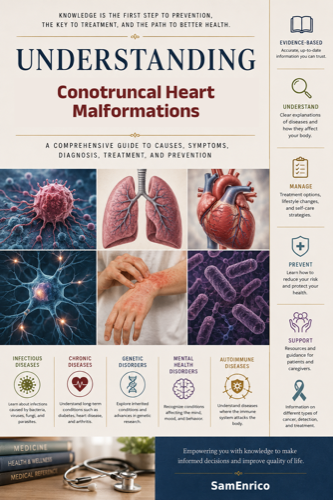
Understanding Conotruncal Heart Malformations
This disease publication, published by SamEnrico,
This disease publication, published by SamEnrico, covers Understanding Conotruncal Heart Malformations
Formats
About this book
Free sample
Chapter 1: The Spiral That Fails--–- The human heart begins not as a fist-sized pump, but as a simple tube. In the third week of gestation, that tube folds itself into a loop, and by the fourth week, a structure called the truncus arteriosus—a single vessel carrying blood away from the developing heart—must divide into two distinct highways: the aorta and the pulmonary artery. This division requires a spiral. That spiral, when executed perfectly, produces a lifetime of uninterrupted circulation. When it fails, the result is a family of birth defects known as conotruncal malformations—conditions that account for nearly one-third of all critical congenital heart disease and remain the leading cause of death from birth defects in the first year of life.This chapter establishes the foundational anatomy and embryology of the outflow tract.
It is not a dry recitation of terms, but a narrative about timing, migration, and geometry. By the end of this chapter, you will understand why neural crest cells are the unsung heroes of cardiac development, why the word "conus" matters, and how a failure of spiralization produces specific, predictable malformations. You will also gain a vocabulary that will serve you through every subsequent chapter of this book.The Blueprint: Defining the Outflow Tract Before we can understand what goes wrong, we must understand what goes right. The cardiac outflow tract is the region through which blood exits the ventricles en route to the lungs and the body. It consists of two embryologically distinct but contiguous structures: the conus (also called the conus cordis or infundibulum) and the truncus arteriosus.The conus is a muscular funnel.
It sits just above the ventricles and below the semilunar valves. In the normal heart, the conus gives rise to the subpulmonary infundibulum on the right side (the muscular cone that supports the pulmonary valve) and a much shorter subaortic conus on the left side. This asymmetry is crucial. The right ventricular outflow tract is long and muscular; the left ventricular outflow tract is short and fibrous. This difference allows the aorta and pulmonary artery to cross…
This is the end of the free sample. Get the eBook to keep going. Buy now
Contents
- Chapter 1
- Chapter 2
- Chapter 3
- Chapter 4
- Chapter 5
- Chapter 6
- Chapter 7
- Chapter 8
- Chapter 9
- Chapter 10
- Chapter 11
- Chapter 12
Details
- Author
- Musser Marietta
- Publisher
- SamEnrico
- Language
- English
- Genre
- Non-Fiction, Informative, Educational
- Released
- 2026-05-09
- Pages (approx.)
- 160
- Available as
- eBook, Audiobook

Read better in the ZLOADR app
Your eBooks on your phone or tablet. Sign in with your SamEnrico account and start reading.
More by Musser Marietta
 Dubai Academic Integrity GuideMusser Marietta$12.99
 Meth Addiction Exit Strategy GuideMusser Marietta$11.99
 Ginger Oil Digestion GuideMusser Marietta$11.99
 Senator Treaty Ratification GuideMusser Marietta$11.99
 Trade Facilitation Agreement GuideMusser Marietta$11.99
 Prostate Cancer Focal Therapy GuideMusser Marietta$11.99
 The Silent Whistle: How Larry Nassar’s Crimes Shattered GymnasticsMusser Marietta$11.99
 The Lost Lakes of the Roof of the World: Prehistoric Explorers of Central Asia's Hidden HighlandsMusser Marietta$11.99
 Travel CNAMusser Marietta$11.99Dubai Academic Integrity GuideMusser Marietta$12.99
 Meta Gambling Ads PolicyMusser Marietta$12.99
 How to Become a Iron-launder OperatorMusser Marietta$11.99
You may also like
 Hong Kong Handover 1997Dunn Johnnie$11.99
 Zumba For Postnatal Recovery CourseNeal Christian$11.99
 Zumba for BeginnersLadner Nikia$11.99
 YouTube Comment Mining GuideHumes Pandora$12.99
 Worry Box MeditationCarlin Rudy$11.99
 Workplace Stress MeditationNguyen Lynn$11.99
 Workplace Stress and Sleep RepairHawley Ivory$11.99
 Workplace Perfectionism CureDelaney Jeffry$11.99
 Workplace Injustice Anger GuideWallen Isabelle$11.99
 Work Addiction and Burnout LinkGreenwood Ester$11.99
 Women in Yoga and WellnessBeattie Galina$11.99
 Women in Stand Up ComedyChun Evangeline$11.99