
Non-FictionInformativeEducational
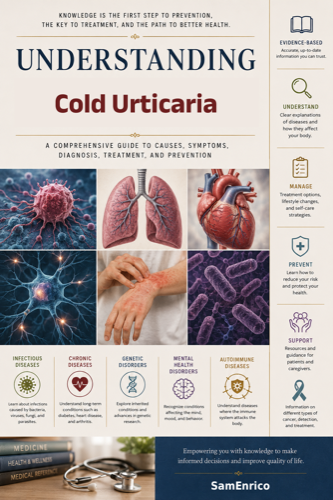
Understanding Cold Urticaria eBook
This disease publication, published by SamEnrico,
by Yoon Treasa
This disease publication, published by SamEnrico, covers Understanding Cold Urticaria
Formats
Free sample
Chapter 1: The Hidden Chill–– It began not with a shiver, but with a rash.For thirty-two-year-old Maria, a schoolteacher in coastal Virginia, the first sign came after a routine morning walk on an unseasonably cool October day. The temperature had dropped to fifty-two degrees—nothing extraordinary, nothing she would have called "cold." Yet within fifteen minutes of returning to her warm kitchen, her forearms erupted in fiery, itchy welts that seemed to appear from nowhere. She assumed it was a food allergy, perhaps the granola bar she had eaten. Her doctor agreed, prescribed antihistamines, and sent her on her way. It took three more episodes—including one terrifying incident after reaching into a grocery store freezer—before an allergist finally performed the ice cube test.
The result was unmistakable. Maria had Cold Urticaria.Across the Atlantic, in a small village in northern France, six-year-old Luc developed a different pattern. Every time he played outside on a windy winter day, he would not only break out in hives but also develop a fever, intense fatigue, and painful swelling in his fingers and knees. His mother, who had similar symptoms as a child, already suspected the diagnosis. Genetic testing confirmed it: Familial Cold Autoinflammatory Syndrome, a rare inherited form of cold sensitivity that runs through generations like a whispered family secret.Two people.
Two different conditions. Both triggered by the same seemingly benign element—cold.Welcome to the world of Cold Urticaria, a condition that transforms the most ordinary of environmental experiences into a potential medical event. This chapter is your foundation, the bedrock upon which everything else in this book will build. Whether you are a newly diagnosed patient, a concerned family member, or a medical professional seeking deeper understanding, the next few pages will give you the essential framework for everything that follows: what Cold Urticaria actually is, how it differs from normal cold responses and from other similar conditions, who gets it and why, and—perhaps most importantly—what it is not.The Normal Cold Response: What Your Body Is Supposed to Do Before we can understand what goes wrong in Cold Urticaria, we must first understand what goes right in a healthy person. The human body’s response to cold is a marvel of evolutionary engineering, a finely tuned survival mechanism designed to protect our core organs from hypothermia.When a person without Cold Urticaria steps into a cold environment, several predictable and entirely normal events unfold.
First, the blood vessels near the skin surface constrict—a process called vasoconstriction. This is the body’s way of shunting warm blood away from the extremities and toward the vital internal organs: the heart, lungs, brain, and liver. You experience this as pale skin, cold fingers and toes, and perhaps a bluish tint to your lips or nail beds. This is not a sign of illness; it is a sign of a functioning autonomic nervous system.Second, the body initiates thermogenesis—the production of heat. Shivering is the most obvious form, as muscles contract rapidly to generate warmth through friction and metabolic activity.
But even before shivering begins, the body increases its basal metabolic rate, burning more calories to maintain a core temperature of approximately 98.6 degrees Fahrenheit (37 degrees Celsius).Third, the endocrine system releases hormones that help the body adapt. Norepinephrine and epinephrine (adrenaline) increase heart rate and blood pressure, ensuring that oxygenated blood continues to reach critical tissues. Thyroid hormone production may gradually increase in prolonged cold exposure, raising the metabolic set point.These responses are unconscious, automatic, and—for most people—entirely unremarkable. You may notice that your nose runs in cold weather (a phenomenon called cold-induced rhinorrhea, caused by increased blood flow to the nasal passages to warm incoming air) or that your fingers become clumsy (reduced blood flow to the small muscles of the hand). But you do not break out in hives.
You do not develop swelling in your throat. And you certainly do not risk losing consciousness.Cold Urticaria changes all of that.Defining Cold Urticaria: More Than a Sensitivity Cold Urticaria belongs to a family of conditions known as physical urticarias—hives that are triggered by physical stimuli rather than by allergens like pollen, peanuts, or pet dander. Other members of this family include dermatographism (hives triggered by scratching or firm stroking of the skin), cholinergic urticaria (hives triggered by heat, exercise, or emotional stress), and pressure urticaria (hives triggered by sustained pressure on the skin, such as from a tight waistband or a heavy backpack).What makes Cold Urticaria distinct is its trigger: exposure to cold temperatures, cold liquids, cold objects, or even cold air. The term "urticaria" comes from the Latin word urtica, meaning nettle—a reference to the stinging, burning sensation that characterizes the rash. In medical terms, urticaria refers to the raised, often pale or red, intensely itchy wheals that appear on the skin.
These wheals are caused by localized leakage of fluid from small blood vessels into the surrounding tissue, a process driven by the release of inflammatory chemicals from mast cells.But here is where precision matters greatly. In everyday conversation, people often use the words "allergy" and "sensitivity" interchangeably. In medicine, they have distinct meanings. Cold Urticaria is not technically a "cold allergy" in the same way that peanut allergy is a true food allergy. In a classic food allergy, the immune system produces specific Ig E antibodies against a protein in the food.
Upon re-exposure, those Ig E antibodies trigger mast cells to release histamine and other mediators. In Cold Urticaria, the trigger is physical, not chemical—but the final common pathway (mast cell activation) is similar. This is why allergists often manage Cold Urticaria, even though it is not a traditional allergy.The condition exists on a spectrum. At the mild end, patients may only develop a few hives on exposed skin after spending time in cold air. At the severe end, whole-body immersion in cold water (even a swimming pool in summer) can trigger a catastrophic release of inflammatory mediators, leading to a sharp drop in blood pressure, difficulty breathing, and loss of consciousness—in other words, anaphylaxis.Acquired Versus Familial: Two Distinct Entities One of the most important distinctions in understanding Cold Urticaria is the difference between the acquired form and the familial form.
They share a trigger—cold—but they differ in nearly every other respect: genetics, symptoms, age of onset, and underlying biology.Acquired Cold Urticaria (ACU) is by far the more common of the two, accounting for the vast majority of cases. As the name suggests, it is not inherited; it develops spontaneously, typically in young adults between the ages of 18 and 25, though cases have been reported in children and older adults as well. The word "idiopathic" is often attached to acquired Cold Urticaria, meaning that doctors do not know exactly what causes it. In some cases, it appears following a viral or bacterial infection, suggesting that the immune system may be "reprogrammed" by an illness. In other cases, it appears after a tick bite (a condition sometimes called "cold urticaria after tick bite" or "alpha-gal syndrome-related cold urticaria," though this is rare).
Most often, however, it appears without any identifiable trigger—hence, idiopathic.The symptoms of acquired Cold Urticaria are typically limited to the…
This is the end of the free sample. Get the eBook to keep going. Buy now
About this book
Details
- Author
- Yoon Treasa
- Publisher
- SamEnrico
- Language
- English
- Genre
- Non-Fiction, Informative, Educational
- Released
- 2026-06-03
- Pages (approx.)
- 160
- Available as
- eBook, Audiobook

Read better in the ZLOADR app
Your eBooks on your phone or tablet. Sign in with your SamEnrico account and start reading.
More by Yoon Treasa
 The Meeting Warm Up GuideYoon Treasa$11.99
 The Amputation Pain GuideYoon Treasa$11.99
 Pinterest VA Discovery Call ScriptsYoon Treasa$11.99
 Exercise During Breast CancerYoon Treasa$11.99
 Conversation Starters for Cultural EventsYoon Treasa$11.99
 Echoes of the Cosmic Symphony: The Voyager Golden Record's Interstellar MessageYoon Treasa$11.99
 The Polio Wars: Salk vs. Sabin and the Race to Eradicate a KillerYoon Treasa$11.99
 Singapore Early Stage Fund GuideYoon Treasa$12.99
 Crisis Response Block GuideYoon Treasa$12.99
 Collection AssistantYoon Treasa$11.99
 How to Start a Show Case Business (Beginners Guide)Yoon Treasa$11.99
You may also like
 Hong Kong Handover 1997Dunn Johnnie$11.99
 Zumba For Postnatal Recovery CourseNeal Christian$11.99
 Zumba for BeginnersLadner Nikia$11.99
 YouTube Comment Mining GuideHumes Pandora$12.99
 Worry Box MeditationCarlin Rudy$11.99
 Workplace Stress MeditationNguyen Lynn$11.99
 Workplace Stress and Sleep RepairHawley Ivory$11.99
 Workplace Perfectionism CureDelaney Jeffry$11.99
 Workplace Injustice Anger GuideWallen Isabelle$11.99
 Work Addiction and Burnout LinkGreenwood Ester$11.99
 Women in Yoga and WellnessBeattie Galina$11.99
 Women in Stand Up ComedyChun Evangeline$11.99