
Non-FictionInformativeEducational
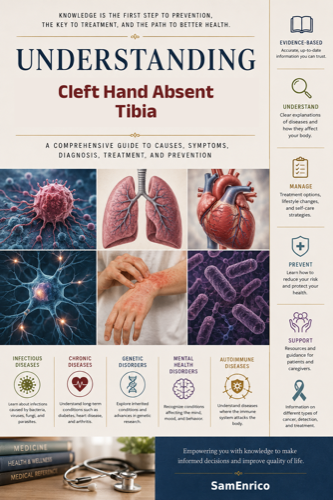
Understanding Cleft Hand Absent Tibia eBook
This disease publication, published by SamEnrico,
This disease publication, published by SamEnrico, covers Understanding Cleft Hand Absent Tibia
Formats
Free sample
Chapter 1: The Ultrasound Room...--The room was too dark. That was the first thing she noticed—the dimmed lights, the gel cold against her stretched belly, the way the technician’s cheerful small talk had evaporated into a thick, humming silence. Maria held her breath, something she had been doing a lot lately at thirty-two weeks pregnant, but this time the stillness was not from the weight of the baby pressing on her diaphragm. It was from fear.She had been here before, twice actually. Two previous pregnancies, two healthy children, two routine anatomy scans where the technician pointed out femurs and heart chambers and tiny curled fists.
“Everything looks beautiful,” they had said both times. This time, no one was saying anything beautiful.The technician—a young woman with kind eyes and a name badge that read “Denise”—frowned at the screen, clicked a few measurements, then frowned again. She turned the monitor slightly away from Maria, a gesture so practiced it must have been part of some unspoken protocol. “I just need to get some more images,” Denise said, her voice too bright, too brittle. “The doctor will review everything and come speak with you.”Maria did not need a medical degree to understand what was happening.
She had been a nurse for fourteen years, most of them in the neonatal intensive care unit. She had watched parents receive devastating news in rooms just like this one. She had been the one holding the clipboard, offering tissues, saying words that tried to bridge the chasm between medical reality and human hope. Now she was on the other side of that chasm, and the view was unrecognizable.“What did you see?” Maria asked, her voice steadier than she felt.Denise hesitated. “I really can’t say.
The doctor—”“I’ve been a NICU nurse for over a decade,” Maria said. “I’m not asking for a diagnosis. I’m asking what you saw.”A long pause. Then Denise turned the monitor back, just slightly. “The tibia—the shin bone—on the left leg.
It’s measuring… significantly shorter than expected. And the hand. The left hand. There’s a central cleft that’s quite pronounced.”Maria’s world narrowed to those two sentences. A missing bone.
A split hand. Her mind, trained to catalogue congenital anomalies, began racing through differential diagnoses. Amniotic band sequence? Femoral-facial syndrome? Or the one that had appeared in her textbooks only as a footnote, so rare that most doctors would never see it in a lifetime of practice.She did not say the name aloud.
Not yet.The Weight of a Single Word The doctor who finally came to speak with Maria was a maternal-fetal medicine specialist named Dr. Hartley. He was older, gray-haired, with the kind of measured calm that suggested he had delivered bad news more times than he could count. He pulled up a stool, sat at eye level with Maria, and placed a hand over hers.“We’ve identified several skeletal anomalies,” he began. “The left lower leg shows what appears to be tibial hypoplasia—the bone is present but severely shortened.
The left hand has a central cleft, which means the middle digits did not form normally. There may also be involvement of the right foot, though it’s less clear at this gestational age.”Maria nodded. She appreciated his precision, his refusal to use alarming language unnecessarily. But she also knew what he was not saying.“Is it syndromic?” she asked. “Or isolated?”Dr.
Hartley exhaled slowly. “It’s too early to say definitively. The combination of upper and lower limb involvement—that raises concern for a broader condition. I’d like to refer you to a genetic counselor and schedule a fetal MRI for more detailed imaging.”“What condition?” Maria pressed. “What are you ruling in and ruling out?”Another pause.
Then: “One possibility is a condition called SHFLD. Split-hand/foot malformation with long bone deficiency. It’s rare—about one in a million births. The spectrum is wide. Some children have very mild involvement.
Others have more significant limb differences.”SHFLD. Now the name had been spoken aloud, and it hung in the air between them like a verdict.The Long Drive Home Maria does not remember driving home that day. She remembers pulling into her driveway, the engine idling, her hands still gripping the steering wheel at ten and two. Her husband, David, was at work. Her two older children were at school.
The house was quiet, and in that quiet, she finally allowed herself to cry.Not for the baby—she was clear about that, even in her grief. She was crying for the future she had imagined. The soccer games. The ballet recitals. The handprints in clay, the little fingers wrapped around hers, the first steps that every parent photographs and replays a thousand times.
All of those scenes now had question marks attached to them.She pulled out her phone—a mistake, as it turned out—and typed three words into the search bar: “Cleft hand absent tibia.”The results were a wasteland. Black-and-white medical diagrams. Case reports from the 1980s describing “lobster claw deformities,” a term that made her stomach turn. A Wikipedia entry that was three paragraphs long. A single photograph of a child with a hand that looked nothing like what she had seen on the ultrasound screen.There were no beautiful Instagram feeds.
No “warrior mom” blogs. No success stories of adults with SHFLD who were doctors or lawyers or artists or parents themselves. Just medical journals, locked behind paywalls, and the hollow echo of the words “one in a million.”She closed her phone and sat in the silence, and for the first time in her life, Maria felt completely, utterly alone.A Diagnosis by Any Other Name When David came home that evening, Maria told him everything. He listened without interrupting, his face a careful mask, and when she finished, he said only: “What do we do next?”This is the difference between Maria and David, and she has always loved him for it. She lives in the emotional reality of a moment; he lives in the logistics.
Together, they make a functional whole.The next morning, she called the genetic counselor.Genetic counseling, Maria would later learn, is not what most people expect. It is not a therapy session, though it often feels like one. It is not a diagnostic test, though it frequently leads to one. It is, at its core, a translation service—taking the arcane language of chromosomes and loci and penetrance and turning it into something a frightened parent can understand.Her genetic counselor was a woman named Elena, whose warmth was matched only by her encyclopedic knowledge of rare skeletal dysplasias. Elena did not flinch when Maria said “SHFLD.” She did not rush to reassure or minimize.
Instead, she pulled out a whiteboard and began to draw.“Let me explain what we know about this condition,” Elena said. “And also what we don’t know.”She drew two hands—one with a central V-shaped cleft, one with all five digits present. “SHFLD is part of a family of conditions called split-hand/foot malformations. The key…
This is the end of the free sample. Get the eBook to keep going. Buy now
About this book
Details
- Author
- Mosier Rolanda
- Publisher
- SamEnrico
- Language
- English
- Genre
- Non-Fiction, Informative, Educational
- Released
- 2026-05-11
- Pages (approx.)
- 142
- Available as
- eBook, Audiobook

Read better in the ZLOADR app
Your eBooks on your phone or tablet. Sign in with your SamEnrico account and start reading.
More by Mosier Rolanda
 Burnout Parenting After RecoveryMosier Rolanda$11.99
 The Funnel ROAS GuideMosier Rolanda$11.99
 Mayor of Sanctuary CityMosier Rolanda$11.99
 Sandy Lyle Scottish Pioneer MemoirMosier Rolanda$11.99
 Credit Card Breach Customer LettersMosier Rolanda$11.99
 Tuskegee Thunder: The Untold Stories of the 99th Pursuit SquadronMosier Rolanda$11.99
 Echoes of the Iron Curtain: The Twin Lives of the Stasi's Double AgentMosier Rolanda$11.99
 Digital Product Idea VaultMosier Rolanda$12.99
 Business Plan Pitch PracticeMosier Rolanda$12.99
 Order Desk ClerkMosier Rolanda$11.99
 How to Start a Hobby in MachiningMosier Rolanda$11.99
You may also like
 Hong Kong Handover 1997Dunn Johnnie$11.99
 Zumba For Postnatal Recovery CourseNeal Christian$11.99
 Zumba for BeginnersLadner Nikia$11.99
 YouTube Comment Mining GuideHumes Pandora$12.99
 Worry Box MeditationCarlin Rudy$11.99
 Workplace Stress MeditationNguyen Lynn$11.99
 Workplace Stress and Sleep RepairHawley Ivory$11.99
 Workplace Perfectionism CureDelaney Jeffry$11.99
 Workplace Injustice Anger GuideWallen Isabelle$11.99
 Work Addiction and Burnout LinkGreenwood Ester$11.99
 Women in Yoga and WellnessBeattie Galina$11.99
 Women in Stand Up ComedyChun Evangeline$11.99