
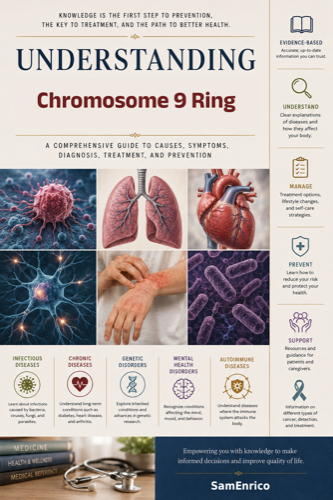
Non-FictionInformativeEducational
Understanding Chromosome 9 Ring eBook
This disease publication, published by SamEnrico,
This disease publication, published by SamEnrico, covers Understanding Chromosome 9 Ring
Formats
Free sample
Chapter 1: The Silent Library...--There is a library inside nearly every cell of your body. Unlike the libraries you know—with hushed reading rooms, stern librarians, and dust motes floating in shafts of afternoon light—this library has no building, no doors, and no hours of operation. It is made of molecules so small that three billion of them would fit inside the period at the end of this sentence. And yet, within that infinitesimal space, it holds the complete instructions for building you: your height, the curl of your hair, the speed of your heartbeat, the shape of your memories, and the precise way you wrinkle your nose when you are confused.This library is your genome. Its books are your chromosomes.
And its sentences are your genes.For most people, these books are arranged in forty-six neat, linear volumes—twenty-three inherited from each biological parent. The pages are intact. The sentences are in order. The story reads smoothly from beginning to end. But for a small number of individuals around the world—perhaps one in every half million to one million births—one of those books is not a straight line at all.
It is a circle. A ring.This is the story of that ring. Specifically, it is the story of a ring formed from one of the most important books in the library: Chromosome 9.The Architecture of Inheritance Before we can understand what it means when a chromosome becomes a ring, we need to understand what a chromosome is when it is behaving normally. This is not a detour into dry science. This is the foundation upon which everything else in this book will rest.Every human cell that contains a nucleus—which is to say, every cell except mature red blood cells—carries within it a complete copy of your genetic blueprint.
That blueprint is written in a molecule called deoxyribonucleic acid, or DNA. DNA is often described as a double helix, which is a scientifically accurate way of saying it looks like a twisted ladder. The rungs of that ladder are made of pairs of chemical bases: adenine (A) always pairing with thymine (T), and cytosine (C) always pairing with guanine (G). These base pairs are the alphabet of life.But an alphabet alone is not a language. Strings of base pairs are organized into functional units called genes.
A gene is a specific sequence of DNA that contains the instructions for making a particular protein—or, in some cases, a functional RNA molecule. Proteins are the workhorses of your body. They build your tissues. They catalyze your metabolic reactions. They fight your infections.
They transmit signals between your nerve cells. If your body were a city, proteins would be the construction workers, the electricians, the mail carriers, the police officers, and the sanitation crew all rolled into one.Genes, then, are the blueprints for those workers. And chromosomes are the binders that hold those blueprints in an organized fashion.Humans have twenty-three pairs of chromosomes, for a total of forty-six. Twenty-two of these pairs are called autosomes, and they are numbered roughly by size: Chromosome 1 is the largest, Chromosome 22 is the smallest. The twenty-third pair determines biological sex: XX for females, XY for males.Each chromosome is a single, continuous molecule of DNA wrapped around proteins called histones, which help package the DNA into a compact, manageable shape.
When a cell is preparing to divide, the chromosomes condense further, becoming visible under a microscope as dark-staining, X-shaped structures. This is the form in which most people have seen chromosomes—those familiar banded images from biology textbooks.Chromosome 9, the subject of this book, is a medium-sized autosome. It contains approximately 138 million base pairs of DNA, representing about 4.5 percent of the total human genome. It is home to between 800 and 1,200 genes, depending on how you count. Among its notable residents are the gene for the ABO blood group system (which determines whether you are type A, B, AB, or O), the gene for the tumor suppressor protein TSC1 (mutations in which cause tuberous sclerosis), and the gene for the enzyme that converts the amino acid tyrosine into melanin (relevant to skin and hair color).Chromosome 9 is not the largest chromosome.
It is not the smallest. It does not carry the most genes or the fewest. But it is gene-rich, meaning that deleting even a small piece of it can have widespread consequences throughout the body. This is the first clue to understanding why a ring formed from Chromosome 9—rather than from, say, Chromosome 22—often produces a more severe clinical picture.The Normal vs. The Abnormal For the vast majority of people, chromosomes remain linear from the moment of conception until the end of life.
They have two ends, just like a piece of string. Those ends are protected by specialized structures called telomeres, which function like the plastic aglets on shoelaces. They prevent the chromosome from fraying, and they keep it from sticking to other chromosomes.A ring chromosome is precisely what it sounds like: a chromosome whose two ends have fused together to form a circle. Instead of having two distinct ends, it has no ends at all. It is a loop.This transformation does not happen without cost.
For two ends to fuse, those ends must first be damaged. Typically, this means both the short arm of the chromosome (called the p arm, from the French petit meaning small) and the long arm (the q arm, chosen simply because it comes after p in the alphabet) break. The broken ends are then repaired by the cell's DNA damage response machinery, but instead of attaching to the correct corresponding ends, they attach to each other. The result is a ring.Crucially, those breaks are not clean. When the p arm and q arm break, small pieces of genetic material are lost from both ends.
These are called terminal deletions. The ring that forms is therefore missing whatever genes were located on those deleted segments. The size of the deletions varies from one individual to another. Some people lose only a few thousand base pairs from each arm. Others lose millions.
This variation is one of the primary reasons that Chromosome 9 Ring can look so different from one person to the next.The Mosaic Reality If the story ended here—with a ring in every cell of the body—it would already be complex enough. But there is another layer of complexity that is perhaps even more important for understanding why this condition is so variable.Most individuals with Chromosome 9 Ring do not have the ring in every single cell. Instead, they have a mixture of cells: some with the ring, some with normal, linear chromosomes, and sometimes even cells with multiple rings, or rings that have broken and reformed in abnormal ways. This mixture is called mosaicism.Mosaicism arises because the ring chromosome is unstable. When a cell with a ring chromosome divides, the ring can twist, break, or fail to replicate properly.
The two daughter cells may inherit completely different genetic material. One daughter cell might get a normal ring. Another might get a broken ring that is now missing even more genetic…
This is the end of the free sample. Get the eBook to keep going. Buy now
About this book
Details
- Author
- Escalante Jaleesa
- Publisher
- SamEnrico
- Language
- English
- Genre
- Non-Fiction, Informative, Educational
- Released
- 2026-05-07
- Pages (approx.)
- 151
- Available as
- eBook, Audiobook

Read better in the ZLOADR app
Your eBooks on your phone or tablet. Sign in with your SamEnrico account and start reading.
More by Escalante Jaleesa
 Burnout Energy Restoration GuideEscalante Jaleesa$11.99
 Work Addiction Self Compassion GuideEscalante Jaleesa$11.99
 IBS Low FODMAP Diet PrimerEscalante Jaleesa$11.99
 Memory Lapses Anger TriggerEscalante Jaleesa$11.99
 Middle Funnel Nurturing GuideEscalante Jaleesa$11.99
 The Silk Road of the Seas: Medieval Indian Ocean Surgery and the Lost Art of Al-Zahrawi's LegacyEscalante Jaleesa$11.99
 How to Start a Consultant Engineer (civil or Structural) Business (Beginners Guide)Escalante Jaleesa$11.99
 Public Company Spin Out TargetsEscalante Jaleesa$12.99
 Baserow Airtable AlternativeEscalante Jaleesa$12.99
 Vintage ClothingEscalante Jaleesa$11.99
You may also like
 Hong Kong Handover 1997Dunn Johnnie$11.99
 Zumba For Postnatal Recovery CourseNeal Christian$11.99
 Zumba for BeginnersLadner Nikia$11.99
 YouTube Comment Mining GuideHumes Pandora$12.99
 Worry Box MeditationCarlin Rudy$11.99
 Workplace Stress MeditationNguyen Lynn$11.99
 Workplace Stress and Sleep RepairHawley Ivory$11.99
 Workplace Perfectionism CureDelaney Jeffry$11.99
 Workplace Injustice Anger GuideWallen Isabelle$11.99
 Work Addiction and Burnout LinkGreenwood Ester$11.99
 Women in Yoga and WellnessBeattie Galina$11.99
 Women in Stand Up ComedyChun Evangeline$11.99