
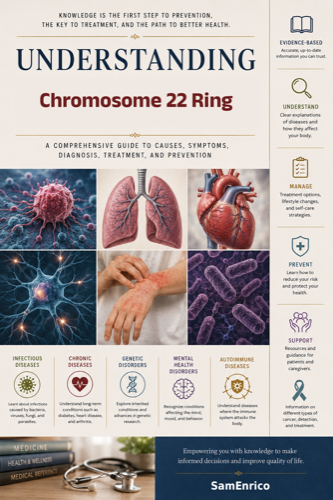
Non-FictionInformativeEducational
Understanding Chromosome 22 Ring eBook
This disease publication, published by SamEnrico,
by Workman Neta
This disease publication, published by SamEnrico, covers Understanding Chromosome 22 Ring
Formats
Free sample
Chapter 1: The Blueprint Within--– For most of human history, the answer to a child’s unexplained challenges was silence. A child who could not walk, who spoke late, who grew differently, or who suffered from seizures was simply labeled “delayed,” “difficult,” or sometimes cruelly, “unreachable.” Families carried that silence alone, without explanation, without a name for what they were watching unfold. Then, in the mid-20th century, a revolution began. Scientists learned to see inside the human cell, to stain its contents, and finally, to count the tiny thread-like structures that carry everything that makes us who we are. Those structures are chromosomes.
And on one of them—Chromosome 22—a rare and extraordinary event can occur that changes everything.This chapter is not about disease. It is about inheritance, about the elegant machinery of life, and about how a single break in that machinery can rewrite a person’s development. Before we can understand what a ring chromosome is, before we can discuss tumors, therapies, or IEP meetings, we must first understand the blueprint. We must understand how DNA folds into genes, how genes organize into chromosomes, and why Chromosome 22—of all forty-six—is uniquely vulnerable to the kind of disruption that creates a ring.The Architecture of Life: From DNA to You Every human body begins as a single cell. That one cell contains a complete set of instructions for building every tissue, every organ, every neuron, and every heartbeat.
Those instructions are written in a molecule called deoxyribonucleic acid—DNA. If you stretched the DNA from a single cell end to end, it would measure about two meters long. Yet it folds itself with astonishing precision into a space one hundred thousand times smaller than the head of a pin.DNA is shaped like a twisted ladder, a double helix. The rungs of that ladder are made of paired chemicals: adenine (A) with thymine (T), and cytosine (C) with guanine (G). The order of those letters—the sequence—is the code.
A stretch of code that contains the instructions for making a specific protein is called a gene. Proteins are the workhorses of the cell. They build structures, send signals, break down waste, and turn other genes on or off. When a gene is altered—when one letter is changed, deleted, or moved—the protein may be missing, malformed, or produced in the wrong amount. That is the beginning of a genetic condition.But genes are not floating freely inside the cell.
They are packaged. During cell division, the long strands of DNA wrap around proteins called histones, coil into loops, and condense further into structures visible under a microscope: chromosomes. Human cells typically contain twenty-three pairs of chromosomes, forty-six in total. Twenty-two of these pairs are called autosomes, numbered roughly by size from 1 to 22. The twenty-third pair determines sex: XX for females, XY for males.Each parent contributes one copy of each chromosome.
That means for every gene on chromosome 1, you have two copies: one from your mother, one from your father. Most of the time, both copies work. But for some genes, having only one functional copy—a condition called haploinsufficiency—is enough to cause problems. You will encounter this concept again when we discuss the SHANK3 gene and the 22q13 deletion.Seeing the Invisible: How We Study Chromosomes To understand what goes wrong, we must first see what right looks like. Chromosomes become visible under a light microscope only when a cell is dividing.
At that moment, each chromosome replicates itself, producing two identical copies called sister chromatids that are joined at a central point called the centromere. Stained with special dyes, chromosomes reveal alternating light and dark bands—like a barcode. These bands are not decorative; they correspond to regions of different DNA density and activity.The short arm of a chromosome is labeled p (from the French petit, small). The long arm is labeled q (simply the next letter in the alphabet). Each arm is divided into regions numbered from the centromere outward.
So when you see a notation like 22q13.3, you are reading a precise address: chromosome 22, long arm, region 1, band 3, sub-band 3. That is where the SHANK3 gene resides. That address will become extremely important in later chapters.Cytogeneticists—scientists who study chromosomes—use a standardized system to describe what they see. A normal female karyotype is written as 46,XX. A normal male is 46,XY.
Any deviation from that is noted. A deletion is written as del. A ring chromosome is written as *r*. So a patient with a ring chromosome 22 would have a karyotype notation that includes 46,XX,r(22) or 46,XY,r(22), often with additional details about the size of the deletion and the percentage of cells that contain the ring. That last detail—the percentage—points to mosaicism, a concept we will explore in depth in Chapter 2.Chromosome 22: The Smallest Giant Chromosome 22 is one of the smallest human chromosomes.
It contains approximately 48 million base pairs—that is, 48 million rungs on the DNA ladder. For comparison, chromosome 1 contains about 249 million base pairs. But size is deceptive. Chromosome 22 was the first human chromosome to be fully sequenced, completed in 1999 as part of the Human Genome Project. What researchers found surprised them: despite its small size, chromosome 22 is extraordinarily gene-rich.
It contains roughly 500 to 800 protein-coding genes, plus hundreds of non-coding RNA genes that regulate when and where those proteins are made.Why is this important? Because the density of genes means that any disruption to chromosome 22—whether a deletion, a duplication, or a ring formation—is likely to affect multiple systems simultaneously. A missing piece on chromosome 22 rarely causes a single, isolated symptom. Instead, it creates a cascade. A child may have low muscle tone and speech delay and characteristic facial features and a predisposition to certain tumors.
That combination is not coincidental; it is the direct consequence of losing multiple genes that work together during development.Chromosome 22 is also a hotspot for genomic disorders. These are conditions caused by small deletions or duplications of DNA segments, often mediated by the chromosome’s unusual structure. The long arm of chromosome 22 contains many low-copy repeats—nearly identical stretches of DNA that can misalign during cell division, leading to rearrangements. This instability is the same mechanism that produces the well-known 22q11.2 deletion syndrome (Di George syndrome), the most common microdeletion syndrome in humans. And it is the same instability, pushed further, that can create a ring chromosome.The Critical Region: 22q13.3 and the SHANK3 Gene If you remember only one genetic address from this book, remember 22q13.3.
That is the terminal region of the long arm of chromosome 22, the very tip. And it is almost always deleted in ring chromosome 22. The reason is mechanical: to form a ring, the chromosome must break at two points, one on the short arm and one on the long arm. The broken ends then fuse. The material beyond the breakpoints—the tips—is lost.
In most cases of ring chromosome 22, the break on the long arm occurs somewhere near the q13.3 region, deleting everything from that breakpoint to the end of the arm.The most critical gene in that deleted region is SHANK3. Its full name is SH3 and…
This is the end of the free sample. Get the eBook to keep going. Buy now
About this book
Details
- Author
- Workman Neta
- Publisher
- SamEnrico
- Language
- English
- Genre
- Non-Fiction, Informative, Educational
- Released
- 2026-05-09
- Pages (approx.)
- 159
- Available as
- eBook, Audiobook

Read better in the ZLOADR app
Your eBooks on your phone or tablet. Sign in with your SamEnrico account and start reading.
More by Workman Neta
 Canadian Immigration Targets 2025Workman Neta$11.99
 Bodyweight Triceps HandbookWorkman Neta$11.99
 Group Creativity Brainstorming GuideWorkman Neta$11.99
 The Crib to Bed TransitionWorkman Neta$11.99
 Innocence Project New Mexico CasesWorkman Neta$11.99
 The Forgotten Archaeologist: Zahi Hawass and the Rediscovery of Egypt's Lost TreasuresWorkman Neta$11.99
 Runes of the Forgotten: The Lost Prophecies of the SeeressWorkman Neta$11.99
 How to Become a Transformer TesterWorkman Neta$11.99
 Reddit Community Validation MethodWorkman Neta$12.99
 Bookkeeping Software SetupWorkman Neta$12.99
 HACCP CoordinatorWorkman Neta$11.99
You may also like
 Hong Kong Handover 1997Dunn Johnnie$11.99
 Zumba For Postnatal Recovery CourseNeal Christian$11.99
 Zumba for BeginnersLadner Nikia$11.99
 YouTube Comment Mining GuideHumes Pandora$12.99
 Worry Box MeditationCarlin Rudy$11.99
 Workplace Stress MeditationNguyen Lynn$11.99
 Workplace Stress and Sleep RepairHawley Ivory$11.99
 Workplace Perfectionism CureDelaney Jeffry$11.99
 Workplace Injustice Anger GuideWallen Isabelle$11.99
 Work Addiction and Burnout LinkGreenwood Ester$11.99
 Women in Yoga and WellnessBeattie Galina$11.99
 Women in Stand Up ComedyChun Evangeline$11.99