
Non-FictionInformativeEducational
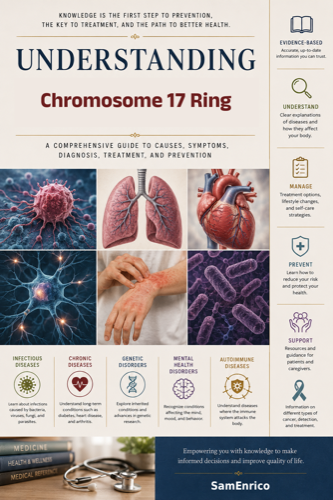
Understanding Chromosome 17 Ring
This disease publication, published by SamEnrico,
This disease publication, published by SamEnrico, covers Understanding Chromosome 17 Ring
Formats
About this book
Free sample
Chapter 1: The Accidental Circle...–- In the summer of 1971, a cytogeneticist in Paris named Dr. Jérôme Lejeune stared through a Zeiss microscope at something he had never seen before. The chromosomes before him—those threadlike structures that carry the entirety of human heredity—were supposed to look like twisted X’s, straight lines, or tiny dots. But on the slide, from a child with unexplained growth failure and profound intellectual disability, one chromosome had formed a perfect circle. Lejeune, who had already discovered the chromosomal basis of Down syndrome a decade earlier, knew immediately that he was looking at something unprecedented.
He called it a "ring chromosome," and his 1971 report in La Presse Médicale opened a door to a new category of human genetic disease.The Discovery That Changed Everything Before that summer, the scientific world understood chromosomal abnormalities in relatively simple terms. Either you had an extra chromosome (trisomy, as in Down syndrome), a missing chromosome (monosomy, as in Turner syndrome), or a piece of a chromosome that had broken off and reattached elsewhere (translocation). These were structural problems—like missing a page from a book or inserting a page from another book entirely. But a ring chromosome was different. It was as if the book's page had been torn, then taped into a circle, and then that circle had been shoved back into the binding.
The page was still there, but its orientation, its accessibility, and its behavior during copying had changed entirely.Lejeune's discovery came at a fortuitous moment in scientific history. The early 1970s were the golden age of cytogenetics. New banding techniques—developed by Swedish researchers Caspersson and Zech using fluorescent dyes—had just made it possible to distinguish each of the 46 human chromosomes individually. Before banding, a cytogeneticist could count chromosomes and detect gross abnormalities but could not tell chromosome 17 from chromosome 18. After banding, each chromosome revealed a unique pattern of light and dark stripes, like a barcode.
When Lejeune applied these new techniques to patients with unexplained syndromes, the ring chromosomes began to emerge from the shadows.The first rings were…
This is the end of the free sample. Get the eBook to keep going. Buy now
Contents
- Chapter 1
- Chapter 2
- Chapter 3
- Chapter 4
- Chapter 5
- Chapter 6
- Chapter 7
- Chapter 8
- Chapter 9
- Chapter 10
- Chapter 11
- Chapter 12
Details
- Author
- Thorne Shiloh
- Publisher
- SamEnrico
- Language
- English
- Genre
- Non-Fiction, Informative, Educational
- Released
- 2026-05-08
- Pages (approx.)
- 154
- Available as
- eBook, Audiobook

Read better in the ZLOADR app
Your eBooks on your phone or tablet. Sign in with your SamEnrico account and start reading.
More by Thorne Shiloh
 The Gentle Sleep Training MethodThorne Shiloh$11.99
 Chinese Green Incentives ManualThorne Shiloh$11.99
 TM Research Paper GuideThorne Shiloh$11.99
 Men's Takotsubo Heart Break GuideThorne Shiloh$11.99
 Stress Management for High Pressure JobsThorne Shiloh$11.99
 The 1977 Wow! Signal: Humanity's First Alien WhisperThorne Shiloh$11.99
 The Rise and Fall of the Biltmore: Vanderbilt’s Grand IllusionThorne Shiloh$11.99
 How to Become a Camouflage AssemblerThorne Shiloh$11.99
 Proof of Funds for GraduatesThorne Shiloh$12.99
 PDP For Career ChangersThorne Shiloh$12.99
You may also like
 Hong Kong Handover 1997Dunn Johnnie$11.99
 Zumba For Postnatal Recovery CourseNeal Christian$11.99
 Zumba for BeginnersLadner Nikia$11.99
 YouTube Comment Mining GuideHumes Pandora$12.99
 Worry Box MeditationCarlin Rudy$11.99
 Workplace Stress MeditationNguyen Lynn$11.99
 Workplace Stress and Sleep RepairHawley Ivory$11.99
 Workplace Perfectionism CureDelaney Jeffry$11.99
 Workplace Injustice Anger GuideWallen Isabelle$11.99
 Work Addiction and Burnout LinkGreenwood Ester$11.99
 Women in Yoga and WellnessBeattie Galina$11.99
 Women in Stand Up ComedyChun Evangeline$11.99