
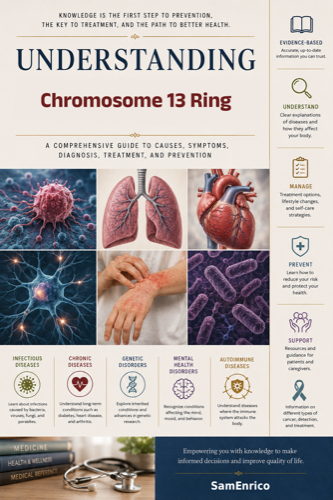
Non-FictionInformativeEducational
Understanding Chromosome 13 Ring eBook
This disease publication, published by SamEnrico,
This disease publication, published by SamEnrico, covers Understanding Chromosome 13 Ring
Formats
Free sample
Chapter 1: The Broken Circle...--The first time Jennifer saw the word "ring" in her daughter's medical chart, she thought of jewelry. She thought of her own wedding band, a simple gold circle that had sat on her finger for twelve years — unbroken, continuous, a symbol of something whole. The geneticist's office was beige and windowless, the kind of room designed to absorb shock rather than amplify it. On the screen, a karyotype image looked like black velvet sprinkled with purple confetti. Twenty-three pairs of chromosomes, each one a twisted ladder of three billion rungs.
And there, on the thirteenth pair, something was wrong.One of the two chromosomes had curled in on itself. It looked like a circle. A ring."I'm sorry," the geneticist said, "but your daughter has a ring chromosome 13."Jennifer didn't know it yet, but she had just joined a very small club. There are approximately 8 billion people on Earth. Of those, only a few thousand have a ring chromosome of any kind.
And only a fraction of those — perhaps one in every 50,000 to 100,000 live births — have a ring on chromosome 13 specifically. This is the territory of rare. This is the landscape of the unknown.But here is what Jennifer would learn over the next five years, through sleepless nights, through sixteen specialist appointments, through two eye exams under anesthesia, through the first time her daughter used a tablet to say "mama": a ring chromosome is not a curse. It is not a punishment. It is not a mistake.It is a broken circle that keeps trying to close.
And so, too, do the families who receive this diagnosis.This chapter is for every parent who has ever Googled "ring chromosome 13" at 2:00 a.m. and found nothing but impenetrable medical journals and outdated case reports. This chapter is for the clinicians who want to understand what their patients' families actually need. And this chapter is for anyone who has ever received news that shattered their expectations — and then had to rebuild, piece by piece, into something new.We begin at the very beginning. Not with the science first, but with the story.
Because before you can understand what a ring chromosome is, you need to understand what it feels like to hear those words. And then — only then — we will walk together into the genetics.The Moment Everything Changes The diagnosis of a rare genetic syndrome rarely arrives in a vacuum. It comes after something else: a concerning ultrasound finding, a baby who isn't meeting milestones, a seizure, a funny-looking toe, a mother's intuition that something isn't quite right. For some families, the diagnosis comes prenatally, during a routine anatomy scan that reveals intrauterine growth restriction or a structural anomaly like a cleft palate or a heart defect. For others, it comes in the newborn nursery, when a pediatrician notices low muscle tone or dysmorphic features.
And for still others — the most difficult path — it comes after months or years of searching, of specialists who shrug, of online forums where no one has quite the same constellation of symptoms.Regardless of how it arrives, the diagnosis of a ring chromosome 13 shares certain common features across families. There is the moment of naming: the geneticist says the words, and they hang in the air like smoke. There is the moment of Googling: the parent returns home, types "ring chromosome 13" into a search engine, and finds either nothing or terrifying case reports of children with profound disabilities. There is the moment of isolation: the realization that no one in their immediate circle has ever heard of this condition. And then — for those who persist — there is the moment of connection: the first time they find another family, a registry, a Facebook group, a whispered "me too."If you are reading this book, you are likely somewhere on that journey.
Perhaps you are in the first moment. Perhaps you are in the last. Wherever you are, know this: you are not alone. And the science, while complex, is ultimately understandable. Let us begin with what a chromosome even is.The Blueprint: Chromosomes, Genes, and DNABefore we can understand what a ring chromosome is, we need to understand what a normal chromosome looks like and what it does.
Imagine that every cell in your body — and there are approximately 37 trillion of them — contains a complete set of instruction manuals. These manuals tell each cell how to grow, divide, function, and eventually die. Without these instructions, a cell would be like a cook without a recipe: capable of chopping and stirring but unable to produce a specific dish.The instruction manuals are called chromosomes. Humans typically have 46 chromosomes, arranged in 23 pairs. You receive one copy of each pair from your biological mother (in the egg) and one copy from your biological father (in the sperm).
Twenty-two of these pairs are called autosomes, and they are numbered from 1 to 22 roughly in order of size (chromosome 1 is the largest; chromosome 22 is one of the smallest). The 23rd pair determines biological sex: XX for females, XY for males.Chromosome 13 is an autosome. It is an acrocentric chromosome, which means that its two arms are very uneven in length. The short arm is called "p" (from the French petit, meaning small), and the long arm is called "q" (the next letter in the alphabet). When you see a karyotype report that says "46,XX,r(13)(p13q34)," you are looking at a code: 46 chromosomes (the normal number), XX (female), r(13) (a ring on chromosome 13), and (p13q34) (the breakpoints occurred at position 13 on the short arm and position 34 on the long arm).
We will decode this fully in Chapter 2, but for now, understand that the numbers and letters are precise addresses on the chromosome — like saying "the corner of 5th Street and Main Avenue."Each chromosome contains a long, continuous strand of DNA. DNA (deoxyribonucleic acid) is a double helix — two strands twisted around each other like a spiral staircase. The steps of the staircase are made of four chemical bases: adenine (A), thymine (T), cytosine (C), and guanine (G). These bases pair specifically (A with T, C with G) to form the rungs. The sequence of these bases — ATCG, GCTA, and so on — spells out the genetic code.Genes are specific segments of DNA that contain the instructions for making proteins.
Proteins are the workhorses of the cell: they build structures, speed up chemical reactions, send signals, fight infections, and perform countless other tasks. Humans have approximately 20,000 to 25,000 genes, but they make up only about 1-2% of our total DNA. The rest was once called "junk DNA," but we now know that much of it regulates when and where genes are turned on or off — a kind of genetic dimmer switch.Chromosome 13 is estimated to contain between 300 and 400 genes. That might not sound like many, but consider this: a single gene can have profound effects. The RB1 gene on chromosome 13, for example, is a tumor suppressor — it normally prevents cells from growing uncontrollably.
When it is missing or broken, a child has a significantly increased risk of developing retinoblastoma, a rare eye cancer. The BRCA2 gene, also on chromosome 13, repairs damaged DNA; mutations in BRCA2…
This is the end of the free sample. Get the eBook to keep going. Buy now
About this book
Details
- Author
- Puckett Yoshie
- Publisher
- SamEnrico
- Language
- English
- Genre
- Non-Fiction, Informative, Educational
- Released
- 2026-05-09
- Pages (approx.)
- 159
- Available as
- eBook, Audiobook

Read better in the ZLOADR app
Your eBooks on your phone or tablet. Sign in with your SamEnrico account and start reading.
More by Puckett Yoshie
 Virtual Pitch Meeting GuidePuckett Yoshie$11.99
 Retirement Housing Lease Options CoursePuckett Yoshie$11.99
 Outsourcing to Latin AmericaPuckett Yoshie$11.99
 Men's Potassium Heart Rhythm GuidePuckett Yoshie$11.99
 Bite Mark Evidence Debunked CasesPuckett Yoshie$11.99
 The Deep Blue Enigma: Solving the Bermuda Triangle’s Greatest MysteryPuckett Yoshie$11.99
 The Cult of the Crystal Skulls: Secrets of the 1930s Nazi ObsessionPuckett Yoshie$11.99
 Tea Sommelier (hotel)Puckett Yoshie$11.99
 Vendor Data Security GuidePuckett Yoshie$12.99
 Coworking Space RetentionPuckett Yoshie$12.99
 How to Become a Calender-machine OperatorPuckett Yoshie$11.99
You may also like
 Hong Kong Handover 1997Dunn Johnnie$11.99
 Zumba For Postnatal Recovery CourseNeal Christian$11.99
 Zumba for BeginnersLadner Nikia$11.99
 YouTube Comment Mining GuideHumes Pandora$12.99
 Worry Box MeditationCarlin Rudy$11.99
 Workplace Stress MeditationNguyen Lynn$11.99
 Workplace Stress and Sleep RepairHawley Ivory$11.99
 Workplace Perfectionism CureDelaney Jeffry$11.99
 Workplace Injustice Anger GuideWallen Isabelle$11.99
 Work Addiction and Burnout LinkGreenwood Ester$11.99
 Women in Yoga and WellnessBeattie Galina$11.99
 Women in Stand Up ComedyChun Evangeline$11.99