
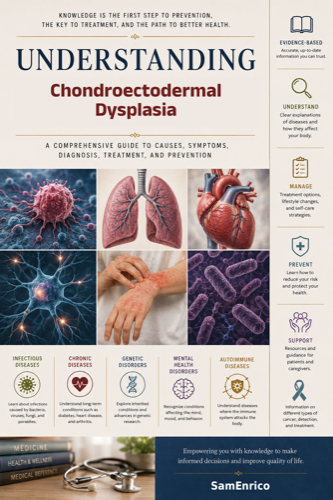
Non-FictionInformativeEducational
Understanding Chondroectodermal Dysplasia eBook
This disease publication, published by SamEnrico,
This disease publication, published by SamEnrico, covers Understanding Chondroectodermal Dysplasia
Formats
Free sample
Chapter 1: The Four Pillars...–- When Sarah first held her newborn son, she noticed two things immediately: his tiny hands had an extra finger on each side, and his breathing was faster than she expected. The nurses exchanged quiet glances. No one said the words “rare disease” that day, but Sarah knew, in that primal way parents know, that her family’s path had just forked into unfamiliar territory.This chapter opens by introducing you to Chondroectodermal Dysplasia (CED)—a name that sounds intimidating but breaks down into understandable parts: chondro (cartilage), ectodermal (skin, hair, nails, teeth), and dysplasia (abnormal growth). You may also hear it called Ellis–van Creveld (EVC) syndrome, named after the two physicians who first described it in 1940. The purpose of this chapter is to give you a complete, honest, and hopeful overview of what CED is, what causes it, what the main features look like, and—most importantly—why a diagnosis does not define your child’s future.A Syndrome, Not a Sentence Let us begin with a truth that will echo through every page of this book: intelligence is almost always completely normal in CED.
Your child will think, learn, dream, argue, love, and laugh just like any other child. The challenges of CED are physical, not cognitive. This single fact transforms everything that follows. While doctors will focus on hearts and bones and teeth, you can focus on piano lessons, soccer practice (adapted, yes, but absolutely possible), and college applications.CED is a rare genetic disorder that affects approximately 1 in 60,000 to 1 in 200,000 live births worldwide. The wide range exists because the condition is significantly more common in certain populations due to what geneticists call a “founder effect.” Specifically, among the Old Order Amish community in Lancaster County, Pennsylvania, the incidence rises to approximately 1 in 5,000 live births.
This is not because the Amish are more susceptible to genetic mutations, but because a small number of founders carrying the gene variant settled in that community centuries ago, and subsequent generations married within the community, concentrating the trait.For the vast majority of families, however, CED appears without any family history—a surprise genetic event that no one could have predicted or prevented. There is no blame here. There is only the next step.The Four Pillars: Understanding the Core Features Every case of CED is unique, like a fingerprint. Your child may have all of the following features, or only some, and the severity will vary widely. To make sense of this complexity, physicians and researchers have organized the syndrome into what we call the Four Pillars of CED.
Think of these as four categories of possible symptoms, each requiring its own medical specialist and management plan.Pillar One: Skeletal Abnormalities The most visible feature of CED involves the bones, particularly the arms, legs, and chest. Children with CED have disproportionate short stature—their arms and legs are shortened, while the trunk (the spine and rib cage) remains closer to average length. This is different from conditions like achondroplasia (the most common form of dwarfism), where the shortening affects the upper arms and thighs more dramatically.Specifically, the bones of the forearms (radius and ulna) and lower legs (tibia and fibula) are most affected. You may notice that your child’s fingers appear short and wide (a finding called brachydactyly), and the wrists may have limited range of motion.The ribs are also shortened, which creates a narrow, bell-shaped chest. This is not simply a cosmetic concern.
A narrow chest can restrict lung growth and make breathing more work for infants and young children. In the most severe cases, respiratory distress in the first year of life becomes a critical medical issue—one that requires close monitoring and, occasionally, supplemental oxygen or surgical intervention. However, for the majority of children, the chest expands naturally as they grow, and breathing difficulties improve dramatically after infancy.Another skeletal hallmark is genu valgum, or knock-knees. By early childhood (typically ages 3 to 5), you may notice that your child’s knees angle inward, causing the ankles to sit far apart when the knees are touching. Mild knock-knees can be managed with bracing and physical therapy.
More severe cases may eventually require surgery—an osteotomy, where the bone is cut and realigned—usually performed after age 5 or 6 once the growth plates have matured.Pillar Two: Limb Anomalies (The Hands and Feet)The second pillar involves the hands and feet. The classic finding is postaxial polydactyly—extra fingers on the ulnar (pinky) side of both hands. The extra digit may be a small, fleshy nubbin attached by a thin stalk, or it may be a fully formed finger with its own bones, nails, and joints. Similarly, extra toes may appear on the feet, though foot polydactyly is less consistently present.Why does this happen? During normal embryonic development, the limb bud forms in a specific sequence, with the thumb (radial) side developing first and the pinky (ulnar) side developing last.
In CED, the genetic signals that normally tell the limb to stop growing after five digits fail to turn off, resulting in one or more extra digits.Parents often ask: “Should we remove the extra fingers?” The answer depends on the structure of the extra digit. A small, soft nubbin can be removed easily in the first year of life, often in a simple outpatient procedure. A fully formed, functional extra finger is a more complex decision. Some families choose surgery for cosmetic reasons or to improve hand function (e.g., to allow a better grip on a pencil or bicycle handlebar). Others choose to leave the extra digit in place if it does not interfere with daily activities.
The decision is deeply personal, and you should never feel pressured either way. In Chapter 9, we will walk through the surgical decision-making process in detail, including the typical timing (consultation by 6 months, surgery at 12-18 months if chosen).Pillar Three: Ectodermal Changes (Hair, Nails, Teeth)The term “ectodermal” refers to the ectoderm—the outermost layer of the developing embryo, which gives rise to the skin, hair, nails, teeth, and certain glands. In CED, ectodermal tissues are often underdeveloped or abnormally formed.Nails: The fingernails and toenails may be small (hypoplastic), ridged, split, or even completely absent. Some children have nails that separate from the nail bed (onycholysis), which can trap debris and lead to infections. These nail changes do not cause pain, but they can be frustrating for parents trying to keep little fingers clean.
Practical strategies include keeping nails short, using emollients on the cuticles, and avoiding trauma (e.g., no picking at hangnails).Teeth: This is often the most emotionally challenging ectodermal feature for families. Children with CED may have natal teeth (teeth present at birth), hypodontia (missing permanent teeth), peg-shaped or conical teeth, and enamel that is thin, pitted, or entirely absent. The enamel defects, in particular, set the stage for rampant cavities (early childhood caries) because the protective outer layer of the tooth is compromised. We will devote all of Chapter 7 to dental management, but the key message here is: see a pediatric dentist by your child’s first birthday, or earlier if natal teeth are present. Loose natal teeth can…
This is the end of the free sample. Get the eBook to keep going. Buy now
About this book
Details
- Author
- Starr Laurene
- Publisher
- SamEnrico
- Language
- English
- Genre
- Non-Fiction, Informative, Educational
- Released
- 2026-06-03
- Pages (approx.)
- 159
- Available as
- eBook, Audiobook

Read better in the ZLOADR app
Your eBooks on your phone or tablet. Sign in with your SamEnrico account and start reading.
More by Starr Laurene
 Retirement Relocation Tax Comparison BriefStarr Laurene$11.99
 Difficult Funding Pitch TalksStarr Laurene$11.99
 Etsy Digital Planner Mobile OptimizationStarr Laurene$11.99
 Remote Retreats Emergency ProtocolsStarr Laurene$11.99
 Zoster Vaccine Elderly SaviorStarr Laurene$11.99
 The Last Telegram: How a 1941 Message Changed the Course of World War IIStarr Laurene$11.99
 The Last Stand of the Iron Queen: A Tale of Fire and BloodStarr Laurene$11.99
 Ultimate Handbook Guide to Pizhou : (China) Travel GuideStarr Laurene$11.99
 Budget Cut Decision FrameworkStarr Laurene$12.99
 Advisor Confidentiality GuideStarr Laurene$12.99
 Nickel MiningStarr Laurene$11.99
You may also like
 Hong Kong Handover 1997Dunn Johnnie$11.99
 Zumba For Postnatal Recovery CourseNeal Christian$11.99
 Zumba for BeginnersLadner Nikia$11.99
 YouTube Comment Mining GuideHumes Pandora$12.99
 Worry Box MeditationCarlin Rudy$11.99
 Workplace Stress MeditationNguyen Lynn$11.99
 Workplace Stress and Sleep RepairHawley Ivory$11.99
 Workplace Perfectionism CureDelaney Jeffry$11.99
 Workplace Injustice Anger GuideWallen Isabelle$11.99
 Work Addiction and Burnout LinkGreenwood Ester$11.99
 Women in Yoga and WellnessBeattie Galina$11.99
 Women in Stand Up ComedyChun Evangeline$11.99