
Non-FictionInformativeEducational
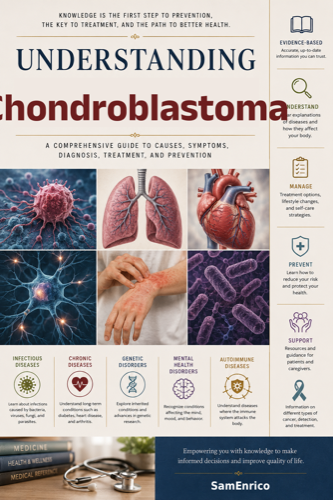
Understanding Chondroblastoma eBook
This disease publication, published by SamEnrico,
This disease publication, published by SamEnrico, covers Understanding Chondroblastoma
Formats
Free sample
Chapter 1: The Architecture Within...--–- Every human skeleton is a miracle of engineering, but like any great structure, it has hidden vulnerabilities. Imagine, for a moment, a medieval cathedral. Its soaring stone walls—the cortical bone—bear the weight of the entire building. Inside, a lattice of flying buttresses and columns—the trabecular bone—provides flexible support. Where the stones meet, a smooth, pearly layer of cartilage lines the joints, allowing the great doors to swing open and closed without friction for decades.
This is the architecture of you. And like any cathedral, your skeleton is not a static monument. It is a living, breathing, growing structure, constantly being torn down and rebuilt. Now, imagine a tiny flaw appearing in one of the keystones of that cathedral—a single cell, a chondroblast, that refuses to follow the blueprints. That is where our story begins.This book is a guide to understanding that flaw: a rare tumor called chondroblastoma.
If you are reading this, you or someone you love has likely been touched by this diagnosis. You have probably heard words like "benign," "tumor," "rare," and "surgery," and you are searching for clarity amidst the noise. This chapter is not about the tumor itself—not yet. Before we can understand the invader, we must understand the land it invades. To truly grasp what chondroblastoma is and why it behaves the way it does, you must first understand the breathtakingly complex world of your own bones and cartilage.The Living Scaffold: More Than Just Sticks and Stones Most people think of bones as dry, dead, white sticks—like the skeleton hanging in a biology classroom.
Nothing could be further from the truth. Your bones are among the most dynamic, metabolically active organs in your body. They are a reservoir for calcium, a factory for blood cells, and a carefully tuned mechanical structure. Every day, specialized cells called osteoclasts chew up old bone, and other cells called osteoblasts lay down new bone in its place. In a healthy young person, your entire skeleton is replaced approximately every ten years.Bone comes in two primary architectural forms.
First, there is cortical bone (also called compact bone). This is the dense, hard outer shell that you can feel when you touch your shin or your skull. It is about 90% calcified and provides the main structural strength. Second, there is trabecular bone (also called cancellous or spongy bone). This is the honeycomb-like meshwork found inside the ends of your long bones and inside your vertebrae.
It is lighter and more flexible than cortical bone, acting like a shock absorber. If cortical bone is the steel girder, trabecular bone is the crumple zone of a car.But the skeleton cannot function with bone alone. Wherever two bones meet—at your knee, your shoulder, your hip—there must be a smooth, low-friction surface to allow movement. That surface is hyaline cartilage. Unlike bone, cartilage is avascular, meaning it has no blood vessels running through it.
It receives its nutrition by diffusion, like a sponge soaking up water from its surroundings. This is a critical detail. Because cartilage has no direct blood supply, it heals very poorly when injured. A scratch on your skin heals in days; a scratch on your articular cartilage may never heal. And as we will see, tumors that arise in cartilage also have unique behaviors because of this avascularity.The Birth of a Bone: Endochondral Ossification To understand chondroblastoma, you must understand how a long bone—like your femur (thigh bone) or humerus (upper arm bone)—is built.
You are not born with a full-sized skeleton. If you were, your mother would never have been able to deliver you. Instead, you are born with a skeleton made mostly of cartilage, soft and flexible. Over the first two decades of your life, that cartilage is systematically replaced by bone in a process called endochondral ossification. Let me walk you through this process, because it is the exact biological stage where chondroblastoma arises.At the end of every long bone in a growing child is a cartilaginous structure called the growth plate, or physis.
This is a thin disc of cartilage located between the main shaft of the bone (the diaphysis) and the rounded end (the epiphysis). The growth plate is the engine of longitudinal bone growth. It is organized into distinct zones, like an assembly line, and every cell in that assembly line is a chondroblast or its descendant.In the outermost zone (the reserve zone), resting chondroblasts wait like seeds in the soil. When growth hormone signals them, they move into the next zone (the proliferative zone), where they begin dividing rapidly, stacking themselves into columns like coins. These are now proliferating chondroblasts.
As they are pushed toward the middle of the bone, they enter the hypertrophic zone. Here, they swell dramatically—up to ten times their original size—and begin secreting a specialized extracellular matrix rich in collagen type II and proteoglycans. This matrix is what gives cartilage its tough, rubbery consistency.Finally, in the zone of provisional calcification, the hypertrophic chondroblasts die a programmed death (apoptosis). Their calcified cartilage matrix remains, and this acts as a scaffold. Blood vessels invade from the bone shaft, bringing osteoblasts that lay down new bone on top of the dead cartilage scaffold.
The chondroblast—the innocent, hardworking cell—dies so that bone can live.This is a beautifully efficient, tightly regulated system. But it has a vulnerable step: the proliferating chondroblast. If that cell receives the wrong signal—if its DNA mutates in just the wrong way—it may refuse to die. It may keep dividing. It may keep secreting cartilage matrix.
And instead of making way for bone, it forms a tumor. That tumor is chondroblastoma.The Epiphyseal Neighborhood: Why Location Matters Now you understand the process. Let me now give you the key that unlocks everything else in this book: Chondroblastoma almost always occurs in the epiphysis—the rounded end of a long bone—in a skeletally immature individual whose growth plates are still open.Think of the epiphysis as a quiet residential neighborhood. The chondroblasts there are not the frantic, dividing cells of the proliferative zone. They are the resting cells of the reserve zone.
They are not supposed to be dividing. But when a mutation occurs in one of these resting chondroblasts, it can transform into a tumor cell that begins dividing when it should be resting. And because it is located in the epiphysis, which is right next to the joint, the tumor soon begins to encroach on the smooth articular cartilage and the joint space itself. This explains the cardinal symptom of chondroblastoma: joint pain.The specific bones that chondroblastoma targets are not random. They are the bones that do the most growing and bear the most weight.
The three most common locations are the proximal humerus (the upper arm bone, at the shoulder), the distal femur (the thigh bone, just above the knee), and the proximal tibia (the shin bone, just below the knee). Together, these three locations account for about 75% of all cases. Less common locations include the proximal femur (the hip), the calcaneus (heel bone)…
This is the end of the free sample. Get the eBook to keep going. Buy now
About this book
Details
- Author
- Peltier Mireya
- Publisher
- SamEnrico
- Language
- English
- Genre
- Non-Fiction, Informative, Educational
- Released
- 2026-05-11
- Pages (approx.)
- 157
- Available as
- eBook, Audiobook

Read better in the ZLOADR app
Your eBooks on your phone or tablet. Sign in with your SamEnrico account and start reading.
More by Peltier Mireya
 Rotavirus Vaccine Diarrhea DefeatPeltier Mireya$11.99
 Math Formula Recall GuidePeltier Mireya$11.99
 Age Restricted Rental Market CoursePeltier Mireya$11.99
 Internal Comms Measurement GuidePeltier Mireya$12.99
 Remote Retreats Planning GuidePeltier Mireya$11.99
 Digital Planner Etsy Sales Funnel CoursePeltier Mireya$11.99
 The Unseen Hand: Jackie Kennedy’s Secret White House ResurrectionPeltier Mireya$11.99
 Neon Mirage: The AI That Dreamed in CodePeltier Mireya$11.99
 Manager Fish and Fish HabitatPeltier Mireya$11.99
 Postpartum Mental Health BoardPeltier Mireya$12.99Internal Comms Measurement GuidePeltier Mireya$12.99
 Ultimate Handbook Guide to Port Elizabeth : (South Africa) Travel GuidePeltier Mireya$11.99
You may also like
 Hong Kong Handover 1997Dunn Johnnie$11.99
 Zumba For Postnatal Recovery CourseNeal Christian$11.99
 Zumba for BeginnersLadner Nikia$11.99
 YouTube Comment Mining GuideHumes Pandora$12.99
 Worry Box MeditationCarlin Rudy$11.99
 Workplace Stress MeditationNguyen Lynn$11.99
 Workplace Stress and Sleep RepairHawley Ivory$11.99
 Workplace Perfectionism CureDelaney Jeffry$11.99
 Workplace Injustice Anger GuideWallen Isabelle$11.99
 Work Addiction and Burnout LinkGreenwood Ester$11.99
 Women in Yoga and WellnessBeattie Galina$11.99
 Women in Stand Up ComedyChun Evangeline$11.99