
Non-FictionInformativeEducational
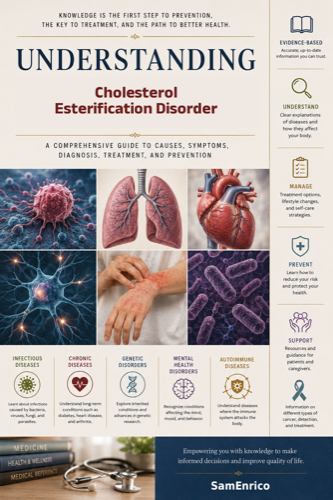
Understanding Cholesterol Esterification Disorder eBook
This disease publication, published by SamEnrico,
This disease publication, published by SamEnrico, covers Understanding Cholesterol Esterification Disorder
Formats
Free sample
Chapter 1: The Recycling Center...--For most people, the word "cholesterol" conjures a single image: danger. It is the villain in heart disease commercials, the red flag on blood work, the reason to skip the second slice of bacon. We have been taught to fear it, to lower it, to scrub it from our bodies like a stubborn stain. But what if the problem was never really cholesterol itself? What if the real issue was not the fat inside your blood, but the broken machine inside your cells—the one designed to break that fat down?This is the central, often-misunderstood truth of Lysosomal Acid Lipase Deficiency, a condition historically and inaccurately labeled "cholesterol esterification disorder." Before we go any further, let us clear up a piece of medical history that has caused decades of confusion.
The old name, "cholesterol esterification disorder," is biologically backward. Esterification is the process of building cholesterol esters. This disorder, however, is about the inability to break them down. The correct, modern name is Lysosomal Acid Lipase (LAL) Deficiency, and it is also known as Cholesteryl Ester Storage Disease (CESD) for its later-onset forms. Throughout this book, we will use these accurate terms, but we mention the old name because you may still encounter it in older medical records or online forums.
Consider this chapter the key that unlocks that confusion.To understand LAL Deficiency, you must first forget almost everything you think you know about "bad cholesterol." You must instead look much, much closer—inside a single cell of your own body. There, hidden within a tiny membrane-bound sac called the lysosome, the answer waits.The Cell's Garbage Disposal Imagine, for a moment, that every cell in your body is a bustling, twenty-four-hour-a-day factory. This factory produces energy, builds proteins, sends signals, and repairs damage. But like any factory, it also produces waste. Used-up parts, damaged molecules, and excess materials must be sorted, broken down, and recycled.
If the factory let this garbage pile up, production would grind to a halt, machines would break, and eventually the entire facility would shut down.Your cells solved this problem billions of years ago. They created the lysosome. Think of the lysosome as the factory's dedicated recycling center. It is a small, spherical compartment filled with powerful digestive enzymes, each one a specialized worker designed to break down a specific type of biological trash. One enzyme shreds proteins.
Another chops up carbohydrates. And one enzyme, the star of our story, is called Lysosomal Acid Lipase, or LAL for short.LAL's job is singular and essential: it breaks down cholesteryl esters and triglycerides. These are not waste products in the usual sense. They are packages of fat that the cell has stored for later use, like boxes of emergency fuel. Under normal, healthy conditions, the cell sends these fat packages to the lysosome, the LAL enzyme goes to work, and the components are released back into the cell to be used for energy, building cell membranes, or producing hormones.
The recycling center hums along, unnoticed and efficient.Now, what happens when the recycling center is missing its most important worker?The Traffic Jam Inside You LAL Deficiency is exactly that: a condition where your body does not produce enough working LAL enzyme. Without this enzyme, the cholesteryl esters and triglycerides arrive at the lysosome but cannot be broken down. They pile up. They accumulate. They form crystals and clumps inside the recycling center, causing it to swell and eventually burst.
The cell becomes clogged, inflamed, and unable to function.This is not a problem of having too much cholesterol in your bloodstream, though that will certainly happen as a secondary effect. This is a cellular storage problem. Imagine a city where the garbage trucks keep running, but the landfill is permanently closed. The trucks (your bloodstream) would become overwhelmed and backed up, but the real disaster is happening at the dump itself (your cells). That is LAL Deficiency.
The high cholesterol doctors see on your blood test is merely a symptom, a downstream effect of the cellular traffic jam.This distinction is the single most important concept in this entire book. If you remember nothing else, remember this: you do not primarily have a cholesterol problem. You have a cellular recycling problem that causes a cholesterol problem.The Two Faces of One Disease Because the amount of working LAL enzyme a person has can vary dramatically depending on their specific genetic mutation, the disease presents in two very different ways. Think of it as a dimmer switch rather than an on-off light. Some people have nearly zero enzyme function.
Others have a small but measurable amount, perhaps 5% or 10% of normal. This difference determines everything.Wolman Disease is the severe, infantile form of LAL Deficiency. In these babies, the LIPA gene produces virtually no functional LAL enzyme. The recycling centers in every organ—but especially the liver, spleen, and adrenal glands—begin filling with fat almost immediately after birth. Within weeks, the abdomen becomes distended.
Vomiting and diarrhea make feeding impossible. The liver and spleen enlarge dramatically. Without treatment, the disease progresses rapidly, and historically, infants with Wolman disease rarely lived past six months. It is a cruel, swift condition, and for decades it was considered an automatic death sentence.But Wolman disease is also where the most remarkable medical progress has been made, as we will explore in Chapter 5. Today, with early diagnosis and enzyme replacement therapy, some of these children are surviving into childhood and beyond, rewriting what we thought we knew about this disease.Cholesteryl Ester Storage Disease (CESD) is the later-onset, milder form.
Patients with CESD usually have a small amount of residual LAL enzyme activity, often due to a specific genetic mutation called the c.894G>A splice site variant. This tiny amount of working enzyme changes everything. Instead of a catastrophic failure in infancy, the cellular recycling center works, but it works slowly. It is like a garbage truck that keeps breaking down, making only three runs a week instead of seven.The fat still accumulates, but over years and decades rather than weeks and months. A child with CESD might have a "fatty liver" that doctors attribute to diet or obesity.
A teenager might have inexplicably high cholesterol that does not respond to statins. An adult in their thirties might be diagnosed with cirrhosis or suffer a heart attack with no obvious risk factors. The insidious nature of CESD is its silence. It hides in plain sight, disguised as common conditions: non-alcoholic fatty liver disease (NAFLD), familial hypercholesterolemia, or simply "bad genes."One family can even have both faces of the disease. Parents who are carriers (with one broken copy of the LIPA gene) have no symptoms at all.
But if both parents pass on their broken copy, each child has a one-in-four chance of inheriting the disease. Depending on which specific mutations combine, one sibling might be born with Wolman disease while another has CESD, and a third might be completely unaffected. This genetic lottery is cruel, random, and entirely beyond anyone's control.The Organs Under Siege Because LAL is active throughout the body, the accumulation of cholesteryl esters affects multiple organ systems.…
This is the end of the free sample. Get the eBook to keep going. Buy now
About this book
Details
- Author
- Gaston Rebbecca
- Publisher
- SamEnrico
- Language
- English
- Genre
- Non-Fiction, Informative, Educational
- Released
- 2026-06-02
- Pages (approx.)
- 153
- Available as
- eBook, Audiobook

Read better in the ZLOADR app
Your eBooks on your phone or tablet. Sign in with your SamEnrico account and start reading.
More by Gaston Rebbecca
 Natural Sleep Memory BoostGaston Rebbecca$11.99
 Housing Equity Release Strategies BriefGaston Rebbecca$11.99
 Navigating In Law BoundariesGaston Rebbecca$11.99
 Cesarean Scar HistoryGaston Rebbecca$11.99
 Digital Planner Etsy Shop MigrationGaston Rebbecca$11.99
 Frozen Wires: The Arctic’s Forgotten Telegraph PioneersGaston Rebbecca$11.99
 Breaking Barriers: The Unseen Legacy of Senator Edward BrookeGaston Rebbecca$11.99
 How to Become a Buttonhole MakerGaston Rebbecca$11.99
 Board Chair for Mental HealthGaston Rebbecca$12.99
 Global Comms Training ProgramGaston Rebbecca$12.99
 Maintenance HandymanGaston Rebbecca$11.99
You may also like
 Hong Kong Handover 1997Dunn Johnnie$11.99
 Zumba For Postnatal Recovery CourseNeal Christian$11.99
 Zumba for BeginnersLadner Nikia$11.99
 YouTube Comment Mining GuideHumes Pandora$12.99
 Worry Box MeditationCarlin Rudy$11.99
 Workplace Stress MeditationNguyen Lynn$11.99
 Workplace Stress and Sleep RepairHawley Ivory$11.99
 Workplace Perfectionism CureDelaney Jeffry$11.99
 Workplace Injustice Anger GuideWallen Isabelle$11.99
 Work Addiction and Burnout LinkGreenwood Ester$11.99
 Women in Yoga and WellnessBeattie Galina$11.99
 Women in Stand Up ComedyChun Evangeline$11.99