
Non-FictionInformativeEducational
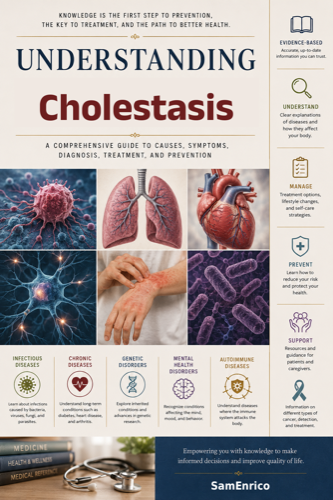
Understanding Cholestasis eBook
This disease publication, published by SamEnrico,
by Matos Gil
This disease publication, published by SamEnrico, covers Understanding Cholestasis
Formats
Free sample
Chapter 1: The Silent Stream...--Every day, without a single conscious thought, your liver produces and pours nearly a quart of bright yellow-green fluid into your digestive system. This fluid—bile—is one of the most underappreciated substances in human physiology. It breaks down fats, eliminates cholesterol, carries away toxins, and disposes of the daily waste of red blood cell recycling. When bile flows freely, you never know it exists. But when that flow slows, stalls, or stops entirely, the body sends out alarms that range from maddening to life-threatening.
This is cholestasis—a word derived from the Greek chole (bile) and stasis (standing still). And understanding this condition begins with understanding why that silent stream matters so much.Cholestasis is not a single disease. It is a pathological state—a final common pathway—that can result from dozens of different causes. Think of it as the liver's version of a plumbing problem. The pipes can be blocked from the inside (by diseased liver cells that cannot properly secrete bile), or they can be blocked from the outside (by a gallstone or a tumor squeezing the bile duct).
In either case, the result is the same: bile backs up, spills into the bloodstream, and begins to poison tissues that were never meant to bathe in these digestive detergents.For patients, the journey to a cholestasis diagnosis is often long and frustrating. The first symptom is almost never jaundice—the yellowing of the skin and eyes that everyone associates with liver disease. Instead, it is itching. Not the mild, scratch-and-move-on itch of a mosquito bite, but a deep, relentless, bone-level pruritus that can make sleep impossible, work unbearable, and life feel like a slow torture. Many patients are initially told they have dry skin, allergies, or psychosomatic itching.
Some are prescribed antidepressants. Others are referred to dermatologists. Only when blood work reveals elevated alkaline phosphatase or bilirubin does the liver enter the conversation.This chapter lays the foundation for everything that follows. We will define cholestasis precisely, distinguish between its two major anatomical forms, explore why bile is essential for survival, and introduce the cardinal symptoms that should raise suspicion for this condition. By the end, you will understand why cholestasis is not just a liver problem—it is a whole-body problem—and why the chapters ahead will guide you through diagnosis, treatment, and the art of thriving despite a chronic biliary disease.Defining Cholestasis: More Than a Diagnosis Let us start with precision.
The medical definition of cholestasis is straightforward: it is the reduction or cessation of bile flow. But that simple definition hides a complex reality. Bile flow can be impaired at two fundamentally different levels, and distinguishing between these levels is the single most important step in diagnosis and treatment.Intrahepatic cholestasis means the problem originates inside the liver itself. The liver cells—the hepatocytes—are either unable to transport bile into the microscopic channels called canaliculi, or the small bile ducts inside the liver have become damaged or destroyed. Causes of intrahepatic cholestasis include drug-induced liver injury (certain antibiotics, anabolic steroids, oral contraceptives), primary biliary cholangitis (PBC, an autoimmune disease that gradually destroys the small bile ducts), primary sclerosing cholangitis (PSC, a fibrosing inflammation of the larger intrahepatic ducts), viral hepatitis, alcohol-related liver disease, genetic disorders like progressive familial intrahepatic cholestasis (PFIC), and the cholestasis of pregnancy (intrahepatic cholestasis of pregnancy, or ICP).
In intrahepatic cholestasis, the liver can look relatively normal under a microscope, or it can show inflammation, scarring, or duct loss—but the key is that the blockage is within the organ.Extrahepatic cholestasis means the problem is outside the liver, in the network of ducts that carry bile from the liver to the intestine. The common bile duct, the hepatic ducts, or the cystic duct (from the gallbladder) can be compressed or obstructed. The classic causes are gallstones that escape the gallbladder and lodge in the common bile duct (choledocholithiasis), benign strictures from prior surgery or inflammation, and malignant obstructions from pancreatic cancer, cholangiocarcinoma (bile duct cancer), or metastatic tumors pressing on the ducts. In extrahepatic cholestasis, the liver itself is often healthy—but it is drowning in its own bile because the drainpipe is clogged.Why does this distinction matter? Because the treatment is radically different.
Extrahepatic cholestasis often requires endoscopy (ERCP) or surgery to remove the blockage. Intrahepatic cholestasis is treated with medications that improve bile flow, suppress the immune system (in autoimmune forms), or manage symptoms while the disease runs its course. A patient with gallstones causing jaundice needs a gastroenterologist with an endoscope; a patient with PBC needs a hepatologist and ursodeoxycholic acid. Mistaking one for the other can delay effective treatment for weeks or months.The chapter summaries provided earlier in this book correctly emphasize that cholestasis can also be classified by its duration (acute vs. chronic) and by its cause (inherited, acquired, or idiopathic).
But the intrahepatic versus extrahepatic split is the most clinically useful framework, and it is the lens through which the rest of this chapter—and this book—should be viewed.Bile: The Unsung Hero of Digestion and Detoxification To understand why cholestasis causes such havoc, we must understand what bile does in a healthy body. Bile is a complex fluid produced continuously by hepatocytes—roughly 500 to 1000 milliliters per day in an adult. It is composed primarily of water (about 85%), but the remaining 15% contains a potent mixture of bile acids, cholesterol, phospholipids (mainly phosphatidylcholine), bilirubin, electrolytes, and other organic molecules.Bile acids are the workhorses. These steroid-like molecules are synthesized from cholesterol in the liver, then conjugated with the amino acids glycine or taurine to make them water-soluble. The primary bile acids—cholic acid and chenodeoxycholic acid in humans—are secreted into the bile and then into the small intestine.
There, they perform their essential function: emulsifying dietary fats. Without bile acids, fats would coalesce into large globules that pancreatic lipase cannot access. With bile acids, fats are broken into tiny micelles—microscopic droplets that present a massive surface area for enzymatic digestion. This is why patients with severe cholestasis develop steatorrhea: fat malabsorption that produces pale, foul-smelling, greasy stools that float.But bile acids do not simply digest fats and disappear. Approximately 95% of bile acids are reabsorbed in the terminal ileum and returned to the liver via the portal vein—a recycling system called the enterohepatic circulation.
The liver then extracts these recycled bile acids and secretes them again. A single bile acid molecule can make this round trip five to ten times per day. This recycling is extraordinarily efficient and conserves the body's cholesterol resources.Bilirubin is the pigment that gives bile its characteristic yellow-green color and, when it accumulates in the blood, turns the skin yellow—jaundice. Bilirubin comes from the breakdown of heme, the iron-containing group in hemoglobin from old red blood cells. The spleen and liver macrophages convert heme to unconjugated (indirect) bilirubin, which is then conjugated with glucuronic acid in the liver to become water-soluble conjugated (direct) bilirubin.
That conjugated bilirubin is secreted into the bile. When bile flow stops, bilirubin backs up into the blood, and the patient becomes jaundiced. Because the liver can still conjugate bilirubin in…
This is the end of the free sample. Get the eBook to keep going. Buy now
About this book
Details
- Author
- Matos Gil
- Publisher
- SamEnrico
- Language
- English
- Genre
- Non-Fiction, Informative, Educational
- Released
- 2026-06-02
- Pages (approx.)
- 160
- Available as
- eBook, Audiobook

Read better in the ZLOADR app
Your eBooks on your phone or tablet. Sign in with your SamEnrico account and start reading.
More by Matos Gil
 55 Plus Community Buy In WorkbookMatos Gil$11.99
 The Late Night Roommate TalkMatos Gil$11.99
 Sleep Talk TechniqueMatos Gil$11.99
 Deep Work Environment DesignMatos Gil$11.99
 Digital Planner Pinterest Traffic CourseMatos Gil$11.99
 Wings of Defiance: The Tuskegee Airmen's Secret Mission Over BerlinMatos Gil$11.99
 The Lehman Trilateral: How Three Brothers Built—and Broke—a Wall Street EmpireMatos Gil$11.99
 Legal Executive AssistantMatos Gil$11.99
 Exercise Coach Board RoleMatos Gil$12.99
 Global Holiday CommunicationMatos Gil$12.99
 Ultimate Handbook Guide to Pimpri Chinchwad : (India) Travel GuideMatos Gil$11.99
You may also like
 Hong Kong Handover 1997Dunn Johnnie$11.99
 Zumba For Postnatal Recovery CourseNeal Christian$11.99
 Zumba for BeginnersLadner Nikia$11.99
 YouTube Comment Mining GuideHumes Pandora$12.99
 Worry Box MeditationCarlin Rudy$11.99
 Workplace Stress MeditationNguyen Lynn$11.99
 Workplace Stress and Sleep RepairHawley Ivory$11.99
 Workplace Perfectionism CureDelaney Jeffry$11.99
 Workplace Injustice Anger GuideWallen Isabelle$11.99
 Work Addiction and Burnout LinkGreenwood Ester$11.99
 Women in Yoga and WellnessBeattie Galina$11.99
 Women in Stand Up ComedyChun Evangeline$11.99