
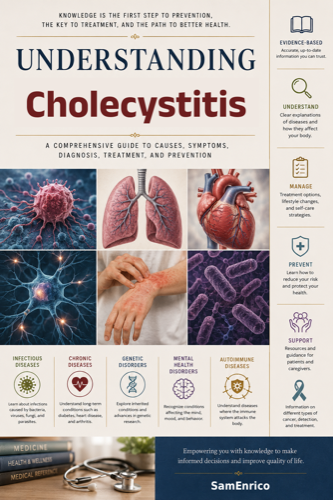
Understanding Cholecystitis eBook
This disease publication, published by SamEnrico,
by Dupre Sean
This disease publication, published by SamEnrico, covers Understanding Cholecystitis
Formats
Free sample
Chapter 1: The First Stitch...--The pain arrives like a thief in the night—unannounced, unwelcome, and utterly convincing in its ability to make you believe something is catastrophically wrong.For Lisa, a 41-year-old mother of two from Ohio, it happened on a Tuesday evening in March. She had just finished dinner—a homemade lasagna she had been craving for weeks—and was helping her youngest daughter with homework when a strange sensation bloomed beneath her ribs on the right side. At first, she ignored it. She had eaten too much, that was all. The lasagna had been rich, layered with full-fat ricotta and generous mozzarella.
She would pay for her indulgence with a little heartburn. No big deal.Twenty minutes later, she was on her hands and knees on the bathroom floor, vomiting into the toilet while her husband stood helplessly in the doorway, asking if she needed to go to the emergency room. She shook her head. She hated hospitals. She would ride this out.Four hours later, the pain had not subsided.
It had changed—sharpened, migrated to her back, settled between her shoulder blades like a hot coal. She could not lie flat. She could not find a comfortable position. She was sweating despite feeling cold. When her husband checked her forehead, he felt the heat before his hand even made contact.
Her temperature was 101.8.That was when they called 911.Lisa's story is not unusual. It is, in fact, so common that emergency room physicians have a name for the constellation of symptoms she experienced: the classic gallbladder attack. But here is what makes Lisa's story worth telling at the very beginning of this book. When the paramedics arrived, they asked her a simple question: "On a scale of zero to ten, how bad is the pain?" She said nine. Then they asked her a second question, one that would determine where she went and how quickly she would be treated: "Has the pain been constant since it started, or has it come and gone in waves?"She hesitated.
It had started as waves—intense, then fading, then intense again. But for the past two hours, it had been unrelenting. The waves had become a tide. The tide had become a flood.That distinction—waxing and waning versus constant—is the single most important detail in the entire story of gallbladder disease. It is the difference between a warning shot and a declaration of war.
It is the difference between a phone call to your doctor in the morning and an ambulance ride to the hospital tonight. And it is the difference between biliary colic (painful but not dangerous) and acute cholecystitis (painful and potentially life-threatening).In this first chapter, we are going to walk through that distinction together. Not as a dry medical lecture—there will be plenty of time for anatomy and biochemistry in later chapters—but as a lived experience. Because before you can understand what is happening inside your body, you need to understand what you are feeling. And before you can make a decision about treatment, you need to know whether you are having the kind of attack that resolves on its own or the kind that demands immediate medical attention.Let me start with a confession that might surprise you, given that this is a book about cholecystitis.
Your gallbladder does not matter.I do not mean that your pain does not matter. I mean that the organ itself—the pear-shaped sac tucked beneath your liver—is not essential to your survival or even to your long-term health. Tens of millions of people around the world are living perfectly normal lives without a gallbladder. They eat what they want. They exercise.
They travel. They forget, most days, that a surgeon ever touched them.What matters is the disease process—the inflammation, the infection, the obstruction—and how it affects you in the moment. This book is not about preserving your gallbladder. It is about understanding what is happening to you so that you can make informed decisions about your care, whether that care ultimately involves surgery, medication, or watchful waiting.So let us begin at the beginning. Let us talk about what actually happened during your attack.The Anatomy of an Attack Imagine a small, deflated balloon.
Now imagine filling that balloon with water and tying off the neck so that nothing can escape. As you add more water, the balloon stretches. Its walls become tight. The pressure inside rises. Eventually, if you add enough water, the balloon will either burst at its weakest point or the knot at the neck will fail.Your gallbladder is that balloon.
Bile is the water. And the stone stuck in your cystic duct is the knot.Here is how it works in real life. Your liver produces bile continuously—about 500 to 600 milliliters per day. Bile is a complex fluid made primarily of water, but also containing bile salts (which help digest fats), cholesterol, phospholipids, bilirubin (a yellow pigment from broken-down red blood cells), and electrolytes. Between meals, most of that bile flows into your gallbladder for storage.
The gallbladder concentrates the bile by absorbing water, making it five to twenty times more potent than when it left the liver. This concentrated bile is excellent at breaking down fats—but it is also more likely to crystallize into stones if the chemical balance is wrong.When you eat, especially when you eat fat, your small intestine releases a hormone called cholecystokinin, or CCK. CCK travels through your bloodstream to two destinations. First, it signals your gallbladder to contract, squeezing its contents out through the cystic duct. Second, it signals the sphincter of Oddi—a muscular valve at the end of the common bile duct, where bile empties into the small intestine—to relax and open.
The result is a coordinated squeeze-and-release that pushes bile from the gallbladder into your intestine, where it can do its job of emulsifying dietary fats.This system works beautifully most of the time. The problem begins when a stone gets in the way.Most gallstones spend their lives floating harmlessly in the main chamber of the gallbladder. They tumble around in the bile like pebbles in a stream, causing no trouble because the gallbladder is a relatively large, flexible space. But when CCK triggers a contraction, it creates a current that can sweep a stone toward the cystic duct. The cystic duct is narrow—only two to four millimeters in diameter in its normal state.
Most stones are larger than that. So the stone gets stuck.The gallbladder continues to contract against a closed outlet. The pressure inside the gallbladder rises. The walls stretch. The nerves in the wall of the gallbladder—nerves that are exquisitely sensitive to tension and distension—fire wildly.
That is the pain. Not the stone itself, but the pressure. Not the obstruction, but the body's desperate attempt to relieve it.If the stone falls back into the gallbladder or squeezes through the duct into the common bile duct (from which it usually continues into the intestine and is eliminated in the stool), the pressure normalizes. The pain stops. You might feel sore for a few hours…
This is the end of the free sample. Get the eBook to keep going. Buy now
About this book
Details
- Author
- Dupre Sean
- Publisher
- SamEnrico
- Language
- English
- Genre
- Non-Fiction, Informative, Educational
- Released
- 2026-05-09
- Pages (approx.)
- 149
- Available as
- eBook, Audiobook

Read better in the ZLOADR app
Your eBooks on your phone or tablet. Sign in with your SamEnrico account and start reading.
More by Dupre Sean
 Lithotomy Gruesome Stone CuttingDupre Sean$11.99
 Memory and Sleep JournalDupre Sean$11.99
 Navigating Breakup TalksDupre Sean$11.99
 Competitive Lifecycle Mapping CourseDupre Sean$11.99
 Etsy Digital Planner Seasonal StrategyDupre Sean$11.99
 Operation Red Hat: The Spy Who Vanished in ViennaDupre Sean$11.99
 The Lost Ship of the Sultan: A 17th-Century Treasure of Science and SurvivalDupre Sean$11.99
 Psychiatrist Board PartnershipDupre Sean$12.99
 Employee Persona CommunicationDupre Sean$12.99
 Lead Experience DesignerDupre Sean$11.99
 Ultimate Handbook Guide to Phoenix : (United States) Travel GuideDupre Sean$11.99