
Non-FictionInformativeEducational
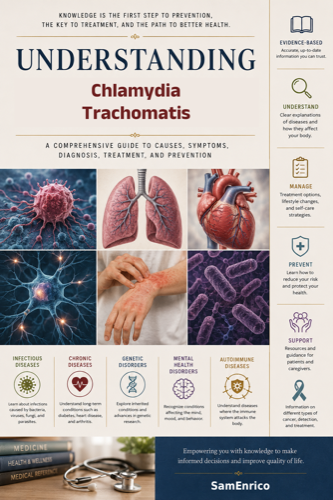
Understanding Chlamydia Trachomatis eBook
This disease publication, published by SamEnrico,
This disease publication, published by SamEnrico, covers Understanding Chlamydia Trachomatis
Formats
Free sample
Chapter 1: The Unseen Invader...–- Every forty-five seconds, somewhere in the world, a young woman receives news that will change the trajectory of her life. Not a cancer diagnosis. Not a positive pregnancy test. A positive chlamydia test. And in the vast majority of cases, she had no idea she was carrying anything at all.Her name is irrelevant.
She could be a college sophomore in Ohio, a factory worker in Vietnam, a nurse in Nigeria, or a marketing executive in London. What unites her with 128 million others each year is a bacterium so exquisitely adapted to human survival that it has perfected the art of hiding in plain sight. Chlamydia trachomatis does not announce itself with dramatic flair. It does not cause the roaring fevers of malaria or the telltale rash of measles. Instead, it whispers—or more often, remains completely silent—while quietly reshaping the reproductive futures of millions.This is the central paradox of the most common bacterial sexually transmitted infection in the world.
It is simultaneously everywhere and nowhere. It is easily cured yet tragically destructive. It is preventable yet stubbornly persistent. And for reasons that have as much to do with human psychology, social stigma, and structural inequality as with biology, it remains the infection that almost everyone has heard of but almost no one truly understands.The Statistic That Demands Attention Let us put the number into perspective. One hundred twenty-eight million new cases annually means that every year, chlamydia infects a population roughly equivalent to the entire country of Japan.
Every single year. In the United States alone, the Centers for Disease Control and Prevention recorded more than 1.6 million cases in the most recent reporting year—and that is only what gets reported. Epidemiologists estimate that the true number is at least twice as high, because most cases are asymptomatic and never tested.To understand the scale, consider this comparison: chlamydia is diagnosed more frequently each year than all forms of cancer combined in the United States. More than heart failure. More than diabetes.
Among young women aged fifteen to twenty-four, the prevalence of chlamydia infection is approximately one in twenty. In some urban populations and among certain demographic groups, the prevalence climbs to one in ten or higher.Yet when was the last time you saw a public health campaign about chlamydia that actually stopped you in your tracks? When did a television drama dedicate an episode to the long-term consequences of untreated cervicitis? Where is the celebrity spokesperson, the awareness ribbon, the month of recognition?The silence surrounding chlamydia is not accidental. It is the product of a perfect storm of factors: the embarrassment associated with sexually transmitted infections, the disproportionate impact on young people and marginalized communities, the absence of visible symptoms in most cases, and a persistent cultural tendency to dismiss STIs as consequences of moral failure rather than as routine medical conditions requiring routine medical attention.The Demographic Earthquake Chlamydia is not an equal opportunity infection.
It has clear preferences, and those preferences tell a revealing story about vulnerability, access, and the social determinants of health.Adolescents and young adults between the ages of fifteen and twenty-four account for nearly two-thirds of all reported cases. This is not because they are promiscuous or reckless—terms loaded with judgment rather than insight. It is because they face a convergence of biological, behavioral, and structural factors that place them at uniquely elevated risk.Biologically, young women are more susceptible to chlamydial infection than older women for a specific anatomical reason. The cervix of an adolescent girl contains a region called the transformation zone, where columnar epithelial cells—the cells that chlamydia preferentially infects—extend outward onto the ectocervix. As a woman ages into her mid-twenties, this zone gradually recedes into the endocervical canal, reducing the surface area available for chlamydia to attach and invade.
This is not a behavioral difference. It is a biological vulnerability built into the female reproductive tract.Behaviorally, young people are more likely to have sequential or concurrent partnerships, less likely to use barrier protection consistently, and less likely to have established routines for routine health maintenance. They are also more likely to face barriers to care: lack of transportation, lack of insurance, lack of confidential access to sexual health services, and fear that parents or guardians will discover their test results.Structurally, the systems designed to provide sexual health services are often poorly aligned with the needs of young people. Clinics that require parental consent for STI testing, even in states with mature minor laws, create insurmountable barriers. School-based health centers that could provide confidential testing remain rare.
And the education that young people receive about chlamydia, when they receive any at all, is often limited to a single slide in a health class, delivered with visible discomfort by a teacher who has not received training on how to discuss STIs without shame.The Geography of Infection If you map chlamydia rates across the globe, a striking pattern emerges. The highest burdens are found in regions where three conditions overlap: high rates of young people, limited access to diagnostic testing, and cultural barriers to discussing sexual health.Sub-Saharan Africa carries the highest burden of chlamydia worldwide, driven by the same structural factors that fuel HIV transmission: poverty, gender inequality, limited healthcare infrastructure, and persistent stigma surrounding any discussion of sexuality. In many African countries, chlamydia testing is simply unavailable outside of major urban centers. Women who develop pelvic inflammatory disease may present to clinics with abdominal pain, receive antibiotics that treat the symptoms but not the underlying infection, and leave without ever knowing they had chlamydia—or that their future fertility is now compromised.The Americas, particularly the United States and parts of Latin America and the Caribbean, report the next highest rates. Within the United States, the geographic distribution is not random.
The highest rates are found in the Southeast, in rural areas with limited access to specialty care, and in urban centers serving predominantly low-income and minority populations.Eastern Europe has experienced a sharp increase in chlamydia cases since the collapse of the Soviet Union, driven by the dismantling of public health infrastructure, the rise of sex work and injection drug use, and delayed adoption of modern diagnostic techniques. In Russia and Ukraine, many clinics still rely on obsolete serologic tests that cannot distinguish between current and past infection, leading to overdiagnosis, overtreatment, and persistent undertesting of asymptomatic populations.Western Europe and Australia have lower reported rates, but this is partly an artifact of different screening practices. The Netherlands, for example, screens far less aggressively than the United States, so its reported rates are lower even though the true prevalence may be similar. Scandinavia, which has robust public health systems and low STI stigma, has successfully reduced chlamydia rates through universal screening programs—demonstrating that political will matters as much as biology.The Economic Calculus Chlamydia is cheap to cure and expensive to ignore. A seven-day course of doxycycline costs approximately five to fifteen dollars in most pharmacies.
A single NAAT test costs between fifty and one hundred fifty dollars. Yet the lifetime cost of a single case of undiagnosed chlamydia that progresses…
This is the end of the free sample. Get the eBook to keep going. Buy now
About this book
Details
- Author
- Burnside Arnita
- Publisher
- SamEnrico
- Language
- English
- Genre
- Non-Fiction, Informative, Educational
- Released
- 2026-05-18
- Pages (approx.)
- 122
- Available as
- eBook, Audiobook

Read better in the ZLOADR app
Your eBooks on your phone or tablet. Sign in with your SamEnrico account and start reading.
More by Burnside Arnita
 Memory Peg System GuideBurnside Arnita$11.99
 Internal Comms Channel MatrixBurnside Arnita$12.99
 Conjoint Analysis Mapping GuideBurnside Arnita$11.99
 Digital Planner Commercial Use License GuideBurnside Arnita$11.99
 Blue Light Memory ImpactBurnside Arnita$11.99
 Kidney Transplant Early FailuresBurnside Arnita$11.99
 The Silent Warnings: Predicting Earthquakes in the Middle East's Fault LinesBurnside Arnita$11.99
 Echoes of the Cosmic Dawn: The Story of the First StarsBurnside Arnita$11.99
 Virtual Mental Health BoardBurnside Arnita$12.99Internal Comms Channel MatrixBurnside Arnita$12.99
 Kombucha BrewerBurnside Arnita$11.99
 How to Become a Butcher ApprenticeBurnside Arnita$11.99
You may also like
 Hong Kong Handover 1997Dunn Johnnie$11.99
 Zumba For Postnatal Recovery CourseNeal Christian$11.99
 Zumba for BeginnersLadner Nikia$11.99
 YouTube Comment Mining GuideHumes Pandora$12.99
 Worry Box MeditationCarlin Rudy$11.99
 Workplace Stress MeditationNguyen Lynn$11.99
 Workplace Stress and Sleep RepairHawley Ivory$11.99
 Workplace Perfectionism CureDelaney Jeffry$11.99
 Workplace Injustice Anger GuideWallen Isabelle$11.99
 Work Addiction and Burnout LinkGreenwood Ester$11.99
 Women in Yoga and WellnessBeattie Galina$11.99
 Women in Stand Up ComedyChun Evangeline$11.99