
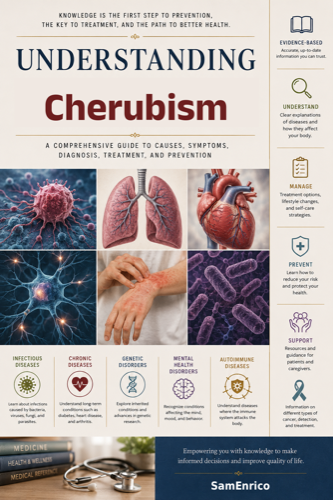
Non-FictionInformativeEducational
Understanding Cherubism eBook
This disease publication, published by SamEnrico,
This disease publication, published by SamEnrico, covers Understanding Cherubism
Formats
Free sample
Chapter 1: The Face in the Mirror...--The first time three-year-old Liam’s grandmother saw him after a six-month separation, she gasped. Not because he was sickly or in pain—he was, in fact, a cheerful, energetic toddler who loved chasing the family dog. Rather, she gasped because his face had transformed. The boy she remembered with a narrow, delicate jawline now had rounded, full cheeks that seemed to swell outward from his mandible. His eyes, once horizontally aligned, appeared to tilt slightly upward, revealing a thin crescent of white beneath each iris.
“He’s just getting his baby fat,” his mother reassured herself, echoing what relatives had suggested. But deep down, she knew this was different. The swelling was too symmetric, too bony to the touch, and it seemed to be progressing month by month. That gnawing sense that something was wrong—without any clear symptoms of illness—is the defining emotional landscape for families first encountering cherubism.This chapter is written for that mother, for Liam’s father who stayed up late searching the internet for “child swollen cheeks both sides,” and for every caregiver who has been told “it’s probably nothing” while their intuition screams otherwise. Welcome to the first step in understanding cherubism—a journey that moves from fear and confusion to knowledge, empowerment, and ultimately hope.Defining Cherubism: More Than a Name Cherubism is a rare, non-cancerous genetic condition that causes progressive, painless enlargement of the lower jaw (mandible) and, in many cases, the upper jaw (maxilla).
The name derives from the cherubs of Renaissance paintings—those chubby-cheeked angelic children whose rounded faces and upward-gazing eyes bear a striking resemblance to the facial appearance of affected individuals. However, as one affected adult later wrote in her memoir, “Being called a cherub sounds flattering until you realize it comes from a medical textbook, not a compliment.”What makes cherubism distinct from other craniofacial conditions is its remarkable symmetry. Unlike tumors or infections that typically affect one side of the face, cherubism almost always presents bilaterally—both jaws grow outward in a mirror image. This symmetry is so characteristic that it is often the first clue for an experienced clinician. The jawbone itself is not cancerous; rather, normal bone marrow is gradually replaced by fibrous tissue containing an overabundance of multinucleated giant cells (which we will explore in depth in Chapter 4).
This tissue expansion stretches the outer cortex of the bone, creating the rounded, full appearance that gives the condition its name.It is crucial to understand from the outset what cherubism is NOT. It is not a tumor. It is not cancer. It does not spread to other parts of the body. It does not cause pain—remarkably, despite significant bone expansion, most children report no discomfort whatsoever.
It does not affect cognitive development or intelligence; children with cherubism grow into adults with the same intellectual potential as their unaffected peers. And perhaps most importantly for newly diagnosed families, cherubism follows a predictable, self-limited course: the jaw enlargement begins in early childhood, stabilizes around age seven, and then—in the majority of cases—spontaneously regresses after puberty, often to the point that the facial appearance returns nearly to normal.The Epidemiology: How Rare Is Rare?Cherubism is classified as a rare disease, though its exact prevalence remains unknown due to underdiagnosis and misdiagnosis. Based on published case reports and clinical series spanning six decades, approximately 300 to 400 families have been documented in the medical literature worldwide. However, experts believe the true number is higher, as mild cases (Grade I, as we will discuss in Chapter 5) may never come to medical attention or may be dismissed as normal facial variation.The condition affects males and females equally, with no known predilection for any race or geographic region. Most cases are diagnosed between ages two and five, corresponding to the rapid expansion phase.
A smaller number of individuals are diagnosed as adults, typically when a parent receives a diagnosis after their child is identified, leading to a cascade of family testing.Significantly, cherubism demonstrates a phenomenon known as incomplete penetrance. This means that not everyone who inherits the genetic mutation (which we will explore in detail in Chapter 3) develops visible symptoms. In some families, a grandparent may carry the mutation but have perfectly normal facial bones, only to pass the condition to a grandchild who develops classic, severe cherubism. This variability is one of the most confusing aspects for families undergoing genetic counseling—and one of the most important to understand.The Natural History: A Story in Three Acts Understanding the natural history of cherubism is the single most important concept for reducing anxiety and making informed treatment decisions. As we will detail comprehensively in Chapter 4, the condition unfolds in three predictable stages.The first act, the Expansion Phase, typically begins between ages two and four.
This is when parents first notice progressive fullness in the cheeks. The jaw enlargement is usually painless and symmetric. Some children also develop firm, nontender swellings under the jaw (submandibular lymphadenopathy), which can be mistaken for infection. During this phase, the fibrous lesions are actively growing, replacing normal bone and causing the characteristic “soap bubble” appearance on X-rays. This is the most emotionally difficult period for families, as the facial changes can be rapid and dramatic—sometimes visibly progressing month to month.The second act, the Stabilization Phase, occurs around age seven.
By this point, the jaw expansion typically plateaus. The facial appearance may remain unchanged for months or even years. Some children even experience partial regression of the submandibular lymph nodes. This phase represents a natural pause in the disease process, and it provides a window for families to adjust, for children to develop social coping strategies, and for medical teams to assess whether intervention will ultimately be necessary.The third act, the Regression Phase, begins after puberty—typically between ages twelve and fourteen for girls and slightly later for boys—and continues into the early twenties. During this phase, the fibrous lesions gradually ossify, meaning they transform into normal bone.
The jaw contours often soften, the “eyes to heaven” appearance may resolve partially or completely, and the face can return to a near-normal appearance. In many cases, the only residual signs of cherubism are subtle flattening or irregularity of the jaw angles visible only on X-ray. This spontaneous regression is unique to cherubism among fibro-osseous diseases and is the primary reason why watchful waiting is the preferred management strategy for most patients.A note on terminology: Throughout this book, we will use the phrase “after puberty” consistently to mean beginning around ages 12-14, with regression continuing into the early twenties. As we will discuss in Chapter 9, this timing informs surgical decisions—elective contouring surgery is typically delayed until ages 15-18 to ensure that active expansion has completely ceased, while still allowing for optimal bone healing before full ossification makes contouring more difficult.The Emotional Weight of a New Diagnosis When a specialist first utters the word “cherubism,” most parents experience a cascade of emotions: relief that someone finally took their concerns seriously, terror at the unfamiliar diagnosis, guilt about possible inheritance, and overwhelming anxiety about their child’s future. These responses are normal, and…
This is the end of the free sample. Get the eBook to keep going. Buy now
About this book
Details
- Author
- Schroeder Wally
- Publisher
- SamEnrico
- Language
- English
- Genre
- Non-Fiction, Informative, Educational
- Released
- 2026-06-02
- Pages (approx.)
- 152
- Available as
- eBook, Audiobook

Read better in the ZLOADR app
Your eBooks on your phone or tablet. Sign in with your SamEnrico account and start reading.
More by Schroeder Wally
 Difficult Client ConversationsSchroeder Wally$11.99
 Hippocampus Sleep GuideSchroeder Wally$11.99
 Cape Town Wellness Tech Startup GuideSchroeder Wally$11.99
 Testosterone and Voice ChangesSchroeder Wally$11.99
 First Heart Transplant HistorySchroeder Wally$11.99
 Secrets of the Silk Road: The Lost Treasures of NiyaSchroeder Wally$11.99
 Black Gold & Blood: The Untold Story of the 18th-Century Coffee WarsSchroeder Wally$11.99
 Culture Bridge Communication GuideSchroeder Wally$12.99
 Cooperative IT SystemsSchroeder Wally$12.99
 How to Become a Button-sewing-machine OperatorSchroeder Wally$11.99
 High Reach Forklift OperatorSchroeder Wally$11.99
You may also like
 Hong Kong Handover 1997Dunn Johnnie$11.99
 Zumba For Postnatal Recovery CourseNeal Christian$11.99
 Zumba for BeginnersLadner Nikia$11.99
 YouTube Comment Mining GuideHumes Pandora$12.99
 Worry Box MeditationCarlin Rudy$11.99
 Workplace Stress MeditationNguyen Lynn$11.99
 Workplace Stress and Sleep RepairHawley Ivory$11.99
 Workplace Perfectionism CureDelaney Jeffry$11.99
 Workplace Injustice Anger GuideWallen Isabelle$11.99
 Work Addiction and Burnout LinkGreenwood Ester$11.99
 Women in Yoga and WellnessBeattie Galina$11.99
 Women in Stand Up ComedyChun Evangeline$11.99