
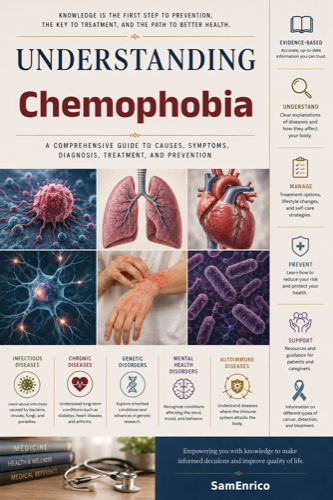
Non-FictionInformativeEducational
Understanding Chemophobia eBook
This disease publication, published by SamEnrico,
This disease publication, published by SamEnrico, covers Understanding Chemophobia
Formats
Free sample
Chapter 1: The Thirty-Dollar Bottle--–- Sarah is not a fool. She is a 34-year-old marketing director with a master’s degree, a mortgage, and a four-month-old daughter named Maya. She reads ingredient labels. She shops at the organic market on Saturdays. She pays 30forafour−ouncebottleof“chemical−free”babyshampoobecausethelabelsaysitis“safeforsensitiveskin”and“pediatricianrecommended”and,mostpersuasively,becausetheword“chemical”appearsnowhereonthefrontofthebottle.Thebottleiswhite,minimalist,andreassuring.Itcosts30 for a four-ounce bottle of “chemical-free” baby shampoo because the label says it is “safe for sensitive skin” and “pediatrician recommended” and, most persuasively, because the word “chemical” appears nowhere on the front of the bottle.
The bottle is white, minimalist, and reassuring. It costs 30forafour−ouncebottleof“chemical−free”babyshampoobecausethelabelsaysitis“safeforsensitiveskin”and“pediatricianrecommended”and,mostpersuasively,becausetheword“chemical”appearsnowhereonthefrontofthebottle.Thebottleiswhite,minimalist,andreassuring.Itcosts7.50 per ounce. Gasoline, by comparison, costs about twelve cents per ounce.Sarah holds the bottle in one hand and her daughter in the other. She has just finished Maya’s bath. The baby smells faintly of lavender and chamomile—natural ingredients, she notes with satisfaction—and is drifting toward sleep.
Sarah feels, in this moment, like a good mother. She has protected her child from the invisible threat of industrial chemicals. She has paid the premium. She has done the right thing.Here is what Sarah does not know. The “chemical-free” baby shampoo contains eighteen chemicals.
The first ingredient is water. Water is a chemical. Its molecular formula is H₂O. It is the most abundant chemical compound on Earth, and it is also, in sufficient quantity, lethal. Drinking six liters in three hours can cause hyponatremia, a condition in which the sodium concentration in the blood becomes dangerously diluted, leading to brain swelling, seizure, coma, and death.
Water is a chemical. It is also essential for life. The dose makes the poison—a principle we will return to in Chapter 4—but Sarah has never heard of Paracelsus, and the label did not mention him.The second ingredient in Sarah’s shampoo is sodium laureth sulfate, a surfactant that creates foam. It is derived from coconut oil, which is natural, but the name sounds like something from a factory. The third ingredient is cocamidopropyl betaine, also a surfactant, also derived from coconut.
The fourth is glycerin, a humectant that draws moisture to the skin. Glycerin occurs naturally in all animal and vegetable fats. The fifth is sodium chloride. Table salt.By the time Sarah finishes reading the label aloud—she would never do this, because the label is tiny and the print is smaller, and anyway she trusts the brand—she would discover that every single ingredient in the “chemical-free” shampoo is a chemical. Every single one.
This is not a paradox. It is a tautology. Everything is a chemical. The air you breathe is a mixture of nitrogen, oxygen, carbon dioxide, and argon. The apple in your kitchen contains over three hundred chemical compounds, including formaldehyde (a preservative and disinfectant) and methanol (a toxic alcohol).
The orange you juiced this morning contains limonene, which is also the active ingredient in industrial degreasers.Sarah does not know these things. She is not supposed to know them. The 1trillioncleanlabelindustry—theglobalmarketforproductsmarketedasfreefromartificialorsyntheticingredients—isbuiltontheprofitablemaintenanceofthisignorance.Theindustrydoesnotwant Sarahtoknowthat“chemical−free”isaphysicalimpossibility.Itdoesnotwanthertoknowthattheword“natural”hasnolegalmeaninginmostproductcategories.Itdoesnotwanthertoknowthatthe1 trillion clean label industry—the global market for products marketed as free from artificial or synthetic ingredients—is built on the profitable maintenance of this ignorance. The industry does not want Sarah to know that “chemical-free” is a physical impossibility. It does not want her to know that the word “natural” has no legal meaning in most product categories.
It does not want her to know that the 1trillioncleanlabelindustry—theglobalmarketforproductsmarketedasfreefromartificialorsyntheticingredients—isbuiltontheprofitablemaintenanceofthisignorance.Theindustrydoesnotwant Sarahtoknowthat“chemical−free”isaphysicalimpossibility.Itdoesnotwanthertoknowthattheword“natural”hasnolegalmeaninginmostproductcategories.Itdoesnotwanthertoknowthatthe30 bottle of shampoo she just bought is chemically almost identical to the $6 bottle at the drugstore, except for the fragrance and the packaging and the price.This book is for Sarah. It is for everyone who has ever stood in a store aisle, paralyzed by choice, trying to decode a label written in a language that seems deliberately designed to confuse. It is for the parent who worries about BPA in a receipt, the shopper who pays extra for “chemical-free” water, and the citizen who reads a headline about a “toxic chemical” and feels a familiar wave of anxiety. The goal of this book is not to mock or dismiss those fears. The goal is to understand where they come from—because they did not appear from nowhere—and to provide a practical, evidence-based framework for distinguishing between real risks and phantom ones.This is a book about chemophobia.
Not the clinical phobia, which is a diagnosed anxiety disorder involving an irrational fear of chemicals. That condition is rare. What is common is the cultural phenomenon of chemophobia: a learned, collective fear of synthetic or manufactured substances, driven by a potent mixture of evolved psychology, historical trauma, marketing manipulation, media amplification, and genuine scientific illiteracy. Chemophobia is why Sarah pays $30 for shampoo. It is why European consumers demanded the removal of E300 from food labels—E300 being vitamin C.
It is why the word “chemical” has become, in common usage, a synonym for “poison,” even though poison is a subset of chemicals, not the opposite of them.The thesis of this book is simple, and it will be repeated in various forms across the next twelve chapters: chemophobia is rarely about actual toxicity. It is about a loss of control over one’s environment and a nostalgic yearning for an idealized, non-industrial world that never existed. The fear is real. The target of the fear—the synthetic molecule—is usually innocent. And the consequences of this misplaced fear are not trivial.
They include wasted money, increased anxiety, environmental harm, and, in the most tragic cases, real public health consequences when safe products are banned and unsafe alternatives take their place.Let us begin with a confession. The author of this book is a chemist. Not the kind who wears a white coat and stares at beakers—though there is nothing wrong with that image—but someone who has spent years studying how molecules interact with each other and with living systems. The author has also spent years watching the public lose trust in chemistry, often for good reasons (the tobacco industry’s lies, leaded gasoline, CFCs and the ozone hole) and often for bad ones (a rat study fed unrealistically high doses of a common preservative, reported without context as proof that the preservative causes cancer).This book is not a defense of the chemical industry. That industry has earned much of the distrust it receives.
This book is not an attack on organic farming, natural products, or environmental activism. Those movements have done genuine good. This book is, instead, an attempt to build a bridge between two worlds that rarely speak to each other: the world of scientific evidence and the world of consumer intuition. The bridge is made of curiosity. The toll is paid in the currency of cognitive effort.
The destination is a place where you can walk into a store, pick up a product, read its label, and make a decision based on actual risk rather than manufactured fear.The Causal Model of Chemophobia Before we…
This is the end of the free sample. Get the eBook to keep going. Buy now
About this book
Details
- Author
- Tierney Keisha
- Publisher
- SamEnrico
- Language
- English
- Genre
- Non-Fiction, Informative, Educational
- Released
- 2026-05-11
- Pages (approx.)
- 134
- Available as
- eBook, Audiobook

Read better in the ZLOADR app
Your eBooks on your phone or tablet. Sign in with your SamEnrico account and start reading.
More by Tierney Keisha
 Testosterone and Vision ChangesTierney Keisha$11.99
 Navigating Boundary SettingTierney Keisha$11.99
 Competitive Positioning Matrix HandbookTierney Keisha$11.99
 Circadian Rhythm MemoryTierney Keisha$11.99
 Antibiotic Resistance Looming CrisisTierney Keisha$11.99
 Echoes of the Blue Lagoon: The Unsung Heroes of the 1979 Fastnet Race DisasterTierney Keisha$11.99
 Blood and Silk: The Forgotten Empress Who Ruled from the ShadowsTierney Keisha$11.99
 Internal Newsletter For Global TeamsTierney Keisha$12.99
 Cooperative Capital MarketsTierney Keisha$12.99
 How to Become a Building ConsultantTierney Keisha$11.99
 Hearing Aid Cleaner and RepairerTierney Keisha$11.99
You may also like
 Hong Kong Handover 1997Dunn Johnnie$11.99
 Zumba For Postnatal Recovery CourseNeal Christian$11.99
 Zumba for BeginnersLadner Nikia$11.99
 YouTube Comment Mining GuideHumes Pandora$12.99
 Worry Box MeditationCarlin Rudy$11.99
 Workplace Stress MeditationNguyen Lynn$11.99
 Workplace Stress and Sleep RepairHawley Ivory$11.99
 Workplace Perfectionism CureDelaney Jeffry$11.99
 Workplace Injustice Anger GuideWallen Isabelle$11.99
 Work Addiction and Burnout LinkGreenwood Ester$11.99
 Women in Yoga and WellnessBeattie Galina$11.99
 Women in Stand Up ComedyChun Evangeline$11.99