
Non-FictionInformativeEducational
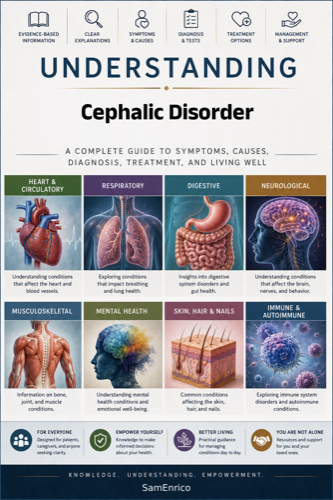
Understanding Cephalic Disorder eBook
This condition publication, published by SamEnrico
This condition publication, published by SamEnrico, covers Understanding Cephalic Disorder
Formats
Free sample
Chapter 1: The Shape of Worry...--The moment you noticed something different about your child’s head, time split into two halves: everything before that moment, and everything after. Perhaps it was the pediatrician who, during a routine checkup, tilted her head and said “hmm” a little too thoughtfully. Perhaps it was a grandparent who whispered, “Should his head look like that?” Or perhaps it was you, alone in the soft light of the nursery, tracing your fingers over a flat spot or a ridge that you couldn’t remember being there last week. Whatever the trigger, you are now standing at the edge of a medical wilderness, holding a phrase you never expected to learn: cephalic disorder.This book is not a collection of cold clinical facts. It is a flashlight.
It is a map. And it is, above all else, a hand reaching out to you in the dark.Understanding cephalic disorders begins with a single, liberating truth: you are not alone, you did not cause this, and there is a clear path forward. The word “cephalic” simply means “related to the head,” and a “cephalic disorder” is any condition affecting the shape, growth, or development of the skull and its contents. That sounds frighteningly broad—and it is. But within that breadth lies hope, because the vast majority of cephalic disorders are treatable, and the worst-case scenarios you have already imagined at 2 AM are almost certainly not your reality.Before we dive into the intricate biology of skull development, before we discuss helmets or surgeries or insurance appeals, we must first establish a shared language and, more importantly, a shared perspective.
This chapter will accomplish three critical goals: first, it will define what a cephalic disorder actually is (and, just as crucially, what it is not). Second, it will place these conditions on a spectrum from mild to complex, giving you a framework to understand where your child’s situation likely falls. Third, it will debunk the most common, soul-crushing myths that parents carry—myths about blame, about brain damage, about a stolen future.By the end of this chapter, you will not be a doctor. But you will be something almost as powerful: an informed, calm, and determined advocate who knows the right questions to ask and the right fears to set aside.What Exactly Is a Cephalic Disorder?Let us begin with anatomy, because fear thrives in mystery, and knowledge is the antidote.The human skull is not a single, bowling-ball-like bone. It is a complex puzzle of 22 separate bones that fit together like pieces of a three-dimensional jigsaw.
In an adult, those bones are fused tight, creating a solid protective casing for the brain. But in an infant, those bones are deliberately, beautifully unfused. Between each bone lies a fibrous joint called a suture, and at the intersections of multiple sutures are soft, membrane-covered gaps called fontanelles—the famous “soft spots” that terrify new parents who fear touching them. (You can touch them. They are remarkably tough.)This design is not a flaw.
It is an engineering miracle.During the first two years of life, the human brain undergoes its most explosive period of growth, doubling in volume by six months and nearly tripling by twelve months. If the skull were a single solid bone, that growth would be impossible—the brain would be crushed. Instead, the sutures and fontanelles act as expansion joints, allowing the skull to stretch and grow in response to the expanding brain. The brain grows, and the skull follows. This is the fundamental principle of cranial development: the brain drives the skull, not the other way around.A cephalic disorder arises when something disrupts this elegant system.
That disruption can take two fundamentally different forms, and understanding this distinction is the single most important concept you will learn in this book.Positional plagiocephaly (often called “flat head syndrome”) occurs when external pressure—usually from prolonged lying in one position—creates a flat spot on the back or side of the head. The sutures remain open and functional. The brain is growing normally. The problem is purely mechanical and external. Think of it like a pumpkin resting on a counter: the side that touches the ground flattens slightly, but the pumpkin inside remains perfectly fine.Craniosynostosis (pronounced kray-nee-oh-sin-os-toh-sis) occurs when one or more sutures fuse prematurely—months or years before they should.
The brain continues to grow, but the skull cannot expand at that fused junction. To accommodate the growing brain, the skull compensates by expanding excessively at the still-open sutures, creating an abnormal, often dramatic head shape. This is not a pressure problem alone; it is a growth restriction problem that, if untreated, can lead to increased intracranial pressure and, rarely, developmental consequences.These two conditions—positional plagiocephaly and craniosynostosis—are often confused by well-meaning but uninformed observers, including some general pediatricians. They are not the same. They have different causes, different treatments, and different prognoses.
Throughout this book, we will treat them separately and clearly. But they share one crucial feature: both are treatable, and both have excellent outcomes when managed appropriately.The Spectrum: From Mild to Complex One of the greatest sources of anxiety for parents is the assumption that all cephalic disorders are essentially the same—that a flat spot from sleeping position is somehow a precursor to brain surgery. This is like assuming that a stubbed toe is the same as a broken femur. Both involve feet and legs. Both may hurt.
But they are worlds apart in severity and treatment.To help you understand where your child’s situation falls, imagine a spectrum with four distinct zones.Zone 1: Mild Positional Plagiocephaly – This is the most common cephalic disorder by an enormous margin. Between 20% and 40% of all infants develop some degree of positional flattening, thanks to the “Back to Sleep” campaign (which has saved tens of thousands of lives from SIDS but inadvertently increased flat head syndrome). In mild cases, the flattening is barely noticeable except in certain lighting or from certain angles. The ears and forehead remain symmetric. There is no ridging.
The child meets all developmental milestones. Treatment is simple: repositioning during sleep and awake time, tummy time, and patience. No helmet. No surgery. No long-term consequences.Zone 2: Moderate to Severe Positional Plagiocephaly – The flattening is obvious even to a casual observer.
One ear may appear slightly shifted forward on the flat side. The forehead may bulge subtly on the opposite side. Despite these cosmetic changes, the brain and sutures remain entirely normal. Treatment typically involves cranial orthotic therapy (a helmet) for 3-6 months, usually starting between 4 and 8 months of age. The success rate is excellent—over 90% correction in most cases.
No surgery. No brain involvement. The child’s future is unaffected.Zone 3: Isolated, Non-Syndromic Craniosynostosis – One suture fuses prematurely. The skull takes on a characteristic shape depending on which suture is involved: a long, narrow head (scaphocephaly) from sagittal fusion; a triangular forehead (trigonocephaly) from metopic fusion; a flat, asymmetric head (anterior plagiocephaly) from unilateral coronal fusion; or a short, tall, wide head (brachycephaly) from bicoronal fusion. The brain itself is structurally normal.
There are no other birth defects or syndromic features. Treatment requires surgery to release the fused suture and reshape the…
This is the end of the free sample. Get the eBook to keep going. Buy now
About this book
Details
- Author
- Hebert Janean
- Publisher
- SamEnrico
- Language
- English
- Genre
- Non-Fiction, Informative, Educational
- Released
- 2026-05-09
- Pages (approx.)
- 159
- Available as
- eBook, Audiobook

Read better in the ZLOADR app
Your eBooks on your phone or tablet. Sign in with your SamEnrico account and start reading.
More by Hebert Janean
 DBT For Grief EmotionsHebert Janean$11.99
 Relationship First Aid for StressHebert Janean$11.99
 Assertiveness For In LawsHebert Janean$11.99
 Persuasion Master ClassHebert Janean$11.99
 Mario Andretti VersatilityHebert Janean$11.99
 Lou Hoover First LadyHebert Janean$11.99
 Toilet Paper Auto-ship StickinessHebert Janean$11.99
 Low Income Therapy InnovationsHebert Janean$11.99
 Darius the Great: Architect of the Achaemenid EmpireHebert Janean$11.99
 The Maestro's Crown: How Black Composers Conquered the Classical WorldHebert Janean$11.99
 A Collector's Handbook to the Bristol 401Hebert Janean$11.99
 How to Start a Ammonium Compounds (excluding Ammonium Nitrate, Sulphate and Phosphate) Business (BegHebert Janean$11.99
You may also like
 Hong Kong Handover 1997Dunn Johnnie$11.99
 Zumba For Postnatal Recovery CourseNeal Christian$11.99
 Zumba for BeginnersLadner Nikia$11.99
 YouTube Comment Mining GuideHumes Pandora$12.99
 Worry Box MeditationCarlin Rudy$11.99
 Workplace Stress MeditationNguyen Lynn$11.99
 Workplace Stress and Sleep RepairHawley Ivory$11.99
 Workplace Perfectionism CureDelaney Jeffry$11.99
 Workplace Injustice Anger GuideWallen Isabelle$11.99
 Work Addiction and Burnout LinkGreenwood Ester$11.99
 Women in Yoga and WellnessBeattie Galina$11.99
 Women in Stand Up ComedyChun Evangeline$11.99