
Non-FictionHealth & WellnessNeurology
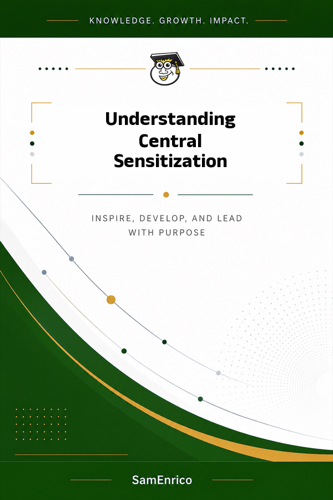
Understanding Central Sensitization eBook
How fibromyalgia amplifies nerve signals and treat
by Hooker Yer
How fibromyalgia amplifies nerve signals and treatments to calm the overactive nervous system.
Formats
Free sample
Chapter 1: The Broken Gain Control--For decades, you have been told that your pain is a mystery. You have heard the whispers—“Your tests are normal,” “It’s probably stress,” “Have you considered seeing a psychiatrist?”—and each time, a small piece of your trust in your own body chipped away. You have learned to smile through the fire, to say “I’m fine” when every nerve ending is screaming, to cancel plans not because you want to but because the simple act of a bedsheet brushing against your skin feels like sandpaper on a sunburn. If you are reading this book, you already know something that much of modern medicine has been slow to accept: your pain is real, it is physical, and it follows rules that can be understood.This chapter will give you a new lens through which to see your experience. It will introduce the central metaphor that will guide this entire book—the broken gain control—and will fundamentally reframe what is happening inside your nervous system.
By the time you finish these pages, you will understand why your body sounds false alarms, why the “brake pedal” for pain in your nervous system has become unreliable, and why the treatments in later chapters are designed not to fix damaged tissues but to retrain an overprotective brain.The Two Kinds of Pain: The Alarm and the Fire To understand why your pain persists, you must first understand what pain is supposed to do. Pain, in its healthy form, is not an enemy. It is the most effective alarm system evolution ever devised. Touch a hot stove, and within milliseconds, an electrical signal races up your arm, through your spinal cord, and into your brain. You jerk your hand back before you even consciously feel the burn.
That is acute pain, and it is a gift. It tells you that tissue damage is happening or imminent, and it compels you to protect that body part until healing occurs. Without acute pain, you would lean on broken bones, walk on torn ligaments, and burn your flesh without flinching. Acute pain is the fire alarm that goes off when there is an actual fire.Chronic pain is something else entirely. Chronic pain is the fire alarm that keeps screaming long after the fire has been extinguished.
The wiring has frayed. The sensor has become stuck. The alarm system now responds to a wisp of smoke, a flickering light, even a change in the weather—all as if the house were engulfed in flames. Your body is not lying to you; it is misreading the world. The danger-detection system has become overcalibrated, hypervigilant, and unable to turn itself off.This distinction is the foundation of everything that follows.
In fibromyalgia and related central sensitivity syndromes, the problem is not primarily in your muscles, joints, or connective tissues. Multiple studies have biopsied fibromyalgia muscles and found no consistent evidence of damage, inflammation, or degeneration. Your MRI of your spine or knee likely looks unremarkable—not because the radiologist missed something, but because the pathology is not in the structure being imaged. The pathology is in the central nervous system: your spinal cord and brain. The tissue is fine.
The processing of signals from that tissue is broken.The Gain Control Metaphor: How Amplifiers Explain Your Pain Let us replace abstract neuroscience with something you can feel in your bones. Imagine a sound system—a guitar amplifier, a stereo, a public address system. Every such system has a gain control. Gain is not the same as volume. Volume is how loud the final output sounds to your ears.
Gain is how much the amplifier boosts the incoming signal before it ever reaches the volume knob. Turn the gain too low, and even a powerful guitar riff comes out as a whisper. Turn the gain too high, and the slightest pluck of a string becomes a distorted, screeching howl that overwhelms everything else.Your nervous system has a gain control. It sits in your spinal cord and brainstem, and its job is to decide how much to amplify the signals arriving from your body. When you stub your toe, the sensory nerves send a modest electrical signal upward.
A healthy gain control multiplies that signal enough to make you notice the injury but not enough to incapacitate you. Then, as healing occurs, the gain control gradually turns back down. The same toe, gently touched a week later, produces no pain because the gain has been reset to normal.In central sensitization, the gain control breaks in the “too high” position. It does not break in the “off” position—that would leave you insensate, unable to feel anything at all. It breaks stuck at maximum amplification.
Now, a light brush of clothing (a normal, non-painful signal) becomes amplified into burning pain. A gentle squeeze of your shoulder (mild pressure) becomes excruciating. Your body is not generating new injury signals; it is amplifying ordinary signals as if they were emergencies.This is why you hurt all over even though no single injury explains it. This is why your pain moves from one location to another. This is why gentle touch, temperature changes, even emotional stress can trigger flares.
The gain control is not selective. It does not amplify only the “bad” signals. It amplifies everything—touch, pressure, vibration, temperature, even the background noise of your own muscles holding you upright. Your nervous system has become an amplifier with the gain cranked to ten, and every input, no matter how small, comes out as pain.The Three Faces of Amplification: Allodynia, Hyperalgesia, and Wind-Up Now that you understand the gain control metaphor, you need the vocabulary to describe what you experience. Medical textbooks use three specific terms to capture the three distinct ways that a broken gain control manifests.
Learn these terms because they will appear throughout this book, and because they give you precise language to use with your doctors.Allodynia is pain resulting from a stimulus that does not normally cause pain. Light touch is the classic example. A gentle stroke of your arm, a tag on your shirt, a warm shower—these should feel merely tactile or pleasantly warm. In allodynia, they feel like burning, stinging, or aching. Another common form is thermal allodynia, where lukewarm water feels scalding or cool air feels like ice picks.
If you have ever winced when someone patted your back in greeting, you have experienced allodynia. Your gain control is so high that a normal, non-painful input crosses the pain threshold.Hyperalgesia is an exaggerated pain response to a mildly painful stimulus. A small pinch that should cause a brief, minor twinge instead feels like a deep bruise that lingers for minutes. A blood draw that should be a quick prick becomes a searing, nauseating event. Hyperalgesia means the gain control is not only amplifying normal signals into pain but is also taking actual pain signals and multiplying them further.
Your pain volume is turned up across the board.Wind-up is the most disturbing of the three because it feels like your pain is learning and growing. Wind-up occurs when a repeated, identical stimulus produces a progressively increasing perception…
This is the end of the free sample. Get the eBook to keep going. Buy now
About this book
Details
- Author
- Hooker Yer
- Publisher
- SamEnrico
- Language
- English
- Genre
- Non-Fiction, Health & Wellness, Neurology
- Released
- 2026-06-06
- Pages (approx.)
- 157
- Available as
- eBook, Audiobook

Read better in the ZLOADR app
Your eBooks on your phone or tablet. Sign in with your SamEnrico account and start reading.
More by Hooker Yer
 The Heckler's BeatingHooker Yer$11.99
 Self Hypnosis for Compulsive BehaviorsHooker Yer$11.99
 Post Lunch Nap StrategyHooker Yer$11.99
 Pet Loss For GroomersHooker Yer$11.99
 SPAC Merger TermsHooker Yer$11.99
 Property Turnover GuideHooker Yer$11.99
 The IBS Endoscopy GuideHooker Yer$11.99
 Caregiver for Cancer PatientsHooker Yer$11.99
 The Silk Spider and the Synthetic Revolution: How Japan Wove a Chemical MiracleHooker Yer$11.99
 Operation Black Buck: The Falklands' Carrier GambitHooker Yer$11.99
 Neymar Jr.: The Beautiful Game’s Chaotic MaestroHooker Yer$11.99
 Founder Medical Crisis Bank Loan Covenant BreachHooker Yer$12.99
You may also like
 Hong Kong Handover 1997Dunn Johnnie$11.99
 Zumba For Postnatal Recovery CourseNeal Christian$11.99
 Zumba for BeginnersLadner Nikia$11.99
 YouTube Comment Mining GuideHumes Pandora$12.99
 Worry Box MeditationCarlin Rudy$11.99
 Workplace Stress MeditationNguyen Lynn$11.99
 Workplace Stress and Sleep RepairHawley Ivory$11.99
 Workplace Perfectionism CureDelaney Jeffry$11.99
 Workplace Injustice Anger GuideWallen Isabelle$11.99
 Work Addiction and Burnout LinkGreenwood Ester$11.99
 Women in Yoga and WellnessBeattie Galina$11.99
 Women in Stand Up ComedyChun Evangeline$11.99