
Non-FictionInformativeEducational
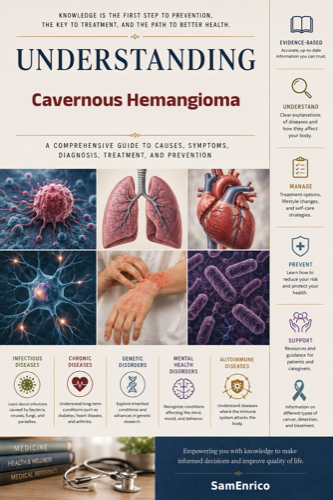
Understanding Cavernous Hemangioma
This disease publication, published by SamEnrico,
by Saenz Maia
This disease publication, published by SamEnrico, covers Understanding Cavernous Hemangioma
Formats
About this book
Free sample
Chapter 1: The Raspberry in Your Brain...--It begins, for most people, with silence. Not the peaceful kind of silence that accompanies a quiet morning or a deep meditation. It is the silence of the unknowing—the long, asymptomatic stretch of years during which a small, abnormal cluster of blood vessels sits quietly within the folds of the brain, doing nothing at all. Then, for some, the silence breaks. It might break with a single, unexplained seizure that sends a previously healthy person to an emergency room.
It might break with a sudden, thunderclap headache unlike anything ever experienced before. Or it might never break at all, and the discovery comes as an accidental finding on an MRI ordered for an entirely different reason—a concussion after a car accident, chronic migraines, or even tinnitus. This chapter is about that thing that has been living inside you or someone you love, often for decades, without asking permission. It is about the raspberry in your brain: the cavernous hemangioma.To understand what a cavernous hemangioma is, you must first unlearn what the word "hemangioma" might suggest to you. In common medical parlance, especially in infants, a hemangioma is a benign tumor of blood vessels that grows rapidly and then often regresses on its own.
That is not this. The lesion we are discussing has many names—cavernous hemangioma, cerebral cavernous malformation (CCM), cavernoma, cavernous angioma—and the very existence of multiple names hints at the medical community's evolving understanding. The term "hemangioma" has fallen somewhat out of favor among specialists at the International Society for the Study of Vascular Anomalies (ISSVA), precisely because it implies a proliferative growth pattern that these lesions do not actually follow. Instead, what you have is a vascular malformation: a cluster of abnormally formed, dilated, thin-walled blood vessels that resemble a raspberry or a mulberry in both shape and texture. Unlike a tumor, these vessels do not undergo rapid cell division.
They are not cancerous. They will not metastasize to your lungs, liver, or bones. They are simply... built wrong, constructed from faulty blueprints that your genes…
This is the end of the free sample. Get the eBook to keep going. Buy now
Contents
- Chapter 1
- Chapter 2
- Chapter 3
- Chapter 4
- Chapter 5
- Chapter 6
- Chapter 7
- Chapter 8
- Chapter 9
- Chapter 10
- Chapter 11
- Chapter 12
Details
- Author
- Saenz Maia
- Publisher
- SamEnrico
- Language
- English
- Genre
- Non-Fiction, Informative, Educational
- Released
- 2026-06-02
- Pages (approx.)
- 158
- Available as
- eBook, Audiobook

Read better in the ZLOADR app
Your eBooks on your phone or tablet. Sign in with your SamEnrico account and start reading.
More by Saenz Maia
 LBO Infrastructure GuideSaenz Maia$11.99
 Tax Shield Modeling GuideSaenz Maia$11.99
 Mastermind Prison InterviewsSaenz Maia$11.99
 Bariatric Surgery Constipation Relief GuideSaenz Maia$11.99
 Gluten Free Holiday Entertaining GuideSaenz Maia$11.99
 The Miracle on Ice: The Untold Story of the 1980 U.S. Olympic Hockey TeamSaenz Maia$11.99
 The Alchemist of Alexandria: Unlocking the Secrets of AntimonySaenz Maia$11.99
 Proposal Graphics And FiguresSaenz Maia$12.99
 AI Financial Data Enrichment GuideSaenz Maia$12.99
 Customer Program ManagerSaenz Maia$11.99
 How to Become a Inner-tube InserterSaenz Maia$11.99
You may also like
 Hong Kong Handover 1997Dunn Johnnie$11.99
 Zumba For Postnatal Recovery CourseNeal Christian$11.99
 Zumba for BeginnersLadner Nikia$11.99
 YouTube Comment Mining GuideHumes Pandora$12.99
 Worry Box MeditationCarlin Rudy$11.99
 Workplace Stress MeditationNguyen Lynn$11.99
 Workplace Stress and Sleep RepairHawley Ivory$11.99
 Workplace Perfectionism CureDelaney Jeffry$11.99
 Workplace Injustice Anger GuideWallen Isabelle$11.99
 Work Addiction and Burnout LinkGreenwood Ester$11.99
 Women in Yoga and WellnessBeattie Galina$11.99
 Women in Stand Up ComedyChun Evangeline$11.99