
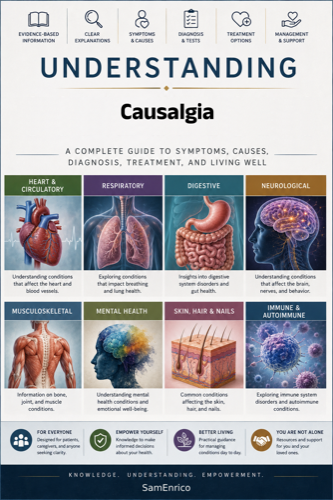
Non-FictionInformativeEducational
Understanding Causalgia eBook
This condition publication, published by SamEnrico
This condition publication, published by SamEnrico, covers Understanding Causalgia
Formats
Free sample
Chapter 1: The Fire Within...--The first time the bedsheet touched your skin, you thought you were imagining it. A gentle brush of cotton—something you have felt ten thousand mornings without a second thought—suddenly registered as pain. Not discomfort. Not irritation. Pain.
The kind of pain that makes you gasp, that makes you snatch your hand or foot away as if you had touched a hot stove. But the stove was not on. The sheet was room temperature. And yet your nervous system was screaming that you were being burned alive.If you are reading this book, you already know that moment. You remember exactly when the rules changed, when your body stopped interpreting touch as touch and started interpreting it as an attack.
Perhaps it happened after a surgery, when the incision healed but the fire remained. Perhaps it happened after a crush injury to a limb—a fall, a car accident, a workplace mishap—and the pain never followed the expected trajectory of healing. Perhaps you cannot even identify a clear trigger; the pain simply arrived one day and refused to leave.Whatever your path to this page, you are here because you are searching for answers that your doctors have not been able to provide. You have been told it is "just anxiety." You have been offered antidepressants. You have been referred to psychiatrists.
You have been looked at with skepticism, with pity, with confusion. And somewhere along the way, you may have started to doubt yourself. Maybe it is in your head. Maybe you are exaggerating. Maybe if you just tried harder, thought more positively, pushed through the pain, you would get better.Let me stop you right there.What You Are About to Learn Changes Everything This chapter is the foundation of everything that follows.
Before we can discuss treatments, before we can build your team, before we can create an action plan, you must understand what you are actually fighting. And the first and most important truth—the one that will reframe your entire experience—is this:Causalgia is a real, named, studied, physical disease. It has been recognized in medical literature for over 150 years. It is not psychological. It is not a form of malingering.
It is not a conversion disorder. It is a dysfunction of the nervous system, triggered by nerve injury, that produces measurable, objective changes in the body.The fact that your pain cannot be seen on an X-ray does not mean it is not real. The fact that your blood work comes back normal does not mean you are making it up. The fact that you have been dismissed by doctors who should have known better is a failure of the medical system, not a failure of your character.This book exists because that failure is epidemic. The average person with causalgia sees seven doctors before receiving a correct diagnosis.
The average time from symptom onset to diagnosis is two to three years. In those years, the disease progresses. Muscles atrophy. Joints stiffen. Bones thin.
The nervous system becomes more entrenched in its dysfunctional patterns. And all the while, the patient is told—explicitly or implicitly—that the problem is psychological.It is not.The Name You Need to Know: Causalgia and Its Modern Identity The word "causalgia" comes from the Greek kausis, meaning "burning," and algos, meaning "pain." It was coined in 1864 by Dr. Silas Weir Mitchell, a Union Army surgeon during the American Civil War. Mitchell was stationed at Turners Lane Hospital in Philadelphia, where he treated soldiers with gunshot wounds to major nerves. These men—young, healthy, often brave—would present with a baffling constellation of symptoms.
Their wounds would heal, the skin would close, and yet they would report a spontaneous, relentless burning pain in the affected limb. Some described it as "liquid fire." Others said it felt like "red-hot irons" pressed against their skin. The pain was so severe that many soldiers would keep their limbs constantly wet, believing that moisture offered some relief. Some would not allow anyone to touch the affected area, not even to change a bandage.Mitchell was a meticulous observer and a compassionate physician. He did not dismiss these men as hysterical or weak.
Instead, he documented their symptoms with extraordinary precision, noting the color changes, the swelling, the hair loss, the muscle wasting, and the psychological toll of unrelenting pain. He wrote: "There is something terrible in the helplessness of these cases. The sufferer is in constant fear of the slightest touch, and lies with his limb wrapped in cotton, dreading the approach of the most careful friend." His descriptions, written more than 150 years ago, remain clinically accurate today.Mitchell called the condition causalgia. And for more than a century, that name was used to describe post-traumatic burning pain associated with confirmed nerve injury.In the 1990s, medical consensus shifted. The International Association for the Study of Pain (IASP) introduced a new umbrella term: Complex Regional Pain Syndrome, or CRPS.
Under this system, CRPS was divided into two types:CRPS Type I, formerly known as Reflex Sympathetic Dystrophy (RSD), occurs without confirmed nerve injury. The symptoms arise after a seemingly minor injury, surgery, or even spontaneously, but no specific nerve damage can be identified.CRPS Type II, which is causalgia, occurs after a confirmed major nerve injury. The damage can be seen on MRI neurography, identified during surgery, or inferred from the pattern of weakness and sensory loss.This distinction matters. It is not merely a semantic difference. The presence or absence of confirmed nerve injury affects prognosis, treatment decisions, and the types of interventions that are most appropriate.
For example, nerve decompression surgery—which releases a trapped or compressed nerve—is more likely to help someone with CRPS Type II than Type I, because there is a specific anatomical target to address. Similarly, the pattern of symptom spread differs between the two types, a distinction we will explore in Chapter 2.However, many clinicians ignore this distinction. They use "CRPS" as a catch-all diagnosis, lumping Type I and Type II together without investigating whether a specific nerve injury exists. This is a disservice to patients. You deserve to know whether you have causalgia or RSD, because the answer shapes your path forward.Throughout this book, we will use the terms causalgia and CRPS Type II interchangeably.
But we will always be referring to the specific condition that follows confirmed nerve injury. If you have been diagnosed with CRPS but no one has investigated whether you have a definable nerve lesion, Chapter 4 will give you the tools to demand that evaluation.Who Gets Causalgia? Understanding the Demographics Causalgia is not a rare disease, but it is a poorly recognized one. Studies suggest that CRPS of all types affects approximately 5 to 26 per 100,000 people annually. Among those, about 10 to 15 percent have CRPS Type II—causalgia.
This means that in the United States alone, thousands of new cases of causalgia occur each year.The demographic patterns are striking and important to understand:Sex. Women are two to three times more likely to develop causalgia than men. The reasons for this disparity are not fully understood, but researchers have proposed several possibilities: hormonal differences…
This is the end of the free sample. Get the eBook to keep going. Buy now
About this book
Details
- Author
- Nielsen Cecille
- Publisher
- SamEnrico
- Language
- English
- Genre
- Non-Fiction, Informative, Educational
- Released
- 2026-05-08
- Pages (approx.)
- 156
- Available as
- eBook, Audiobook

Read better in the ZLOADR app
Your eBooks on your phone or tablet. Sign in with your SamEnrico account and start reading.
More by Nielsen Cecille
 The Quiet Conflict WithinNielsen Cecille$11.99
 Assertiveness Group TrainingNielsen Cecille$11.99
 DBT For PTSD EmotionNielsen Cecille$11.99
 Persuasion For CoachesNielsen Cecille$11.99
 Mobile Therapy For Remote RegionsNielsen Cecille$11.99
 Grace Coolidge First LadyNielsen Cecille$11.99
 E-learning Platform Dropout AnalysisNielsen Cecille$11.99
 The Swiss Gold Standard: How Neutrality Built a Banking EmpireNielsen Cecille$11.99
 Burke and Wills: The Epic Quest to Cross a ContinentNielsen Cecille$11.99
 How to Produce ShoelacesNielsen Cecille$11.99
 How to Produce Foot FilesNielsen Cecille$11.99
 Weather and Nature Stock Video NicheNielsen Cecille$12.99
You may also like
 Hong Kong Handover 1997Dunn Johnnie$11.99
 Zumba For Postnatal Recovery CourseNeal Christian$11.99
 Zumba for BeginnersLadner Nikia$11.99
 YouTube Comment Mining GuideHumes Pandora$12.99
 Worry Box MeditationCarlin Rudy$11.99
 Workplace Stress MeditationNguyen Lynn$11.99
 Workplace Stress and Sleep RepairHawley Ivory$11.99
 Workplace Perfectionism CureDelaney Jeffry$11.99
 Workplace Injustice Anger GuideWallen Isabelle$11.99
 Work Addiction and Burnout LinkGreenwood Ester$11.99
 Women in Yoga and WellnessBeattie Galina$11.99
 Women in Stand Up ComedyChun Evangeline$11.99