
Non-FictionInformativeEducational
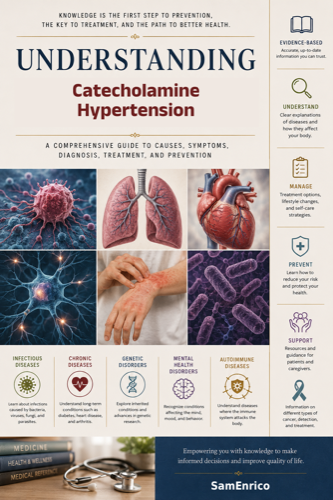
Understanding Catecholamine Hypertension eBook
This disease publication, published by SamEnrico,
This disease publication, published by SamEnrico, covers Understanding Catecholamine Hypertension
Formats
Free sample
Chapter 1: The Masked Crisis--– The call came in at 2:47 AM on a Tuesday. The paramedics were already en route, and the report was familiar enough to sound boring: "Thirty-four-year-old female, acute anxiety attack, tachycardia, blood pressure 210/115, patient reports history of panic disorder." The emergency department attending, Dr. Sarah Chen, had heard this exact presentation a hundred times. Anxiety. Panic.
Tachycardia. Maybe a little dehydration. She ordered the standard protocol: IV access, benzodiazepine for the anxiety, and an antihypertensive if the pressure didn't come down on its own. Then she moved on to the next patient.What Dr. Chen did not know was that she was about to come within twenty minutes of losing a patient to one of the most treatable causes of hypertensive crisis in all of medicine.
And she would not be alone. Every year, thousands of emergency physicians, cardiologists, and primary care doctors do exactly what Dr. Chen did. They see the sweat, hear the palpitations, and write it off as a panic attack. Because that is what the textbooks have taught them to do.
Because the alternative—catecholamine hypertension—is rare enough to be a footnote and strange enough to be forgotten.This book exists because that footnote deserves to become a chapter. And that chapter deserves to become a reflex.The Anatomy of a Missed Diagnosis The patient's name was Megan. She was a middle school math teacher, a marathon runner, and a mother of two. She had no history of hypertension, no diabetes, no smoking. Her only medical history was "anxiety," for which she had been taking escitalopram for three years.
The anxiety had started suddenly, without any obvious trigger. Her primary care doctor had diagnosed panic disorder after a normal EKG and a normal thyroid panel. Megan accepted the diagnosis because she did not know what else to do.But Megan's anxiety was different. It did not come in the gentle waves that most patients describe. It came as a tsunami: sudden, overwhelming, accompanied by a crushing sensation in her chest, a blinding headache behind her eyes, and sweat that soaked through her clothes.
The episodes lasted anywhere from five minutes to an hour. They came without warning. They left her exhausted and terrified of the next one. She learned to avoid caffeine, alcohol, and anything that seemed to trigger the episodes. Nothing helped.What Megan did not know—and what her primary care doctor did not consider—was that her "panic attacks" were actually paroxysms of catecholamine excess.
Somewhere deep in her abdomen, tucked against her left kidney, a tumor the size of a grape was secreting norepinephrine into her bloodstream. Not all the time, but in unpredictable bursts. Each burst sent her blood pressure soaring past the point where her body's autoregulatory mechanisms could compensate. Her brain was being bathed in pressure it was never designed to handle. Her heart was being forced to pump against a closed, constricted vascular system.
And everyone around her—her doctor, her family, even Megan herself—believed she was simply anxious.The Paramedics' Dilemma When the paramedics arrived at Megan's house at 2:52 AM, they found her sitting on her kitchen floor, back against the refrigerator, clutching her chest. Her husband stood nearby, unsure whether to call an ambulance or wait for the episode to pass, as it always did. Megan's blood pressure was 215/118. Her heart rate was 142. She was pale, diaphoretic, and trembling.The paramedics faced a common clinical problem: is this cardiac, psychiatric, or something else?
Megan's age and lack of risk factors made acute coronary syndrome unlikely but not impossible. Her history of panic disorder made anxiety the most likely diagnosis. But her blood pressure was dangerously high, and that demanded attention. The paramedics administered oxygen, started an IV, and transported her to the nearest emergency department. En route, they gave her 2 mg of intravenous midazolam for presumed anxiety.
Her blood pressure came down slightly—to 185/105—but did not normalize.At 3:07 AM, Megan arrived at the emergency department.The Emergency Department's Protocol Dr. Chen reviewed Megan's chart. Normal EKG from three months ago. Normal echocardiogram from last year. Normal thyroid function.
A diagnosis of panic disorder. Nothing in the chart suggested anything other than anxiety. The elevated blood pressure could be explained by the panic attack itself—sympathetic activation in response to fear. The tachycardia was consistent. The sweating, the pallor, the tremor—all of it fit.But Dr.
Chen had done a residency rotation in endocrinology three years earlier, and she vaguely remembered a lecture about something called a pheochromocytoma. The word came back to her as she stared at Megan's blood pressure: 210/115 despite the midazolam. Anxiety should have responded to benzodiazepines. This patient had not responded.Dr. Chen ordered a plasma metanephrine test—a simple blood draw that measures the metabolites of catecholamines.
She also ordered a CT of the abdomen. These were not standard tests for a patient with presumed anxiety, but Dr. Chen had learned one thing from that long-ago lecture: when hypertension and episodic symptoms do not respond to standard therapy, think about the adrenal gland.The results came back three hours later. Megan's plasma normetanephrine level was more than ten times the upper limit of normal. The CT showed a 2.8-centimeter mass in the left adrenal gland.
Megan did not have a panic disorder. She did not have anxiety. She had a pheochromocytoma—a catecholamine-secreting tumor that had been pushing her toward a stroke or a heart attack every time she thought she was having a panic attack.Megan was admitted to the intensive care unit, started on intravenous phentolamine (an alpha-blocker), and prepared for surgical resection. She survived. Dr.
Chen's quick thinking saved her life. But the question that haunts every clinician who hears this story is: what if Dr. Chen had not remembered that lecture? What if she had signed Megan out to the day shift with a note that said "anxiety, stable for discharge"? What if she had given her a beta-blocker before the alpha-blocker, triggering the unopposed alpha effect that would have sent her blood pressure to 260/140 and caused a fatal pulmonary edema?Megan's story is not unique.
It is, tragically, typical.The Definition We Need to Learn Catecholamine hypertension is a specific subtype of secondary hypertension caused by excess circulating catecholamines—epinephrine, norepinephrine, or both. Unlike essential hypertension, which accounts for 90-95% of all high blood pressure cases and is driven by a complex interplay of genetics, diet, and lifestyle, catecholamine hypertension has a discrete, identifiable, and often curable cause. That cause is almost always a tumor: a pheochromocytoma (arising from the adrenal medulla) or a paraganglioma (arising from extra-adrenal chromaffin tissue along the sympathetic chain).The distinction matters. Essential hypertension develops over years, responds to standard antihypertensives (ACE inhibitors, calcium channel blockers, diuretics, beta-blockers), and is managed, not cured. Catecholamine hypertension, by contrast, is paroxysmal in many patients, resistant to standard therapy, and curable by surgical resection of the underlying tumor.
But cure requires diagnosis. And diagnosis requires suspicion.The Threshold That Separates Urgency from Emergency The definition of hypertensive crisis has evolved over decades, but the current consensus is clear: a systolic blood pressure above 180 mm Hg or a diastolic…
This is the end of the free sample. Get the eBook to keep going. Buy now
About this book
Details
- Author
- Mattson Alane
- Publisher
- SamEnrico
- Language
- English
- Genre
- Non-Fiction, Informative, Educational
- Released
- 2026-05-11
- Pages (approx.)
- 149
- Available as
- eBook, Audiobook

Read better in the ZLOADR app
Your eBooks on your phone or tablet. Sign in with your SamEnrico account and start reading.
More by Mattson Alane
 LBO Healthcare GuideMattson Alane$11.99
 Second Vault Attempt FoiledMattson Alane$11.99
 PIK Interest Modeling GuideMattson Alane$11.99
 Bariatric Surgery Sleep Apnea GuideMattson Alane$11.99
 Lactose Intolerance and IBS ConnectionMattson Alane$11.99
 The Last Broadcast: The Mysterious Signal of 1923Mattson Alane$11.99
 Electric Dreams: The Untold Story of Wendy Carlos and the Birth of Synthesizer MusicMattson Alane$11.99
 How to Start a Potato Dehydrating for Animal Feed Business (Beginners Guide)Mattson Alane$11.99
 AI Financial Data Integration GuideMattson Alane$12.99
 Proposal Reviewer Expectation GuideMattson Alane$12.99
 Associate ManagerMattson Alane$11.99
You may also like
 Hong Kong Handover 1997Dunn Johnnie$11.99
 Zumba For Postnatal Recovery CourseNeal Christian$11.99
 Zumba for BeginnersLadner Nikia$11.99
 YouTube Comment Mining GuideHumes Pandora$12.99
 Worry Box MeditationCarlin Rudy$11.99
 Workplace Stress MeditationNguyen Lynn$11.99
 Workplace Stress and Sleep RepairHawley Ivory$11.99
 Workplace Perfectionism CureDelaney Jeffry$11.99
 Workplace Injustice Anger GuideWallen Isabelle$11.99
 Work Addiction and Burnout LinkGreenwood Ester$11.99
 Women in Yoga and WellnessBeattie Galina$11.99
 Women in Stand Up ComedyChun Evangeline$11.99