
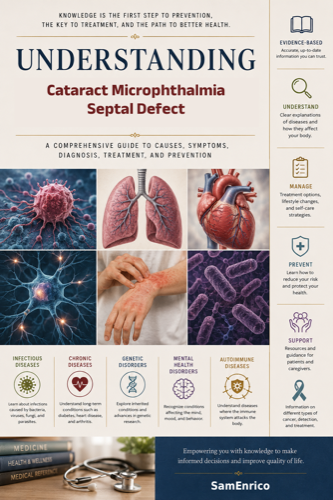
Understanding Cataract Microphthalmia Septal Defect
This disease publication, published by SamEnrico,
This disease publication, published by SamEnrico, covers Understanding Cataract Microphthalmia Septal Defect
Formats
About this book
Free sample
Chapter 1: The Storm Before the Diagnosis--The first time a parent hears the words “cataract,” “microphthalmia,” and “septal defect” strung together, it sounds like three separate disasters. An eye that is too small. A lens that is clouded. A heart with a hole. In the examining room, these words land like hammer blows, each one seemingly unrelated to the last.
The ophthalmologist speaks of vision loss and glaucoma. The cardiologist murmurs about surgical timing and pulmonary overcirculation. The dentist, years later, will mention something about long tooth roots on a routine X-ray. No one uses the same language. No one connects the dots.
And for the family sitting in the middle of this fragmented medical odyssey, the silence between specialists is the loudest sound in the world.This chapter is about that silence—and about breaking it.The title of this book, Understanding Cataract Microphthalmia Septal Defect, is a clinical descriptor, not a true diagnosis. It is the medical equivalent of calling a hurricane “rain, wind, and thunder” without naming the storm. Each word is accurate. Each word describes a real, measurable finding. But strung together without context, they obscure more than they reveal.
They hide the unifying truth that transforms three frightening words into a single, coherent, manageable syndrome.That unifying truth is Oculofaciocardiodental (OFCD) syndrome (MIM #300166), also known as Syndromic Microphthalmia Type 2 (MCOPS2). These are the correct names for the condition that causes cataracts, small eyes, and septal defects to appear together—not by coincidence, but by design. The same genetic instruction, written in the same chapter of the human genome, directs the development of the lens of the eye, the size of the orbit, the wall between the heart’s chambers, the shape of the face, and the roots of the teeth. When that instruction is altered, all of these structures develop differently. The pattern is not random.
It is not bad luck. It is genetics.This chapter will dismantle the title of this book word by word, then rebuild it into something useful: a framework for recognizing OFCD syndrome early, for distinguishing it from other conditions that look…
This is the end of the free sample. Get the eBook to keep going. Buy now
Contents
- Chapter 1
- Chapter 2
- Chapter 3
- Chapter 4
- Chapter 5
- Chapter 6
- Chapter 7
- Chapter 8
- Chapter 9
- Chapter 10
- Chapter 11
- Chapter 12
Details
- Author
- Adler Elinore
- Publisher
- SamEnrico
- Language
- English
- Genre
- Non-Fiction, Informative, Educational
- Released
- 2026-06-03
- Pages (approx.)
- 155
- Available as
- eBook, Audiobook

Read better in the ZLOADR app
Your eBooks on your phone or tablet. Sign in with your SamEnrico account and start reading.
More by Adler Elinore
 LBO Add On Acquisition ModelingAdler Elinore$11.99
 LBO Case Study DatabaseAdler Elinore$11.99
 Discord Voice Chat Overuse WorkbookAdler Elinore$11.99
 Bariatric Surgery Fertility GuideAdler Elinore$11.99
 Body Scan Meditation Stress ReliefAdler Elinore$11.99
 Wings Over the World: The Untold Story of JAL's 1985 Miracle LandingAdler Elinore$11.99
 The First Amazon: Mapping the World's Greatest River in Ancient TimesAdler Elinore$11.99
 Proposal Revision StrategiesAdler Elinore$12.99
 AI Revenue Trend AnalysisAdler Elinore$12.99
 Sales Development RepresentativeAdler Elinore$11.99
 How to Become a Inker And OpaquerAdler Elinore$11.99