
Non-FictionInformativeEducational
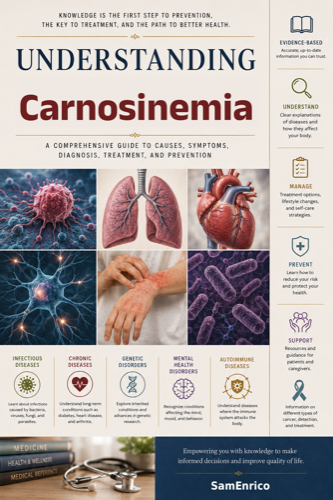
Understanding Carnosinemia eBook
This disease publication, published by SamEnrico,
This disease publication, published by SamEnrico, covers Understanding Carnosinemia
Formats
Free sample
Chapter 1: The Molecular Loom...--–- In the quiet, unseen world of human metabolism, trillions of chemical reactions unfold every second, weaving together the fabric of life itself. This intricate loom operates without conscious thought, yet its precision determines everything from the energy in a child's laugh to the myelin sheath insulating a single neuron. When the loom functions perfectly, health emerges as a seamless tapestry. But when a single thread frays—when one enzyme fails to do its job—the pattern can unravel in ways that science is still struggling to understand. This book is about one such frayed thread: a rare metabolic condition called carnosinemia.
To grasp what goes wrong in this disease, we must first understand how the metabolic loom is supposed to work. We must learn the language of dipeptides, the roles of specialized enzymes, the sources of the molecule called carnosine, and the elegant system of checks and balances that maintains homeostasis in the human body.The Architecture of Metabolism: A City of Chemical Reactions Imagine the human body as a vast, bustling city. Within this city, thousands of factories operate simultaneously. Some factories break down raw materials into energy. Others assemble complex structures from simple building blocks.
Still others recycle waste products or produce signaling molecules that allow different districts to communicate. This entire industrial complex is metabolism—the sum total of all chemical reactions occurring within our cells.At the heart of this metabolic city are enzymes. Enzymes are specialized proteins that act as workers, foremen, and quality control inspectors. Each enzyme has a specific job: it recognizes a particular molecule (called a substrate) and transforms it into a different molecule (called a product) through a carefully orchestrated chemical reaction. Without enzymes, the reactions that sustain life would occur millions of times too slowly to keep us alive.
With enzymes, metabolism proceeds at breathtaking speed and remarkable accuracy.To understand carnosinemia, we need to zoom in on one small neighborhood within this metabolic city: the world of amino acids and the small molecules they form when linked together.Amino Acids: The Alphabet of Life Before we can understand carnosine, we must understand its constituent parts. Amino acids are organic compounds that serve as the fundamental building blocks of proteins. Twenty standard amino acids appear in the human body, each with a unique side chain that gives it distinct chemical properties. Some amino acids are hydrophobic and cluster together away from water. Others carry electric charges and interact readily with their aqueous environment.
Some are tiny and flexible; others are bulky and rigid.The human body can synthesize many amino acids from other metabolic precursors. However, nine amino acids—histidine, isoleucine, leucine, lysine, methionine, phenylalanine, threonine, tryptophan, and valine—are considered essential because we cannot produce them internally. We must obtain these essential amino acids from our diet, primarily from protein-rich foods like meat, fish, eggs, dairy, and legumes.Two amino acids are particularly relevant to our story: beta-alanine and histidine. Beta-alanine is a non-essential amino acid, meaning the body can synthesize it from other compounds. Histidine is essential in children (and conditionally essential in adults), requiring dietary intake to maintain adequate levels.
When these two amino acids link together through a specific type of chemical bond called a peptide bond, they form a dipeptide—a molecule consisting of exactly two amino acids joined end to end.That dipeptide is carnosine.Carnosine: A Dipeptide with Remarkable Properties Carnosine (beta-alanyl-L-histidine) is a deceptively simple molecule with an extraordinary range of biological activities. First discovered in 1900 by Russian chemist Vladimir Gulevich, carnosine has since been shown to participate in numerous physiological processes. It acts as an antioxidant, protecting cells from damage caused by reactive oxygen species. It buffers p H in muscle tissue, allowing muscles to continue contracting during intense exercise when lactic acid accumulates. It chelates metal ions, preventing them from catalyzing harmful reactions.
It even appears to influence gene expression and protein folding.Despite this impressive resume, carnosine is not typically considered an essential nutrient. The human body produces carnosine endogenously—that is, from within—using the enzyme carnosine synthase to join beta-alanine and histidine. Additionally, we ingest significant quantities of carnosine when we consume animal products. Red meat, poultry, and fish are particularly rich sources, with beef and pork containing the highest concentrations. Plant-based foods contain negligible amounts of carnosine, as plants do not synthesize this dipeptide.Under normal circumstances, carnosine levels in the body are tightly regulated.
When carnosine is no longer needed, or when its concentration rises too high, specialized enzymes break it down into its constituent amino acids, which can then be recycled for other purposes. This breakdown process is where carnosinemia begins—not with the production of carnosine, but with its destruction.The Carnosinase Enzymes: CN1 and CN2Humans possess two primary enzymes capable of breaking down carnosine. Both belong to a family of enzymes called dipeptidases, which cleave dipeptides into their individual amino acid components. However, these two enzymes differ in their genetic origins, tissue distributions, substrate preferences, and physiological roles.Serum Carnosinase (CN1) is encoded by the CNDP1 gene located on chromosome 18. As its name suggests, CN1 circulates in the blood—specifically in the serum, the liquid component of blood that remains after clotting factors have been removed.
CN1 is a secreted enzyme, meaning cells produce it and then release it into the extracellular space where it can travel throughout the body via the bloodstream. The primary source of CN1 is the liver, though other tissues contribute to a lesser degree.CN1 has a strong preference for carnosine as its substrate, though it can also break down other dipeptides containing beta-alanine, such as anserine (beta-alanyl-1-methylhistidine) and homocarnosine (gamma-aminobutyryl-histidine). When CN1 encounters carnosine, it hydrolyzes—or cleaves—the peptide bond, releasing free beta-alanine and free histidine into the bloodstream. These individual amino acids can then be taken up by cells and used for protein synthesis, energy production, or other metabolic pathways.Tissue Carnosinase (CN2) is encoded by the CNDP2 gene located on chromosome 18q22.3, in close proximity to CNDP1. Unlike CN1, CN2 is primarily an intracellular enzyme, meaning it remains inside cells rather than being secreted.
CN2 is widely distributed throughout the body, with particularly high concentrations in the brain, kidneys, and liver. Within the brain, CN2 is found in neurons and glial cells, where it plays a role in breaking down homocarnosine—a dipeptide specifically found in the central nervous system that is involved in GABA metabolism.CN2 has broader substrate specificity than CN1. While CN2 can certainly break down carnosine, it also cleaves many other dipeptides, including those not containing beta-alanine. This broader specificity suggests that CN2 serves a more general housekeeping function within cells, helping to maintain appropriate levels of various dipeptides, whereas CN1 has evolved as a more specialized enzyme for carnosine metabolism in the circulation.The Critical Distinction: Why Are There Two Enzymes?The existence of two distinct carnosinase enzymes raises an obvious question: why do we need both? The answer lies in the compartmentalization of metabolism—the principle that different chemical reactions occur in different locations within the body, each optimized for its specific environment.CN1 operates in the bloodstream, where it functions as a gatekeeper, regulating…
This is the end of the free sample. Get the eBook to keep going. Buy now
About this book
Details
- Author
- France Kathlene
- Publisher
- SamEnrico
- Language
- English
- Genre
- Non-Fiction, Informative, Educational
- Released
- 2026-05-11
- Pages (approx.)
- 158
- Available as
- eBook, Audiobook

Read better in the ZLOADR app
Your eBooks on your phone or tablet. Sign in with your SamEnrico account and start reading.
More by France Kathlene
 Diamonds Uncensored StoryFrance Kathlene$11.99
 HIIT for Skiers and SnowboardersFrance Kathlene$11.99
 Smoking Cessation Skin BenefitsFrance Kathlene$11.99
 Mother's Alcohol BlackoutsFrance Kathlene$11.99
 Low Vision Gardening GuideFrance Kathlene$11.99
 The Silent Revolution: How a Japanese Engineer Invented the First Practical High-Level Programming LanguageFrance Kathlene$11.99
 The Last Broadcast: How a Pirate Radio Station Defied the FCC for 30 YearsFrance Kathlene$11.99
 Late Exam Start ProtocolFrance Kathlene$12.99
 Young Decision Maker Selling GuideFrance Kathlene$12.99
 How to Start a Potato Starch Business (Beginners Guide)France Kathlene$11.99
 Payload CreatorFrance Kathlene$11.99
You may also like
 Hong Kong Handover 1997Dunn Johnnie$11.99
 Zumba For Postnatal Recovery CourseNeal Christian$11.99
 Zumba for BeginnersLadner Nikia$11.99
 YouTube Comment Mining GuideHumes Pandora$12.99
 Worry Box MeditationCarlin Rudy$11.99
 Workplace Stress MeditationNguyen Lynn$11.99
 Workplace Stress and Sleep RepairHawley Ivory$11.99
 Workplace Perfectionism CureDelaney Jeffry$11.99
 Workplace Injustice Anger GuideWallen Isabelle$11.99
 Work Addiction and Burnout LinkGreenwood Ester$11.99
 Women in Yoga and WellnessBeattie Galina$11.99
 Women in Stand Up ComedyChun Evangeline$11.99