
Non-FictionInformativeEducational
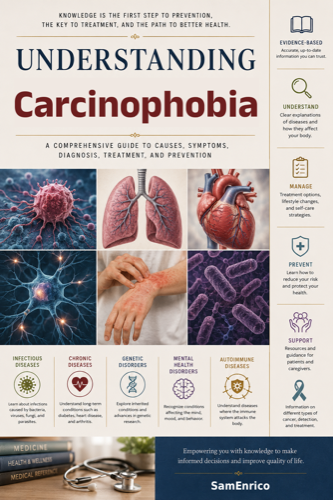
Understanding Carcinophobia eBook
This disease publication, published by SamEnrico,
This disease publication, published by SamEnrico, covers Understanding Carcinophobia
Formats
Free sample
Chapter 1: The Twelfth Mammogram--– In the dim fluorescence of a radiology waiting room, a thirty-four-year-old woman named Elena sat clutching a paper gown that gaped open at the back. She had been here eleven times before. Each previous visit had ended the same way: a radiologist's calm voice, a normal result, a few days of peace, and then the creeping return of certainty that something had been missed. Today was her twelfth mammogram in twenty-four months. She had no family history of breast cancer.
She carried no genetic mutations. Her only risk factor was an imagination that had learned to turn every twinge, every fleeting ache, every slightly irregular texture in her breast tissue into a death sentence.The technician called her name. Elena stood, walked through the double doors, and pressed her breast against the cold compression plate for the twelfth time. She held her breath. The machine hummed.
And somewhere beneath her ribcage, a small voice whispered: This time, they will find it. This time, you will be right.That voice was wrong. The mammogram was normal. The radiologist, who had begun to recognize Elena's face, gently suggested she might benefit from speaking with someone about health anxiety. Elena nodded, took the all-clear letter, and drove home.
For three days, she felt light, almost giddy. On the fourth day, she noticed a mild ache in her left armpit. By the fifth day, she had already Googled "axillary lymphadenopathy breast cancer" and scheduled mammogram number thirteen.Elena is not crazy. She is not weak. She is not attention-seeking or hypochondriacal in the pejorative sense that word has carried for decades.
Elena has a specific, treatable, and increasingly common condition: carcinophobia. This book is for her. It is also for the man who cannot say the word "chemotherapy" without his throat closing. For the cancer survivor who checks her scar every night, five years after being declared NED. For the parent who has secretly prayed that a routine cough in their child is just a cold.
For the partner who has spent more hours Googling "pancreatic cancer symptoms" than planning their next vacation. For everyone who has ever thought: I am not afraid of much, but I am terrified of cancer.This chapter will establish what carcinophobia really is and, just as importantly, what it is not. It will distinguish rational vigilance from clinical phobia, map the hidden epidemic of cancer fear in the age of awareness campaigns, introduce the three subtypes of carcinophobia that will be addressed throughout this book, and present the core paradox that will guide everything that follows: reassurance does not cure phobia. It fuels it.The Critical Distinction: Vigilance Versus Phobia Let us begin with a distinction that will save you years of confusion if you internalize it now. There is a difference between rational cancer vigilance and clinical carcinophobia.
The difference is not in the presence of fear but in its proportion to actual risk and its interference with daily functioning.Rational vigilance looks like this: a sixty-year-old former smoker with a forty-pack-year history and a father who died of lung cancer gets an annual low-dose CT scan as recommended by the USPSTF. He does not enjoy the scan. He feels a flutter of anxiety before the results. But between scans, he lives his life. He does not check his breathing multiple times per day.
He does not avoid friends who smoke. He does not cancel travel plans because he might be "too far from a hospital." His vigilance is targeted, time-limited, and evidence-based.Clinical carcinophobia looks like this: a thirty-year-old never-smoker with no family history of cancer feels a mild, intermittent ache in his chest. He has felt this ache before, usually after sleeping in an awkward position or lifting something heavy. But this time, his brain flags it as "lung cancer." He spends the next four hours Googling mesothelioma statistics. He cancels dinner plans.
He calls his doctor after hours. The doctor, based on age and risk factors, recommends ibuprofen and rest. The man feels temporarily relieved. The next morning, the ache is still there—because he slept poorly in a state of anxiety—and the cycle begins again.The difference is not the symptom. The difference is the response to the symptom.
Rational vigilance responds to probability and evidence. Clinical carcinophobia responds to possibility and feeling. And because possibility is infinite (anything could be cancer) and feeling is immediate, the phobic response never lacks fuel.Elena's twelve mammograms illustrate the same principle. A single mammogram at age thirty-four without risk factors is not rational vigilance; it is already a concession to anxiety. Twelve mammograms in two years is a full surrender.
Each test confirmed what Elena already knew intellectually—that she did not have breast cancer—but could not feel emotionally. Her fear was never about the evidence. It was about the experience of uncertainty. And no test, no matter how sensitive, can eliminate uncertainty entirely.The Hidden Epidemic: Why Now?Carcinophobia is not new, but it is newly prevalent. Clinicians across primary care, oncology, and psychiatry report a striking increase in patients presenting with debilitating fear of cancer in the absence of any reasonable risk factors.
Several converging cultural forces explain this rise, and understanding them is essential because they are not going away.First, the awareness-industrial complex. Pink ribbon campaigns, cancer awareness months, foundation commercials featuring young children with shaved heads, and relentless media coverage of rare cancers in celebrities have created an environment in which cancer is simultaneously the most feared disease and the most visible one. The implicit message of these campaigns is that cancer is everywhere, that it strikes without warning, that it does not discriminate, and that the only responsible response is constant vigilance. For a person predisposed to health anxiety, this message is not empowering. It is terrorizing.Second, the democratization of medical information (and misinformation).
Twenty years ago, if you felt a lump, you called your doctor. Now you Google it first. And Google, as we will explore in depth in Chapter 5, is the worst possible oncologist. Search algorithms prioritize rare, dramatic, and terminal conditions because those generate the most clicks, engagement, and advertising revenue. A search for "headache" will surface "brain tumor" before "tension headache" because the algorithm has learned that fear drives behavior.
The result is a generation of people who have diagnosed themselves with terminal illnesses they do not have, based on symptoms that are statistically almost certainly benign.Third, the collapse of medical authority. Trust in physicians has declined significantly over the past two decades. This is not entirely irrational—medicine has made real errors, and patients have legitimate reasons to advocate for themselves. But for the carcinophobe, declining trust means that a doctor's "you are fine" carries less weight than a stranger's "I had that symptom and it was cancer" on a Reddit forum. The result is endless reassurance-seeking across multiple providers, multiple tests, and multiple second opinions—none of which satisfy because the problem was never insufficient evidence.
It was an inability to tolerate uncertainty.Fourth, the pandemic effect. The COVID-19 pandemic normalized health hypervigilance on a global scale. Millions of people spent years monitoring themselves for fever…
This is the end of the free sample. Get the eBook to keep going. Buy now
About this book
Details
- Author
- Mcfall Alishia
- Publisher
- SamEnrico
- Language
- English
- Genre
- Non-Fiction, Informative, Educational
- Released
- 2026-05-06
- Pages (approx.)
- 152
- Available as
- eBook, Audiobook

Read better in the ZLOADR app
Your eBooks on your phone or tablet. Sign in with your SamEnrico account and start reading.
More by Mcfall Alishia
 Reddit Compulsive Check WorkbookMcfall Alishia$11.99
 Parent Teen Anger GuideMcfall Alishia$11.99
 Incubation Period MethodMcfall Alishia$11.99
 Senior Balance and Fall PreventionMcfall Alishia$11.99
 Smoking Relapse Prevention CourseMcfall Alishia$11.99
 The Bitcoin Laundromat: How a Tech Startup Became a Money Mule EmpireMcfall Alishia$11.99
 Seeds of the Sky: The Forgotten Farmers of the AndesMcfall Alishia$11.99
 Student Discounts Europe GuideMcfall Alishia$12.99
 Oman B2B Sales GuideMcfall Alishia$12.99
 Osarizawaite MiningMcfall Alishia$11.99
 How to Start a Hobby in MetrophileMcfall Alishia$11.99
You may also like
 Hong Kong Handover 1997Dunn Johnnie$11.99
 Zumba For Postnatal Recovery CourseNeal Christian$11.99
 Zumba for BeginnersLadner Nikia$11.99
 YouTube Comment Mining GuideHumes Pandora$12.99
 Worry Box MeditationCarlin Rudy$11.99
 Workplace Stress MeditationNguyen Lynn$11.99
 Workplace Stress and Sleep RepairHawley Ivory$11.99
 Workplace Perfectionism CureDelaney Jeffry$11.99
 Workplace Injustice Anger GuideWallen Isabelle$11.99
 Work Addiction and Burnout LinkGreenwood Ester$11.99
 Women in Yoga and WellnessBeattie Galina$11.99
 Women in Stand Up ComedyChun Evangeline$11.99