
Non-FictionInformativeEducational
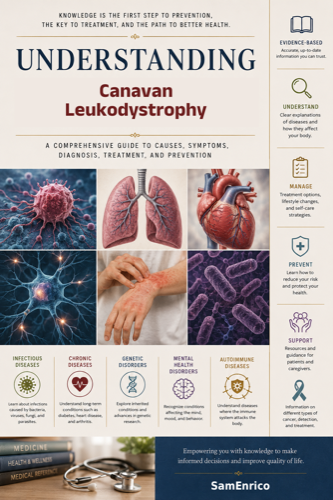
Understanding Canavan Leukodystrophy eBook
This disease publication, published by SamEnrico,
This disease publication, published by SamEnrico, covers Understanding Canavan Leukodystrophy
Formats
Free sample
Chapter 1: The Spongy Brain...--Imagine holding a newborn who grips your finger with perfect, reflexive strength. Now imagine watching that same hand, six months later, flopping uselessly at the wrist – unable to reach, unable to grasp, unable to hold onto anything except the diminishing hope you carry. This is the arc of Canavan leukodystrophy, a disease that does not announce itself with a dramatic crisis but with a quiet, devastating subtraction: first the loss of head control, then the loss of sitting, then the loss of eye contact, then the loss of almost everything except the child's presence. This chapter is not a clinical introduction. It is a doorway.
Step through it, and you will learn what this disease actually is – not the terrifying rumors you may have heard, not the oversimplified explanations from hurried doctors, but the precise, understandable, and surprisingly logical biology that turns a healthy infant's brain into what pathologists call "spongy degeneration."What the Name Actually Means The term "leukodystrophy" comes from Greek and Latin roots: leuko (white), dys (abnormal or impaired), and trophy (growth or nourishment). Put together, it means "abnormal growth of white matter." But that translation is slightly misleading. The problem is not that white matter grows incorrectly – it is that white matter fails to grow correctly and then begins to die. Think of a construction crew building a skyscraper. If the steel beams never arrive, the building stays a hollow frame.
If the beams arrive but are made of brittle metal, the frame cracks and collapses. In Canavan, both things happen: the white matter never gets the materials it needs to build properly, and the materials that do arrive are toxic to the structure that exists."Leukodystrophy" is the family name. Canavan is the specific first name within that family. There are dozens of leukodystrophies – Krabbe, metachromatic, Alexander, adrenoleukodystrophy (made famous by the film Lorenzo's Oil). Each one attacks white matter, but each uses a different weapon.
Krabbe destroys oligodendrocytes directly. Metachromatic accumulates sulfatides that poison the myelin. Canavan floods the brain with a single molecule called N-acetylaspartate (NAA) until the white matter becomes waterlogged and vacuolated. That last word – vacuolated – is the key to the nickname this disease earned in pathology textbooks: spongy degeneration.The Spongy Degeneration Explained If you cut a thin slice of a healthy brain and look at it under a microscope, the white matter appears dense and organized – like a tightly woven wool sweater. The myelin sheaths wrap around axons in concentric layers, and the oligodendrocytes (the cells that make myelin) sit like factory workers at their stations.
Now take a slice of white matter from a child with advanced Canavan. The structure is gone. Instead of a sweater, you see something that looks like Swiss cheese: holes everywhere, fluid-filled spaces where myelin used to be, cells swollen to twice their normal size. This is spongy degeneration. The brain tissue has not turned into literal sponge, of course.
But it has lost its integrity. It has become porous, fragile, inefficient.Imagine a sponge soaked with water. Squeeze it, and water runs out. That is not what happens in Canavan – the water is trapped inside the cells and the spaces between them. The brain is not leaking; it is drowning from within.
And because the brain is enclosed in a hard skull, that drowning has nowhere to go. The pressure builds. The head grows. This is why macrocephaly – an abnormally large head – is one of the hallmark signs of infantile Canavan, appearing in more than 85% of cases by the age of one year. The brain is literally swelling, not from infection or bleeding, but from the accumulation of a single biochemical mistake.A Brief History: Dr.
Myrtle Canavan's Discovery The year is 1931. A pathologist named Dr. Myrtle Canavan is working at the Boston City Hospital and the Harvard Medical School. She is one of the few women in American medicine at a time when female physicians were still a rarity. A 16-month-old child dies after a progressive neurological illness that no one can name.
The child had presented with the classic features that would later become diagnostic: early normal development, then hypotonia (floppiness), then head enlargement, then spasticity, then blindness, then death. Dr. Canavan performs an autopsy. She examines the brain under her microscope. She sees the holes, the vacuoles, the spongy appearance.
She writes a paper titled "Schilder's Encephalitis Periaxialis Diffusa" – borrowing a name from a similar disease described by another doctor – but she adds a crucial observation: the myelin sheaths are not inflamed. They are simply gone, replaced by fluid.For decades, the disease carried various names: Canavan's disease, Canavan's leukodystrophy, spongy degeneration of the brain. But the underlying cause remained a mystery. Why did some families have multiple affected children? Why did the disease cluster in certain populations?
Scientists suspected a genetic cause, but the technology to find genes was decades away. In 1988, a research team led by Reuben Matalon identified the culprit: a missing enzyme called aspartoacylase. In 1993, the gene that codes for this enzyme – the ASPA gene on chromosome 17 – was cloned and sequenced. Suddenly, Canavan joined the small group of metabolic disorders that could be understood not just by their appearance under a microscope but by the precise letter-by-letter spelling of the genetic code that had gone wrong. Dr.
Myrtle Canavan could not have known, when she peered through her microscope in 1931, that she was looking at a disease defined by a single typo on a single gene. But she knew she was looking at something distinct. That distinction has saved thousands of families from misdiagnosis – and has opened the door to the gene therapies now on the horizon.How Canavan Differs from Other Leukodystrophies One of the most common sources of confusion for newly diagnosed families – and even for general pediatricians – is the alphabet soup of leukodystrophies. Tay-Sachs. Krabbe.
Alexander. Metachromatic. Adrenoleukodystrophy. They all sound similar. They all affect white matter.
They all cause regression and early death. But the differences matter enormously, because treatment options, genetic counseling, disease progression, and even the possibility of newborn screening depend entirely on which disease you are facing.Canavan vs. Tay-Sachs: Both diseases are more common in Ashkenazi Jewish populations. Both cause regression in infancy. But Tay-Sachs is a gangliosidosis – it accumulates GM2 ganglioside in neurons, not NAA in white matter.
The key clinical difference: macrocephaly is common in Canavan; Tay-Sachs children typically have normal or small heads. Also, Tay-Sachs produces a characteristic cherry-red spot on the retina, visible during an eye exam. That spot is absent in Canavan.Canavan vs. Krabbe: Krabbe disease (also called globoid cell leukodystrophy) presents with extreme irritability, unexplained crying, and peripheral neuropathy (damage to nerves outside the brain and spinal cord). Canavan infants are typically hypotonic and quiet, not irritable.
Krabbe also responds to bone marrow transplant if caught very early – the only leukodystrophy for which that is true. Canavan does not respond to bone marrow transplant, as Chapter 10 will explain in detail.Canavan vs. Alexander Disease: Alexander is also a leukodystrophy that causes macrocephaly and regression. But it is caused by mutations in the GFAP gene, not ASPA. The key distinguishing feature on MRI: Alexander disease typically…
This is the end of the free sample. Get the eBook to keep going. Buy now
About this book
Details
- Author
- Banuelos Madelaine
- Publisher
- SamEnrico
- Language
- English
- Genre
- Non-Fiction, Informative, Educational
- Released
- 2026-05-09
- Pages (approx.)
- 153
- Available as
- eBook, Audiobook

Read better in the ZLOADR app
Your eBooks on your phone or tablet. Sign in with your SamEnrico account and start reading.
More by Banuelos Madelaine
 Hospitality Anger Management GuideBanuelos Madelaine$11.99
 Strategic Innovation WorkbookBanuelos Madelaine$11.99
 OCD And ADHD ComorbidityBanuelos Madelaine$11.99
 Survey Response Parsing with AIBanuelos Madelaine$11.99
 Nonverbal Cues In Sports HandbookBanuelos Madelaine$11.99
 The Ghost in the Machine: How a Single Hacker Nearly Collapsed the Internet in 2016Banuelos Madelaine$11.99
 Echoes of the Lost Battalion: The Forgotten 300Banuelos Madelaine$11.99
 Small Liberal Arts College PhD PathBanuelos Madelaine$12.99
 Latvian University Master GuideBanuelos Madelaine$12.99
 Dice MakerBanuelos Madelaine$11.99
 How to Start a Construction of Indoor Sports Facilities Business (Beginners Guide)Banuelos Madelaine$11.99
You may also like
 Hong Kong Handover 1997Dunn Johnnie$11.99
 Zumba For Postnatal Recovery CourseNeal Christian$11.99
 Zumba for BeginnersLadner Nikia$11.99
 YouTube Comment Mining GuideHumes Pandora$12.99
 Worry Box MeditationCarlin Rudy$11.99
 Workplace Stress MeditationNguyen Lynn$11.99
 Workplace Stress and Sleep RepairHawley Ivory$11.99
 Workplace Perfectionism CureDelaney Jeffry$11.99
 Workplace Injustice Anger GuideWallen Isabelle$11.99
 Work Addiction and Burnout LinkGreenwood Ester$11.99
 Women in Yoga and WellnessBeattie Galina$11.99
 Women in Stand Up ComedyChun Evangeline$11.99