
Non-FictionInformativeEducational
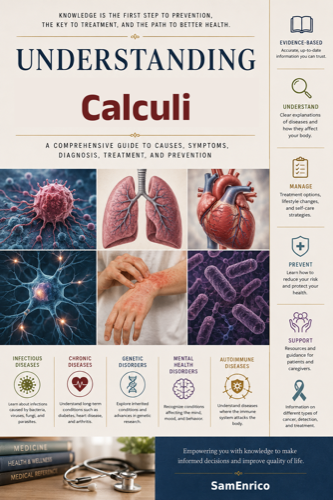
Understanding Calculi eBook
This disease publication, published by SamEnrico,
This disease publication, published by SamEnrico, covers Understanding Calculi
Formats
Free sample
Chapter 1: The Silent Epidemic...-- In the predawn hours of a Tuesday morning, a fifty-three-year-old construction worker named Michael awoke to what he would later describe as a knife twisting inside his left flank. He had survived three decades of heavy labor, a fractured pelvis from a scaffolding collapse, and the searing heat of Arizona summers, but this pain was different. It came in waves, each crescendo climbing higher than the last, radiating downward into his groin until he found himself curled on the bathroom floor, vomiting into the toilet while his wife dialed 911. The emergency physician delivered a diagnosis that would change Michael's life: a 7-millimeter calcium oxalate stone lodged at the ureteropelvic junction, complete with hydronephrosis and a creatinine level creeping upward. Michael had joined an exclusive club that nobody wants to belong to—the one in eleven Americans who will experience a kidney stone in their lifetime.This chapter establishes the public health significance of urinary calculi, framing kidney stone disease not as an intermittent nuisance but as a growing global epidemic with profound economic, occupational, and human costs.
For decades, kidney stones were dismissed by the medical establishment as an uncomfortable but relatively benign condition—a "stone, water, and waiting" disease that required little more than analgesics and a strainer. That perception has shattered. Contemporary epidemiological data reveal that urolithiasis now affects approximately one in eleven individuals in the United States, with lifetime prevalence rising from 3.8 percent in the 1970s to nearly 11 percent in the most recent National Health and Nutrition Examination Survey (NHANES) data. Among men, the lifetime risk approaches 15 percent; among women, it has climbed to nearly 10 percent, narrowing a historical gender gap that once favored males by a ratio of three to one. The economic burden is staggering: over 1.2 million emergency department visits annually, hundreds of thousands of hospital admissions for surgical intervention, and direct medical costs estimated between five and ten billion dollars per year in the United States alone.
Lost workdays add billions more, with the average stone former missing eight to twelve days of work per acute episode—time that cannot be recovered and productivity that cannot be replaced.But the epidemic is not confined to America's borders. Across the globe, urolithiasis prevalence has risen sharply in parallel with industrialization, dietary westernization, and climate change. The so-called "stone belts"—regions where lifetime risk exceeds the global average of 8 to 10 percent—include the southeastern United States (the "kidney stone belt" stretching from Texas through the Carolinas), the Middle East (Saudi Arabia, Kuwait, and the United Arab Emirates, where prevalence reaches 20 percent in some adult male populations), the Indian subcontinent (particularly northern and western India, Pakistan, and Bangladesh), and parts of Southeast Asia. In the Middle East, the combination of extreme heat, chronic dehydration from outdoor labor, high-oxalate diets rich in spinach and nuts, and genetic predisposition among consanguineous populations has created a perfect storm of stone formation. In India, the shift from traditional high-fiber, low-protein diets to westernized eating patterns has accelerated stone incidence, particularly in urban centers like Mumbai and Delhi, where fast food consumption and reduced physical activity have become normative.The Changing Demographics of Stone Disease Perhaps the most alarming epidemiological trend is the emergence of kidney stones in populations once considered low-risk.
Historically, urolithiasis was a disease of middle-aged white men—obese, sedentary, and consuming a diet rich in animal protein and sodium. That demographic profile has expanded dramatically. Women now account for nearly half of all new stone diagnoses, a shift driven by rising obesity rates, changes in dietary patterns, and possibly increased diagnostic imaging that detects stones previously missed. The female predominance in struvite stones (infection-related) persists, but calcium oxalate stones—once rare in women—now occur at nearly the same frequency as in men among postmenopausal women, suggesting that estrogen's protective effect (enhanced urinary citrate excretion and reduced calcium absorption) diminishes with age and is overwhelmed by modern dietary and lifestyle factors.Children represent an even more concerning frontier. Two decades ago, pediatric nephrolithiasis was a rare clinical curiosity, typically associated with inborn errors of metabolism such as cystinuria or primary hyperoxaluria.
Today, pediatric stone clinics have become standard fixtures at major children's hospitals, with incidence rising four to six percent annually over the past fifteen years. The typical pediatric stone former is no longer a child with a genetic disorder but an adolescent—often overweight or obese, consuming a diet high in sodium and low in fluid, with metabolic abnormalities that mirror those seen in adults. A fifteen-year-old girl presenting with recurrent calcium oxalate stones, hypercalciuria, and hypocitraturia would have been a medical anomaly in 1990; today, she is a routine referral to pediatric nephrology. This shift has profound implications for lifelong disease burden: a child who forms a first stone at age twelve faces decades of recurrence, multiple surgical interventions, progressive renal damage from obstructive episodes, and the cumulative cost of preventive medications and dietary monitoring.Genetic Predisposition: The Inherited Risk Stone disease runs in families, and the heritability is stronger than most patients realize. First-degree relatives of stone formers carry a two-and-a-half to three-fold elevated lifetime risk compared to the general population, even after controlling for shared dietary and environmental factors.
Twin studies have refined this estimate: monozygotic twins (identical) show concordance rates for urolithiasis approximately twice that of dizygotic twins (fraternal), suggesting that genetic factors account for 45 to 60 percent of disease susceptibility. This heritability is not attributable to a single gene but rather to a polygenic architecture involving dozens of loci that influence urinary calcium excretion, oxalate absorption, citrate production, urine p H, and the expression of crystal inhibitors like osteopontin and Tamm-Horsfall protein.Several monogenic forms of stone disease, though rare, illustrate the power of single-gene defects. Cystinuria, caused by mutations in SLC3A1 or SLC7A9 (genes encoding the transport proteins responsible for reabsorbing cystine in the proximal tubule), produces recurrent stones beginning in childhood or early adulthood and carries a near-100 percent lifetime recurrence rate without aggressive medical management. Primary hyperoxaluria types 1, 2, and 3—autosomal recessive disorders of glyoxylate metabolism—lead to massive hepatic overproduction of oxalate, causing calcium oxalate stones, nephrocalcinosis, and often end-stage renal disease by early adulthood. Distal renal tubular acidosis (RTA), caused by mutations in the AE1 (SLC4A1) or ATP6V1B1 genes, produces calcium phosphate stones in a persistently alkaline, hypocitraturic urine.
The Dent's disease family (X-linked recessive disorders caused by CLCN5 or OCRL mutations) causes low-molecular-weight proteinuria, hypercalciuria, and progressive nephrolithiasis and nephrocalcinosis in affected males.For the vast majority of stone formers, however, the genetic contribution manifests as polygenic susceptibility: multiple common variants, each with modest effect size, that collectively increase risk. Genome-wide association studies (GWAS) have identified over twenty loci associated with urolithiasis, including variants in CLDN14 (affecting paracellular calcium transport in the thick ascending limb), SLC34A1 (encoding a sodium-phosphate cotransporter), and ALPL (tissue-nonspecific alkaline phosphatase, involved in pyrophosphate metabolism, a natural crystal inhibitor). These findings have not yet translated into routine clinical genetic testing—the predictive value remains too low and the cost too high—but they point toward future personalized prevention strategies that target an individual's specific metabolic vulnerabilities.Modifiable Risk Factors: Where Patients Have Control If genetics loads the gun, environment…
This is the end of the free sample. Get the eBook to keep going. Buy now
About this book
Details
- Author
- Sanborn Kenna
- Publisher
- SamEnrico
- Language
- English
- Genre
- Non-Fiction, Informative, Educational
- Released
- 2026-05-23
- Pages (approx.)
- 159
- Available as
- eBook, Audiobook

Read better in the ZLOADR app
Your eBooks on your phone or tablet. Sign in with your SamEnrico account and start reading.
More by Sanborn Kenna
 OCD And Hoarding DisorderSanborn Kenna$11.99
 The Discord Gaming Server EscapeSanborn Kenna$11.99
 Parenting with Depression GuideSanborn Kenna$11.99
 Body Language For Customer Service GuideSanborn Kenna$11.99
 Survey Data Enrichment with AISanborn Kenna$11.99
 The Ghost of Flight 447: Voices from the Black BoxSanborn Kenna$11.99
 STEM PhD Without First Author PaperSanborn Kenna$12.99
 Soft Landing After PR ApprovalSanborn Kenna$12.99
 York Gum HarvestingSanborn Kenna$11.99
 How to Become a Car-cleaning SupervisorSanborn Kenna$11.99
You may also like
 Hong Kong Handover 1997Dunn Johnnie$11.99
 Zumba For Postnatal Recovery CourseNeal Christian$11.99
 Zumba for BeginnersLadner Nikia$11.99
 YouTube Comment Mining GuideHumes Pandora$12.99
 Worry Box MeditationCarlin Rudy$11.99
 Workplace Stress MeditationNguyen Lynn$11.99
 Workplace Stress and Sleep RepairHawley Ivory$11.99
 Workplace Perfectionism CureDelaney Jeffry$11.99
 Workplace Injustice Anger GuideWallen Isabelle$11.99
 Work Addiction and Burnout LinkGreenwood Ester$11.99
 Women in Yoga and WellnessBeattie Galina$11.99
 Women in Stand Up ComedyChun Evangeline$11.99