
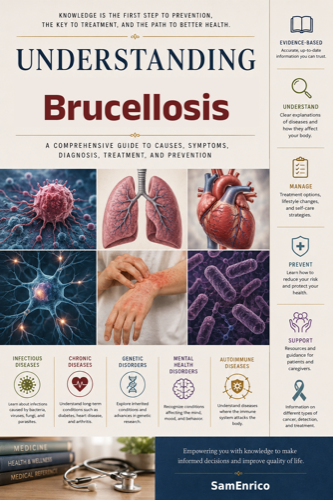
Non-FictionInformativeEducational
Understanding Brucellosis eBook
This disease publication, published by SamEnrico,
by Kohn Genie
This disease publication, published by SamEnrico, covers Understanding Brucellosis
Formats
Free sample
Chapter 1: The Forgotten Plague...--In the summer of 1856, a British soldier stationed on the Mediterranean island of Malta collapsed in the barracks. His name was Private Thomas Williams, a twenty-three-year-old infantryman from Liverpool. He had been healthy, robust, and ready for battle just one week earlier. Now he lay shivering beneath three wool blankets despite the August heat, his bedsheets soaked through with sweat, his joints aching as if they had been pulled from their sockets. The regimental surgeon recorded his symptoms in neat cursive: fever spiking to 104 degrees, drenching night sweats, severe lumbago, and a peculiar "prostration" that left the young man unable to stand without assistance.
Over the next ten days, Private Williams's fever would rise and fall like the Mediterranean tides—three days of burning heat, then a day of near-normal temperature, then another wave of fire. On the eleventh day, his fever returned with such intensity that he became delirious, calling out for his mother before losing consciousness entirely. He died three hours later.Private Williams was not killed by enemy fire. He was not struck down by cholera or typhus, the great scourges of nineteenth-century military campaigns. He died of a disease so mysterious, so protean in its manifestations, that it would baffle physicians for another three decades.
They called it Malta Fever. Later, it would be known as undulant fever, Mediterranean fever, Gibraltar fever, rock fever, and—most evocatively—the disease of a thousand faces. Today, we call it brucellosis.The story of Private Williams is not an isolated historical curiosity. By the time the British Army finished its Crimean campaign, Malta Fever had incapacitated more soldiers than all combat injuries combined. Between 1810 and 1890, over twenty thousand British troops stationed in Malta were stricken, with a case fatality rate that ranged from 2 to 10 percent depending on the year.
The disease did not discriminate by rank: privates died alongside sergeants, lieutenants, and at least one colonel. Winston Churchill, then a young cavalry officer and war correspondent, reportedly suffered from a "mysterious intermittent fever" during his 1899 sojourn in South Africa—a fever many historians now suspect was brucellosis contracted from contaminated milk.Yet for all its historical weight, brucellosis remains largely invisible to the modern world. Ask a hundred people on the street what brucellosis is, and ninety-nine will draw a blank. Those who do recognize the name might recall a vague association with farm animals or a disease that was supposedly "eradicated" decades ago. This is the first and most dangerous myth about brucellosis: that it belongs to the past.A Disease Hiding in Plain Sight Let me share a more recent story.
In 2019, a thirty-four-year-old woman named Sarah (not her real name) returned to her home in suburban Chicago after a two-week trip to Turkey. She had visited family in a rural village south of Ankara, where her aunt served fresh goat cheese made that morning from the milk of a single goat named Fatma. Sarah ate the cheese with relish, as she had done every summer since childhood. Three weeks later, she began to feel tired. Not the ordinary fatigue of jet lag, but a bone-crushing exhaustion that made climbing the stairs to her apartment feel like scaling a mountain.
Her primary care physician ran a standard battery of tests: complete blood count, metabolic panel, thyroid function, mononucleosis screen. All were normal. "It's probably a viral syndrome," the doctor told her. "Rest and fluids."Over the next eight weeks, Sarah developed fevers that came and went without apparent pattern. She would feel well enough to go to work on Monday, collapse with a fever of 102 degrees on Tuesday, feel almost normal on Wednesday, and then spike again on Thursday.
Her joints began to ache—first her knees, then her hips, then the small joints of her hands. She developed a cough. She lost fifteen pounds without trying. She saw three different doctors. She was tested for lupus, rheumatoid arthritis, Lyme disease, multiple sclerosis, and even HIV.
All were negative. One physician suggested her symptoms might be psychosomatic. Another prescribed an antidepressant.Nine months after her return from Turkey, Sarah was unable to work. She had spent her life savings on medical bills. Her marriage was strained to the breaking point.
It was only when a fourth doctor—an infectious disease specialist who had trained in Israel and recognized the pattern—asked a simple question that everything changed. "Have you consumed any unpasteurized dairy products?" Sarah burst into tears. "Only the goat cheese my aunt makes. Every summer. For twenty years."She was diagnosed with brucellosis caused by Brucella melitensis, the most virulent species of the bacterium.
After eight weeks of combination antibiotic therapy, her fevers resolved. But the fatigue and joint pain lingered for another fourteen months. Today, she still struggles with occasional "brain fog" and flares of arthralgia when she is stressed or ill. She will never eat unpasteurized cheese again.Sarah's story is not exceptional. It is, in fact, so typical that infectious disease physicians have a name for this diagnostic odyssey: "the brucellosis shuffle." Patients bounce from primary care to rheumatology to neurology to psychiatry before someone finally thinks to ask about animal contact or travel to endemic regions.
The average time from symptom onset to correct diagnosis for brucellosis in non-endemic countries is six to nine months. In that window, the disease can disseminate to the spine, the heart valves, the brain, or the liver—causing permanent, sometimes fatal, damage.The Global Burden You've Never Heard Of If brucellosis were a rare disease, its obscurity might be understandable. But it is not rare. The World Health Organization estimates that more than 500,000 new human cases occur each year. Many experts believe this is a dramatic underestimate.
A 2020 systematic review published in The Lancet Infectious Diseases suggested the true annual incidence may exceed two million cases when accounting for underreporting in rural Africa, the Middle East, and Central Asia. To put that number in perspective: brucellosis causes more human illness each year than dengue fever, more than leprosy, more than the Ebola virus disease across its entire history.Yet brucellosis receives a fraction of the research funding, media attention, and public awareness devoted to those other diseases. Why? The answer is uncomfortable but straightforward. Brucellosis is a disease of poverty.
It thrives in places where people live in close contact with livestock, where pasteurization is a luxury, where veterinary services are underfunded or nonexistent, and where diagnostic laboratories lack the equipment to identify a fastidious, slow-growing bacterium. It is a disease of shepherds, goatherds, dairy farmers, and slaughterhouse workers. It is a disease of nomadic pastoralists whose herds cross invisible borders that bacteria do not recognize. It is, in short, a disease that primarily afflicts people without political power or economic influence.This neglect has consequences. In Kyrgyzstan, where brucellosis is hyperendemic, the annual incidence exceeds 100 cases per 100,000 population—one hundred times higher than in the United States.
Young adults are disproportionately affected, their productive years stolen by chronic fatigue and arthritis. In Peru, the Andean highlands report thousands of cases each year among indigenous Quechua communities who depend on llamas, alpacas, and cattle for their survival. In Syria, a decade…
This is the end of the free sample. Get the eBook to keep going. Buy now
About this book
Details
- Author
- Kohn Genie
- Publisher
- SamEnrico
- Language
- English
- Genre
- Non-Fiction, Informative, Educational
- Released
- 2026-06-02
- Pages (approx.)
- 160
- Available as
- eBook, Audiobook

Read better in the ZLOADR app
Your eBooks on your phone or tablet. Sign in with your SamEnrico account and start reading.
More by Kohn Genie
 AI Automated Documentary EditingKohn Genie$11.99
 Parental Burnout Recovery GuideKohn Genie$11.99
 Agoraphobia Postpartum Onset GuideKohn Genie$11.99
 The Chasing Losses CycleKohn Genie$11.99
 High Intensity Training HGH StudyKohn Genie$11.99
 The Ice and the Invisible Killers: How a Forgotten Doctor Conquered Cholera in the Arabian DesertKohn Genie$11.99
 How to Start a Rowing Club - Recreational BusinessKohn Genie$11.99
 IELTS For Canadian ImmigrationKohn Genie$12.99
 AI Audit Trail for BusinessKohn Genie$12.99
 Police OfficerKohn Genie$11.99
You may also like
 Hong Kong Handover 1997Dunn Johnnie$11.99
 Zumba For Postnatal Recovery CourseNeal Christian$11.99
 Zumba for BeginnersLadner Nikia$11.99
 YouTube Comment Mining GuideHumes Pandora$12.99
 Worry Box MeditationCarlin Rudy$11.99
 Workplace Stress MeditationNguyen Lynn$11.99
 Workplace Stress and Sleep RepairHawley Ivory$11.99
 Workplace Perfectionism CureDelaney Jeffry$11.99
 Workplace Injustice Anger GuideWallen Isabelle$11.99
 Work Addiction and Burnout LinkGreenwood Ester$11.99
 Women in Yoga and WellnessBeattie Galina$11.99
 Women in Stand Up ComedyChun Evangeline$11.99